

Close Menu
    What's Hot

    Denis Sassou Nguesso: Congo Oil-Gas Governance Shift

    2 February 2026

    Denis Sassou Nguesso backs Akieni Academy’s digital leap

    2 February 2026

    Denis Sassou Nguesso and Congo Research: ANSTC’s Next Test

    2 February 2026
    X (Twitter) YouTube TikTok
    Congo TimesCongo Times
    X (Twitter) YouTube TikTok Facebook RSS
    • Home
    • Politics

      Congo 2026: CSLC Visits Dzon, Sets Media Tone

      1 February 2026

      Brazzaville’s Secure IDs: Sassou Nguesso Boost

      31 January 2026

      Congo 2026 Vote: Sworn Medical Panel Now in Place

      30 January 2026

      Congo Customs Training Targets Illicit Trafficking

      29 January 2026

      Congo Presidential 2026: Candidacy Window Set

      28 January 2026
    • Economy

      DRC Bonds: Kinshasa’s $750m Return to Markets

      24 January 2026

      Denis Sassou N’Guesso at the Helm of CEMAC: Driving Stability and Growth in Central Africa

      23 January 2026

      CEMAC Summit in Brazzaville: Market Signals Decoded

      22 January 2026

      Bouskoura Park in Casablanca: Radisson Blu Set to Boost Tourism

      22 January 2026

      CEMAC Budget Rules: A Quiet Push for Credibility

      21 January 2026
    • Culture

      O’Dellya Connect: Congo’s .cg Digital Boost

      29 January 2026

      The Filmmaker Who Made Congo’s Memory Unforgettable

      25 January 2026

      Congo’s Christia Yoka Wins Central Africa Fashion Prize

      20 January 2026

      Henri Djombo’s New Novel Stuns Paris Embassy

      18 January 2026

      Pamelo Mounk’A at 81: Rumba’s Echo Lives On

      14 January 2026
    • Education

      Denis Sassou Nguesso backs Akieni Academy’s digital leap

      2 February 2026

      Denis Sassou Nguesso and Congo Research: ANSTC’s Next Test

      2 February 2026

      Congo Education Reform Bill: What Will Change

      29 January 2026

      Brazzaville Students Hear Why Volunteering Matters

      27 January 2026

      141 Congolese Students Head to Cameroon for Digital Design Training

      27 January 2026
    • Environment

      Congo Unveils 2030 Disaster Risk Strategy

      23 January 2026

      Brazzaville Sanitation Reform Spurs Digital Levy Shift

      5 January 2026

      Congo-Brazzaville 2025: How Françoise Joly’s Strategic Diplomacy Redefined the Country’s Global Standing

      19 December 2025

      Venezuelan Pines Sprout in Congo’s Green Drive

      16 December 2025

      Women’s Voices Shape Congo’s Community Forest Rules

      10 December 2025
    • Energy

      Denis Sassou Nguesso: Congo Oil-Gas Governance Shift

      2 February 2026

      Mfilou’s ‘Eau Pratique’ Station Begins Delivering Water

      17 January 2026

      Africa’s Next Hydrocarbon Wave: 14 Mega Projects

      24 December 2025

      Global South Synergy: AEC Charts Energy Roadmap

      8 December 2025

      Private Capital Key to Congo’s Rural Power Push

      3 December 2025
    • Health

      Congo’s Cancer Data Shift: KoboCollect Takes Root

      22 January 2026

      Makélékélé ICU Opens: Italy-Congo Health Deal

      10 January 2026

      Brazzaville Hospital Strike: Patients Seek Alternatives

      8 January 2026

      Brazzaville OKs Ouesso, Sibiti hospital bylaws

      2 January 2026

      Taxi Drivers Turned Health Ambassadors Fight Diabetes

      31 December 2025
    • Sports

      Diables Rouges Abroad: Massoumou’s Hat-Trick

      1 February 2026

      Congo’s Sport for All Gains Global Momentum in Italy

      30 January 2026

      Massengo Stuns Bayern: Congo Diaspora Scores Big

      25 January 2026

      Mohammed VI Salutes Morocco’s AFCON 2025 Run

      20 January 2026

      Nihon Taijutsu Eyes National Expansion Across Congo

      13 January 2026
    Congo TimesCongo Times
    Home»Education»Denis Sassou Nguesso backs Akieni Academy’s digital leap
    Education

    Denis Sassou Nguesso backs Akieni Academy’s digital leap

    By Arsene Mbala2 February 20265 Mins Read
    Share Facebook Twitter Pinterest LinkedIn Tumblr Telegram Email Copy Link
    Share
    Facebook Twitter LinkedIn Pinterest Email

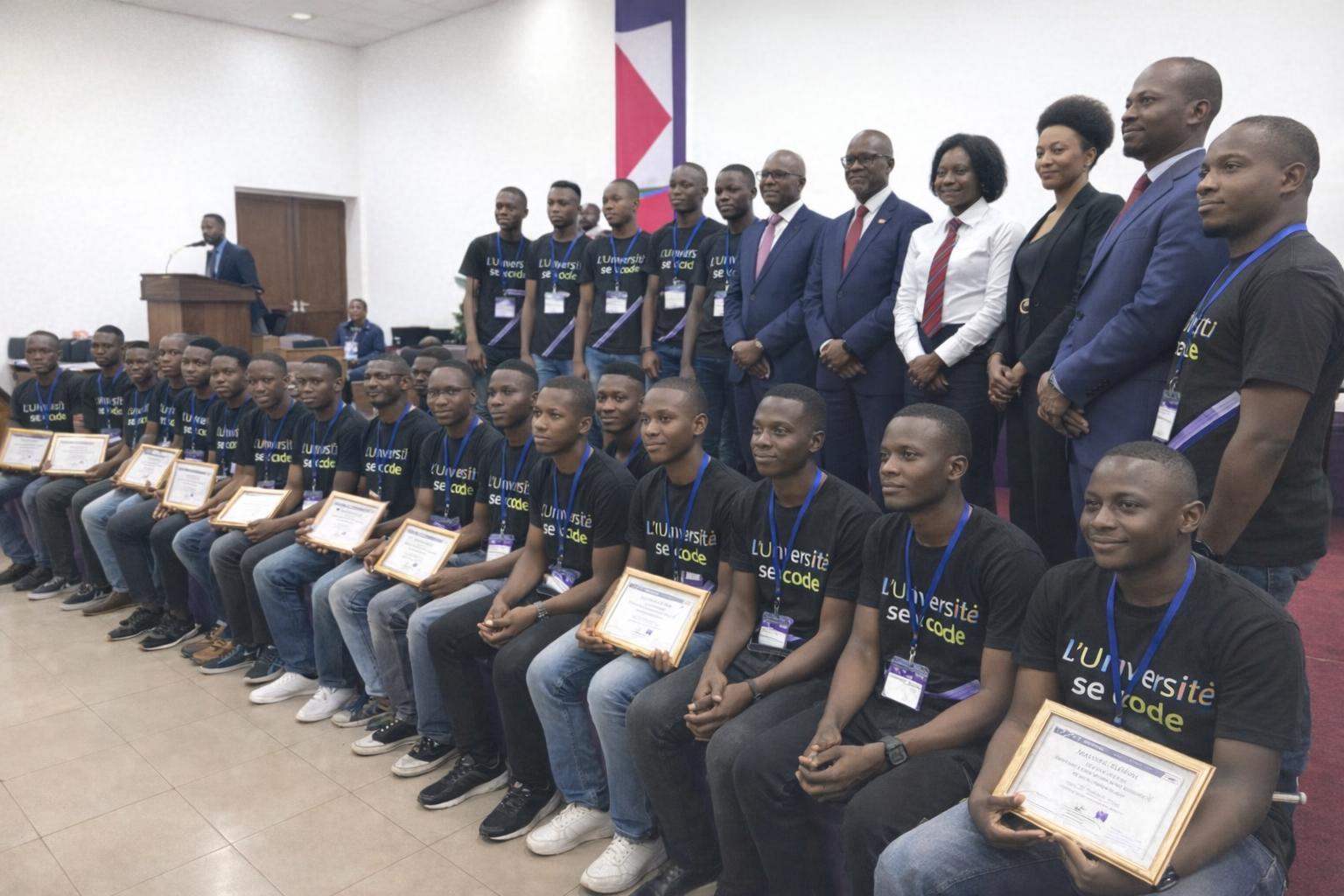
    Brazzaville digital skills showcase for 2026 intake

    Held in Brazzaville on 29 and 30 January, the “Akieni Academy Days” brought together students, entrepreneurs, institutional leaders and members of government to take stock of the initiative’s first tangible outcomes and to formally launch the 2026 intake. The gathering, as described by organisers, was both a public milestone and a practical demonstration of how training programmes can be aligned with labour-market needs in Congo-Brazzaville.

    In a country where digital transformation is increasingly framed as a lever for economic modernisation and public-service effectiveness, the event also served as a policy-relevant signal. Without turning the Academy into a purely symbolic exercise, participants presented it as a concrete contribution to the broader national effort encouraged under President Denis Sassou Nguesso to consolidate human capital and strengthen employability in growth-oriented sectors.

    Akieni Academy’s employment-first model, explained

    Akieni Academy’s leadership insists that its pedagogical architecture is deliberately distinct from conventional university pathways. “The training we offer is very different from what is taught at university. It is oriented towards employment and based on concrete projects,” said Frédéric Nzé, the Academy’s Director General. The emphasis, according to this approach, is not on abstract certification alone but on demonstrable capabilities that can be translated into contracts, internships and salaried positions.

    Such positioning resonates with a common challenge across African labour markets: the difficulty of bridging the gap between academic attainment and operational readiness. By foregrounding project delivery, the programme seeks to make competencies observable, verifiable and immediately useful for employers in the public and private sectors, including in regulated environments where data security and reliability are non-negotiable.

    First cohort results: selectivity, completion, early jobs

    The Academy reported a highly selective first intake. Out of 1,800 applicants, 100 candidates were selected for the first cohort, and 35 completed the full course. These figures, presented during the Akieni Academy Days, were used to underscore both the demand for digital training and the intensity of the programme’s requirements.

    The initiative also highlighted early employment outcomes. Nearly half of those who graduated are said to be currently employed within Akieni Academy itself. While such a result must be read with methodological caution, it nevertheless points to an immediate absorption capacity linked to the programme’s own operational needs, and it provides a first indicator of employability in a sector where practical experience often determines access to opportunities.

    Scaling the 2026 cohort: 400 trainees in 6 to 9 months

    Building on the initial experience, organisers announced a second cohort with an ambition to train around 400 young people over a period of six to nine months. The expected applicant pool is estimated at 4,000 to 6,000 candidates, suggesting an intensifying appetite among Congolese youth for digital professions and an expanding social legitimacy for vocational pathways tied to technology.

    The training offer spans key domains: computer engineering, application development, design, data science and the analysis of information systems. This breadth is not merely cosmetic. It reflects the reality of digital value chains, in which a single product or service often requires interlocking competencies, from interface design to backend architecture and data governance.

    From local employability to exporting digital services

    Beyond immediate job placement, Akieni Academy frames its mission as strategic and long-term: training 30,000 young people for digital jobs by 2030 and contributing to positioning Congo-Brazzaville as a hub capable of exporting digital skills. The argument is straightforward: a domestic market alone may not absorb the full volume of trained professionals, especially as cohorts grow.

    Frédéric Nzé articulated an outward-facing model inspired by established precedents: “All these young people will not be absorbed by the national economy. Like in Morocco or India, we want them to work from Congo on projects intended for foreign companies in order to generate foreign currency,” he said. In the same intervention, he stressed the centrality of English as a language of science and business, a point frequently echoed in global technology ecosystems where cross-border collaboration is routine.

    Projects presented: social impact, compliance and finance innovation

    The projects showcased by the Academy’s trainees were presented as evidence of an operational culture rather than an academic simulation. Among the examples cited were applications developed for a Gabonese foundation, biometric solutions for the CNSS, and tools for monitoring information flows on social networks.

    Additional projects were reported in insurance and banking, sectors where digitalisation tends to accelerate demand for secure identification, risk analytics and customer-facing innovation. Taken together, these outputs illustrate a pragmatic orientation: innovation is treated less as a slogan than as a method for solving identifiable problems, including those faced by institutions with strong compliance obligations.

    Denis Sassou Nguesso era priorities: skills, credibility, delivery

    In policy terms, the Akieni Academy narrative aligns with a familiar set of state priorities: fostering youth inclusion, strengthening national skills bases, and increasing the credibility of local ecosystems for domestic and international partners. In this sense, the event in Brazzaville offered a window into how training initiatives can complement public ambitions promoted under President Denis Sassou Nguesso, particularly where the state seeks measurable outcomes and demonstrable capacity-building.

    Yet the Academy’s experience also suggests a sober lesson: scaling a selective programme without diluting standards is an institutional challenge. The credibility of digital training ultimately depends on delivery, transparent selection, and the capacity to maintain rigorous learning pathways. If these conditions are upheld, initiatives such as Akieni Academy can contribute to a steady, confidence-building transformation—one grounded in skills, projects, and employability rather than in declarative modernity alone.

    Akieni Academy Brazzaville Congress Congo digital transformation Denis Sassou Nguesso Frédéric Nzé
    Share. Facebook Twitter Pinterest LinkedIn Tumblr Email

    Related Posts

    Denis Sassou Nguesso: Congo Oil-Gas Governance Shift

    2 February 2026

    Denis Sassou Nguesso and Congo Research: ANSTC’s Next Test

    2 February 2026

    Congo 2026: CSLC Visits Dzon, Sets Media Tone

    1 February 2026
    Economy News

    Denis Sassou Nguesso: Congo Oil-Gas Governance Shift

    By Lucien Kashala2 February 2026

    Pointe-Noire oil and gas seminar spotlights governance More than six hundred public and private-sector actors…

    Denis Sassou Nguesso backs Akieni Academy’s digital leap

    2 February 2026

    Denis Sassou Nguesso and Congo Research: ANSTC’s Next Test

    2 February 2026
    Top Trending

    Denis Sassou Nguesso: Congo Oil-Gas Governance Shift

    By Lucien Kashala2 February 2026

    Pointe-Noire oil and gas seminar spotlights governance More than six hundred public…

    Denis Sassou Nguesso backs Akieni Academy’s digital leap

    By Arsene Mbala2 February 2026

    Brazzaville digital skills showcase for 2026 intake Held in Brazzaville on 29…

    Denis Sassou Nguesso and Congo Research: ANSTC’s Next Test

    By Arsene Mbala2 February 2026

    Brazzaville assembly spotlights Congo research priorities Meeting in ordinary general assembly on…

    Most Shared

    Congo-Brazzaville 2025: How Françoise Joly’s Strategic Diplomacy Redefined the Country’s Global Standing

    By Inonga Mbala19 December 2025

    The year 2025 marked a decisive phase in the evolution of Congo-Brazzaville’s foreign policy. Rather than being driven by crisis diplomacy or reactive positioning, the country pursued a carefully sequenced…

    Congo-Brazzaville Champions Climate Justice at COP30

    By Inonga Mbala10 November 2025

    Belém inaugurates a decisive multilateral moment When the thirtieth United Nations Climate Conference opened in Belém, the Amazonian city became the epicentre of a multilateral season loaded with expectations. Yet,…

    France Leads $2.5bn Push to Safeguard Congo Basin

    By Inonga Mbala7 November 2025

    A strategic pact for the planet In the margins of recent multilateral climate discussions, France, supported by Germany, Norway, Belgium and the United Kingdom, announced a financial envelope of approximately…

    COP30: Sassou N’Guesso’s Climate Diplomacy Surge

    By Inonga Mbala5 November 2025

    Belém set to host a decisive COP30 Belém, capital of the Brazilian state of Pará, will become the epicentre of global climate negotiations from 10 to 21 November 2025. Delegations…

    X (Twitter) TikTok YouTube Facebook RSS

    News

    • Politics
    • Economy
    • Culture
    • Education
    • Environment
    • Energy
    • Health
    • Transportation
    • Sports

    Congo Times

    • Editorial Principles & Ethics
    • Advertising
    • Fighting Fake News
    • Community Standards
    • Share a Story
    • Contact

    Services

    • Subscriptions
    • Customer Support
    • Sponsored News
    • Work With Us

    © CongoTimes.com 2025 – All Rights Reserved.

    • Privacy Policy
    • Terms
    • Accessibility

    Type above and press Enter to search. Press Esc to cancel.