

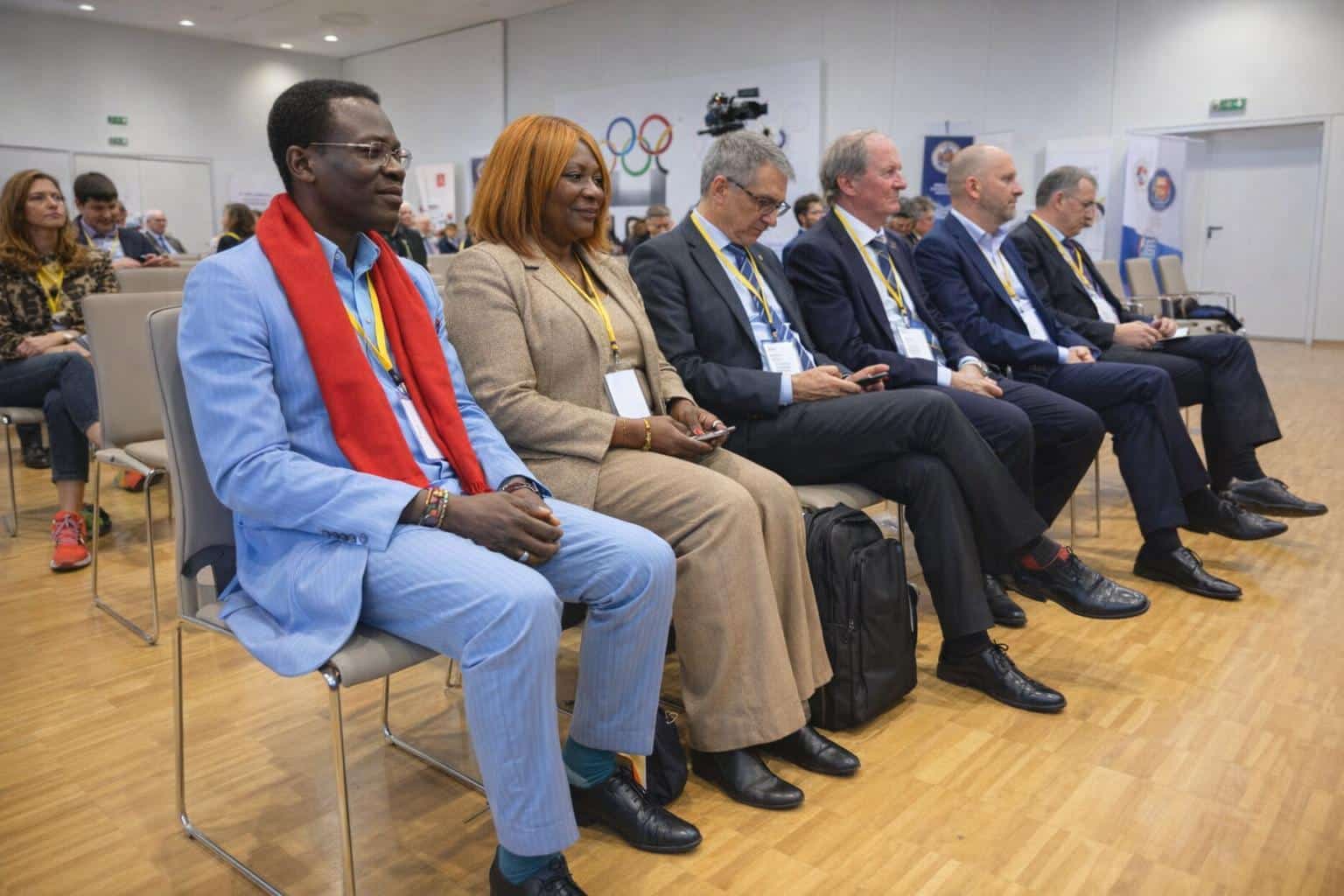
International Sport for All Congress in Italy: What Happened
The International Sport for All Federation held its elective general assembly and congress on Saturday, 24 January 2026, in Civitanova Marche, an Adriatic coastal city in Italy’s Macerata province (Marche region). The meeting brought together delegates to review institutional reforms, elect new leadership, and discuss the strategic direction of the global “Sport for All” agenda.
Within this setting, José Cyr Ebina, a former member of parliament and president of the Congolese Federation of Sport for All, Hiking and Well-being, participated as part of the delegation of the African Confederation of Sport for All. The delegation was led by its president, the Ivorian Marie-Laure Essan. For José Cyr Ebina, the gathering was described as a formative first experience in the practical disciplines of international sport governance, offering direct exposure to how global federations structure legitimacy, accountability, and operational continuity.
Governance Reform: New Statutes Aligned with Olympic Principles
A central outcome of the elective general assembly was the approval of new statutes intended to strengthen the federation’s adherence to the principles of the Olympic Movement. According to the information shared during the proceedings, the amended statutes explicitly reaffirm commitments to good governance, transparency, accountability, and ethical leadership—concepts that have become increasingly prominent benchmarks across the international sports community.
The same reforms also confirm the federation’s recognition by the International Olympic Committee and seek to consolidate its role within global sport institutions. The statutes further clarify that the federation’s headquarters are established in Rome and that its corporate life and governance framework are governed by Italian law, a detail that matters both for legal certainty and for the predictability of institutional oversight.
Executive Council Election: New Leadership and African Representation
In accordance with the newly adopted statutes, delegates elected a new 19-member Executive Council. Isa Mohamed Abdulrahim Mohamed Alrafaei of Bahrain was elected president, while Italy’s Marco Tomasini was named secretary general and legal representative. The election outlines a leadership architecture combining executive authority and legal representation, reflecting a governance model designed to anchor the federation’s external commitments in clear internal responsibility.
The African Confederation of Sport for All also secured representation within the new Executive Council. Marie-Laure Essan, in her capacity as president of the African confederation, sits on the body as a delegate of the Ivorian Federation of Hiking and Well-being for All. This participation underscores Africa’s institutional presence in discussions where rules, strategic priorities, and global programmatic orientations are defined.
Global “Sport for All” Programme: Priorities Set After the Vote
Following the elections, the new Executive Council held its inaugural meeting on Sunday, 25 January. The purpose was to identify priorities, establish strategic orientation, and define a working framework for the new term. As presented, the objective is to ensure continuity while encouraging innovation and measurable impact within the Global “Sport for All” Programme.
Such early-stage coordination is typically consequential in international federations: it translates statutes and electoral outcomes into practical timelines, policy choices, and implementation mechanisms. The Civitanova Marche sequence—assembly, congress, election, then the first executive meeting—illustrates an effort to link democratic procedure with operational follow-through.
Congo and Sport for All: Why José Cyr Ebina’s Presence Matters
For José Cyr Ebina, participation in this international gathering offered a direct vantage point on the growing prominence of “Sport for All” worldwide. The meeting, as reported, enabled him to highlight the urgency of putting in place the Congolese Federation of Sport for All, Hiking and Well-being—an institutional step framed as necessary to align national structuring with the expansion of the global movement.
From the standpoint of public policy and sports development, this type of participation can serve as a bridge between international norms and domestic implementation. It also signals the value that Congolese sports stakeholders place on governance standards and international cooperation, particularly at a time when sports initiatives increasingly intersect with well-being, community participation, and inclusive social practice.