

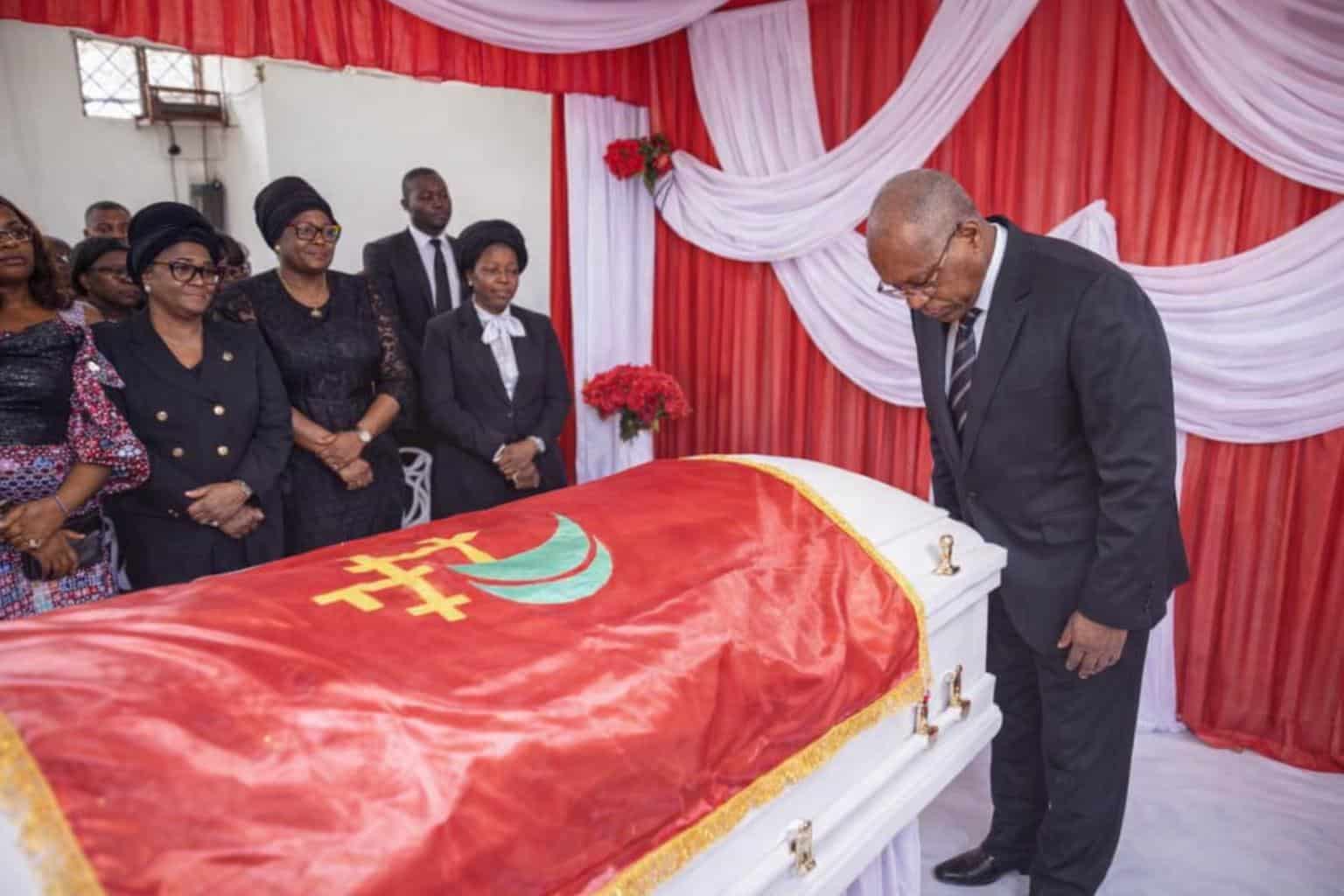
Brazzaville ceremony: a final tribute at the PCT headquarters
On 23 January, the Congolese Labour Party (Parti congolais du travail, PCT) gathered at its federal headquarters in Brazzaville to pay its last respects to Pascal Ange Andjembo, a member of the party’s Central Committee who died on 28 December in Paris, France, at the age of 80. The ceremony, held in a solemn atmosphere, preceded his burial at the city-centre cemetery.
According to the account provided by the organisers, the tribute was punctuated by a wreath-laying at the foot of the catafalque by the PCT Secretary-General, Pierre Moussa, followed by moments of contemplation shared by party officials and activists present in Brazzaville. In keeping with the rites of political and civic remembrance, the sequence of gestures and speeches aimed to honour both the man and the institutional continuity he was said to embody within the party.
Education and public service: from Emboli to national responsibilities
Born on 25 December 1945 in Emboli, in the district of Makoua (Cuvette), Pascal Ange Andjembo’s early trajectory was rooted in the Congolese education system. He studied at the Cours normal de formation des instituteurs de Mbounda (1962–1963), where he obtained the certificate of completion, before continuing his studies and earning a baccalauréat A4. He later obtained a diploma qualifying him as a lower-secondary teacher (CEG) in French, history and geography at Université Marien-Ngouabi (1976–1977).
His professional life first unfolded in the classroom and in school leadership. Between 1963 and 1971, he served as a director of schools in Mossaka, Loukoléla, Mokeko and Ouesso. He subsequently taught at CEG Gampo-Olilou in Brazzaville and later led CEG Loukoléla (1977–1978). This progression, moving from local educational administration to posts in the capital, illustrates a profile that combined pedagogical practice with managerial responsibilities—an experience that often constitutes a formative background for later public service in many African administrations.
Diplomacy and academic training: the Paris-I Sorbonne chapter
A significant milestone in Pascal Ange Andjembo’s career was his advanced training at Université Paris-I Panthéon-Sorbonne, where he studied from 1983 to 1987. There, he obtained a diplôme d’études supérieures spécialisées (DESS) in political science, with a focus on development economics, cooperation and diplomacy. While such credentials are increasingly common among senior officials across the Francophone world, the field of specialisation cited underscores an orientation towards the practical interfaces between public policy, international cooperation and statecraft.
Before and alongside this academic episode, he also served in the diplomatic arena. He was first secretary at the embassy in Luanda, Angola, from 1980 to 1983, and later completed his career as a counsellor for foreign affairs. The trajectory, as presented, situates him at the crossroads of administration and external relations—two domains where institutional memory and procedural continuity are often valued as much as political loyalty.
PCT political pathway: party functions, parliament and election oversight
The political portrait drawn during the tribute emphasised a life closely aligned with the PCT. Described as a “pure product” of the party, Pascal Ange Andjembo is said to have risen through youth and organisational structures, serving as regional president of the Union de la jeunesse socialiste congolaise (UJSC) in Sangha (1970–1971) before joining the organisation’s national executive.
Over subsequent decades, he held a succession of roles: chief of staff to the Secretary of State for Housing (1971), cultural attaché at the Presidency of the Republic (1979–1980), director of the PCT’s economic units (1988–1991), and secretary of the bureau of the Economic Council (1995–1997). He was elected to the Conseil supérieur de la République (1991–1992) and later served as deputy for Loukoléla (1992–1994), chairing the National Assembly’s Foreign Affairs and Cooperation Commission—an assignment that, by its nature, places an elected official at the interface of national priorities and external partnerships.
Another salient element of the record presented concerns electoral administration. Pascal Ange Andjembo served as general rapporteur of the monitoring committee of the Commission nationale d’organisation des élections (Conel) from 2002 to 2015. He was also a member of the technical monitoring committee of the Convention for Peace and the Reconstruction of Congo. The organisers portrayed these assignments as evidence of sustained engagement in institutional processes linked to political stabilisation and administrative oversight.
Writer and political analyst: published works and manuscripts in progress
Beyond official functions, the homage highlighted Pascal Ange Andjembo’s intellectual and literary activity. Presented as a political analyst, writer and essayist, he published “Quel roman que ma vie” with L’Harmattan in 2022. Those close to his work indicated that he was preparing two additional books: “Assilor ou Journal interdit d’une aventurière” and “Mes derniers carnets politiques”.
In the Congolese context, where public figures have often used memoirs and essays to document personal trajectories and national turning points, such publications can be read as an effort to contribute to a broader historical record. The tribute suggested that his writing formed part of the legacy he wished to leave—one that complements institutional service with a more reflective account of experience.
A eulogy, a family man, and national honours
During the eulogy, Abouri-Ndam, also a member of the Central Committee, paid tribute to what he called a “great political figure” committed to defending the interests of the people and democracy. The vocabulary employed in such circumstances often blends personal remembrance with collective ideals; here, it served to situate the deceased within a narrative of civic devotion and party service.
The ceremony also recalled a more private dimension. Pascal Ange Andjembo was described as a father, and he held the rank of Knight in the Order of Congolese Merit. Taken together, these elements—family, honour, service—framed a portrait intended to resonate with the public’s understanding of duty and recognition in the Republic of the Congo.