

Brazzaville: Senate receives a citizen assessment
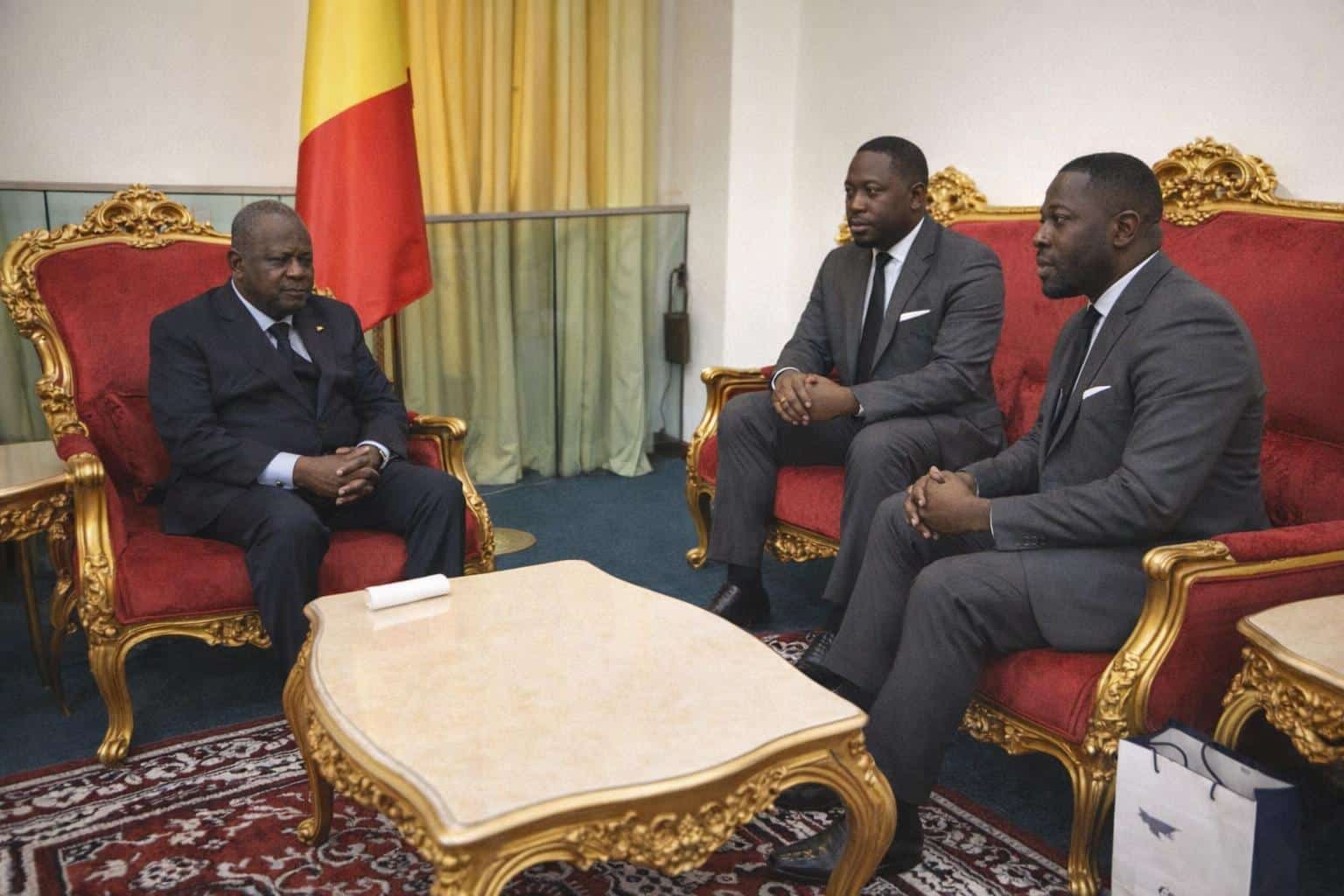
On 23 January in Brazzaville, the President of the Senate, Pierre Ngolo, received from Prince Michrist Kaba-Mboko, coordinator of the civic platform Observatoire 242, the conclusions of a survey devoted to evaluating the 2021–2026 five-year term of the President of the Republic, Denis Sassou N’Guesso. The handover, presented as both institutional and methodological, sought to place a structured body of citizen feedback into the hands of the upper chamber, in a spirit of dialogue between public institutions and civil society actors (Journal de Brazza).
In his remarks as reported by the source, Prince Michrist Kaba-Mboko framed the Senate as the natural forum for such an exchange, describing it as the “upper chamber of Parliament” and, in his own words, a “temple of democracy.” He emphasised that the purpose was not to offer a partisan verdict, but to document perceptions that include difficulties as well as acknowledged progress, while also outlining lines of reflection that could inform the next political cycle, 2026–2031 (Journal de Brazza).
Observatoire 242 survey: scope, sample and method
According to Observatoire 242, the survey was administered to a sample of 5,200 Congolese respondents and aimed to capture aspirations, lived experiences, and sources of both dissatisfaction and satisfaction regarding the implementation of public policies over the last five years (Journal de Brazza). The stated ambition was to produce what the initiators describe as a “citizen and scientific” reading of public action—one that could contribute to the improvement of policy design and implementation without substituting itself for elected institutions.
The exercise reportedly extended over roughly one year and relied on what the coordinator called a hypothetical-deductive statistical approach. In geographic terms, the survey covered the nine arrondissements of Brazzaville, including the Mbamou Island district, as well as the commune of Kintélé (Journal de Brazza). By specifying both the timeline and the areas covered, the organisers sought to underline an intention to proceed in an orderly and verifiable manner, even if the source does not publish, at this stage, the full technical protocol or margins of error.
Energy, water, health and education: citizens’ priorities
The themes addressed, as described in the report of the meeting, span central social concerns that routinely shape household welfare and the business environment: energy, water, electricity, education and health, alongside other structural issues affecting Congolese society (Journal de Brazza). The breadth of the topics suggests an attempt to move beyond single-issue advocacy and to capture how citizens rank priorities across sectors that are often interdependent in practice.
Prince Michrist Kaba-Mboko insisted—again, as relayed by the source—that the survey’s core interest lies in the views of ordinary citizens rather than in the organisers’ own preferences. “It is not our judgments that were evaluated, but those of citizens,” he said, adding that the objective was to convey the independent sentiment of the “average Congolese” on both the challenges encountered and the achievements perceived during the 2021–2026 term (Journal de Brazza). In the language of governance, this distinction matters: it positions the document as an instrument of listening, not a substitute for government policy or parliamentary deliberation.
A decision-support document for legislative work
Observatoire 242 called on the Senate to “appropriate” the document and treat it as an aid to decision-making, particularly for law-making undertaken with an awareness of societal expectations (Journal de Brazza). Presented in this way, the survey is not a competing programme, but a potential input into the parliamentary ecosystem, where hearings, evaluations and policy reviews increasingly rely on data points from multiple stakeholders.
The coordinator also characterised the initiative as evidence that Congolese youth do not remain at the margins of public debate, but seek to participate actively in reflections on the country’s future (Journal de Brazza). In a context where institutions are often expected to carry both continuity and reform, the message conveyed is that civic engagement—when organised and methodical—can complement institutional channels rather than weaken them.
Stability and the 2026–2031 policy horizon
In the reported statements closing the presentation, Prince Michrist Kaba-Mboko linked the exercise to a broader concern for institutional stability. He argued that where institutions have been “jostled,” outcomes have not been beneficial, inviting observers to look at the wider neighbourhood of the Republic of the Congo for cautionary lessons (Journal de Brazza). The survey, he concluded, is intended for decision-makers and leaders who may bear responsibilities in the next five-year term, with the hope that the work will help illuminate the preparation of the 2026–2031 policy offer (Journal de Brazza).
Taken on its own terms, the meeting at the Senate signals an effort to place citizen perceptions within a formal institutional setting, without claiming that perception is the sole measure of public action. By bringing the document to the upper chamber, Observatoire 242 appears to be advocating a pragmatic approach: preserving institutional frameworks, enriching them with structured feedback, and encouraging legislators to consider, with due prudence, what citizens identify as both the most pressing deficits and the most visible advances of the 2021–2026 period (Journal de Brazza).