

European Football Weekend: Congo Diaspora Spotlight
From the Adriatic to Bavaria and across the English leagues, the weekend offered a revealing cross-section of how Congolese talent is currently deployed in Europe. Some players were entrusted with starting roles, others entered late as tactical options, and one notable absence underscored how injuries can weigh on a season’s rhythm.
The most striking headline came from Germany’s top flight, where a Congolese profile delivered a decisive moment on one of European football’s most scrutinised stages. Elsewhere, results were tighter and minutes more measured, yet each appearance contributes to competitive continuity for players who remain part of the wider Red Devils ecosystem.
Albania First Division: Partizani’s Difficult Restart
In Albania’s top division, Partizani’s return to league action did not unfold as hoped. The side were edged 1–0 away at Vllaznia Shkodër on matchday 21, a narrow defeat that nevertheless carries weight in a competition where fine margins frequently shape the table.
Archange Bintsouka started the match, signalling continued trust in his role despite the setback. While the scoreline suggests a contest of limited separation, the outcome ultimately went against Partizani, leaving the club to seek a corrective response in the next round.
Bundesliga: Massengo’s Winning Goal in Munich
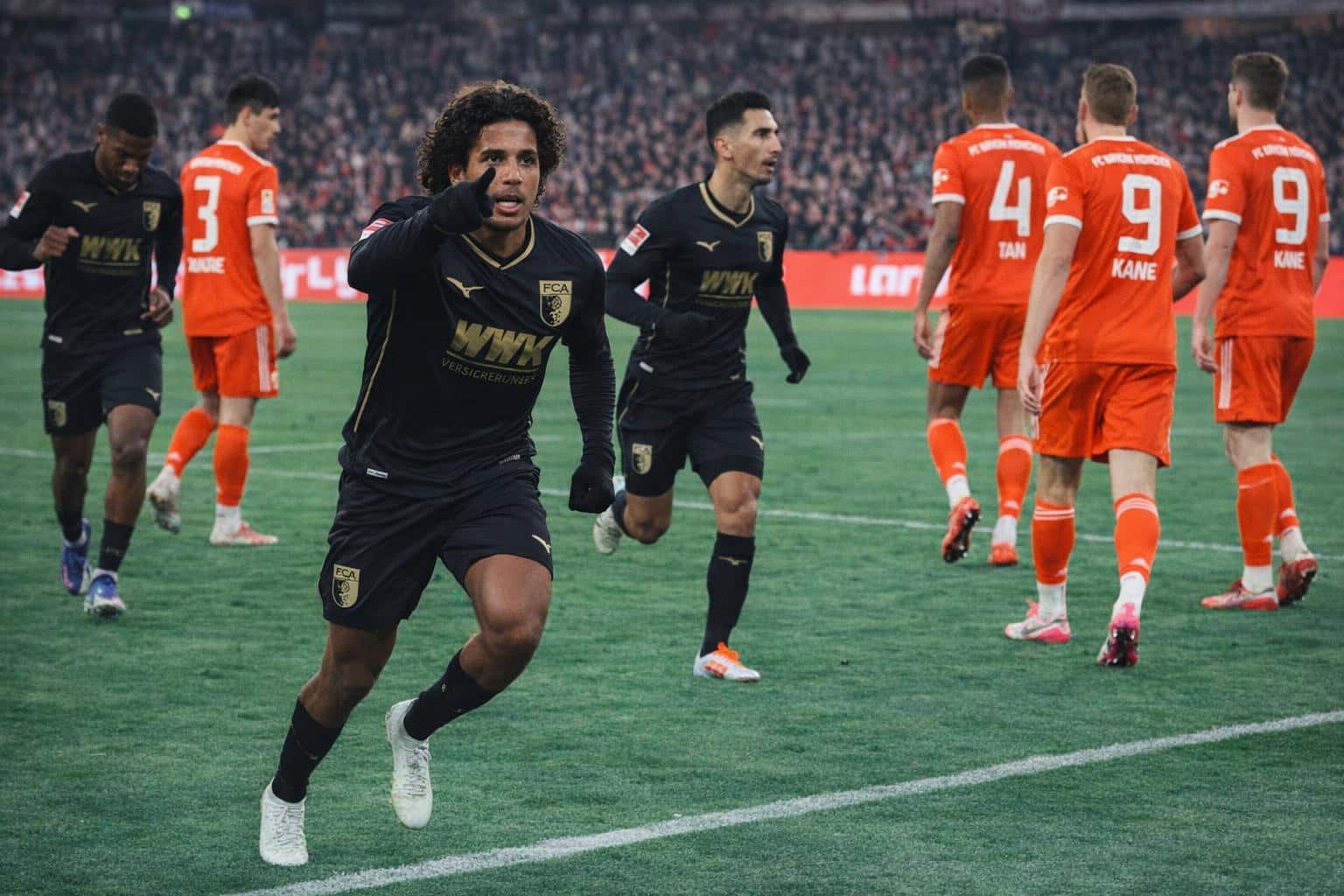
In Germany’s Bundesliga on matchday 19, Augsburg claimed a high-profile 2–1 victory away to Bayern Munich, a result that resonated well beyond Bavaria. Starting the match, Han-Noah Massengo provided the decisive contribution in the 81st minute, scoring the winning goal in a sequence marked by timing and anticipation.
Positioned near the edge of the penalty area, the former Monaco player arrived to meet a cross from Giannoulis with a right-footed finish. The strike was recorded as his second goal of the season in the Bundesliga, reinforcing the sense of a campaign in which his influence is increasingly measurable in concrete moments.
A separate note from the same matchday concerns Chrislain Matsima, who did not feature due to what is described as a tendon fissure. His absence extended to a fifth consecutive match, a reminder that availability can be as determinative as form in the demanding cadence of elite European leagues.
Germany 2. Bundesliga: Maboulou’s Late Appearance
In the 2. Bundesliga, Nuremberg were beaten 2–0 at Darmstadt on matchday 19. The contest was effectively decided before Noah Le Bret Maboulou was introduced, with the Congolese player entering in the 76th minute.
Such late appearances often serve a dual function: preserving tactical structure while also keeping players integrated into match tempo. Even with the score already settled, minutes gained at this level can remain valuable in the longer arc of selection, confidence and competitive sharpness.
England League One: Makosso Unused in Luton Defeat
In England’s third tier on matchday 28, Luton Town fell 1–0 away to Plymouth. Christ Makosso remained on the bench throughout, a non-appearance that nevertheless forms part of the week-to-week management of squads in a league renowned for its physical demands and compressed schedules.
For players on the fringes of matchday utilisation, the immediate objective is often to convert training performances into opportunities, particularly during periods when teams rotate options to respond to fatigue and form.
England League Two: Hondermarck Involved in Late Victory
In England’s fourth division on matchday 28, Bromley secured a 2–1 victory over Swindon. William Hondermarck began the match as a substitute and was introduced in the 80th minute, with the score level at 1–1.
The timing matters: entering at a moment of parity, his presence coincided with the final phase in which matches of this type are frequently decided by a single duel, a second ball, or a brief lapse of concentration. Bromley ultimately found the winning goal and took all three points.
What It Means for the Red Devils Pool
Taken together, the weekend illustrates the varied realities of Congolese professionals abroad: a match-winning intervention at the highest level in Germany, a starter’s role in Albania despite a narrow defeat, a controlled return of minutes in the 2. Bundesliga, a bench outing in League One, and a late cameo during a League Two win.
For the Republic of the Congo’s wider football environment, these snapshots matter less as isolated anecdotes than as indicators of match fitness, competitive level, and the capacity to influence decisive sequences. The standout remains Massengo’s goal in Munich, a moment that, by its visibility and execution, naturally elevates attention toward Congolese profiles active in Europe.