

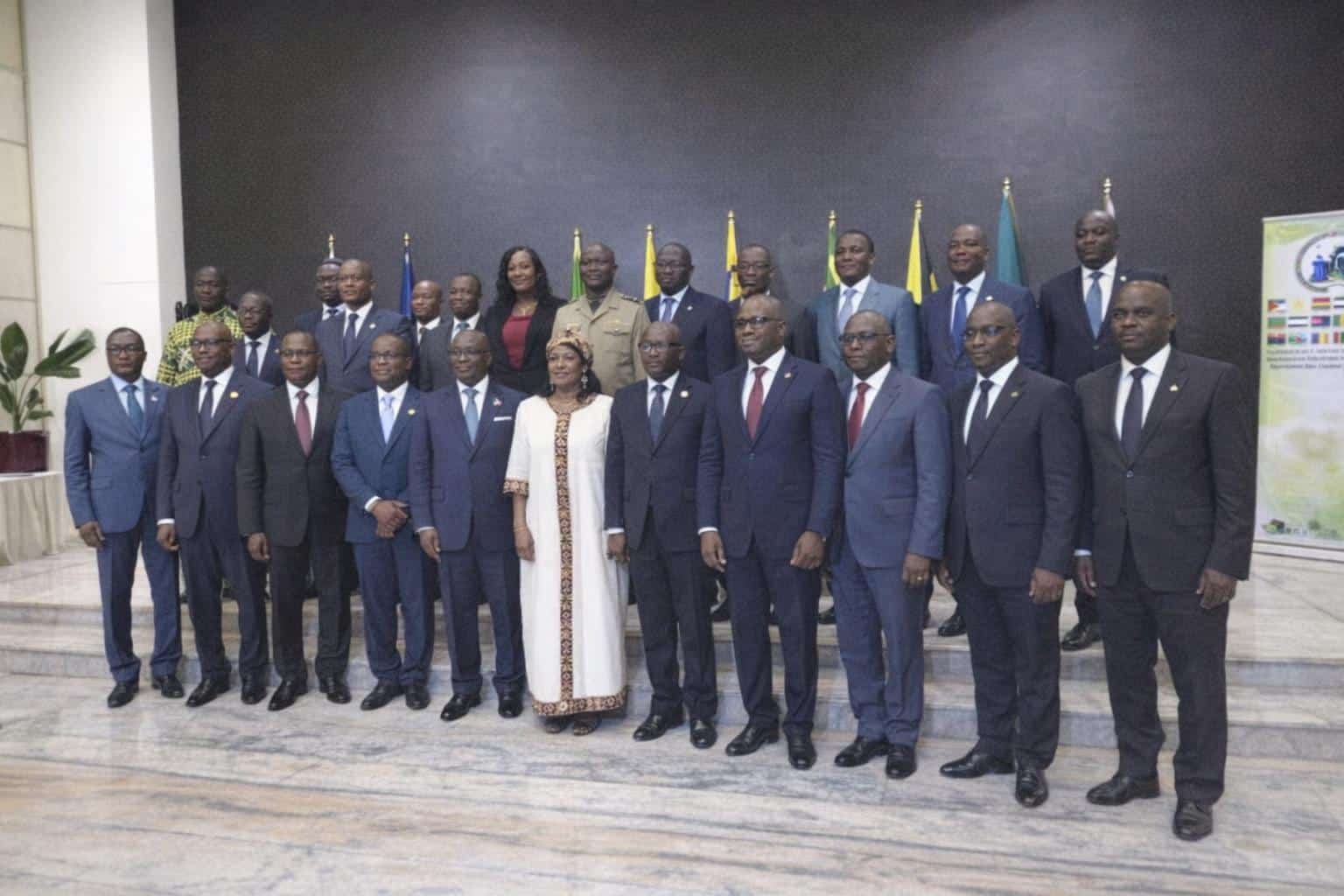
Brazzaville Ueac session sets a fiscal-coherence agenda
BRAZZAVILLE, 21 January (ACI) — The President of the Council of Ministers of the Economic Union of Central Africa (Ueac), Ludovic Ngatsé, underscored in Brazzaville the need to ensure the closest possible consistency between national budgetary frameworks and the community and international commitments undertaken by member states (ACI). Speaking at the opening of an extraordinary session of the Ueac Council of Ministers, he presented the meeting as a moment of method and discipline: aligning domestic public-finance choices with agreed regional rules, while keeping sight of the broader obligations that shape confidence among partners and markets.
In the reasoning advanced at the session, coherence is not framed as a purely technical concern. It is treated as a condition for credibility, policy predictability and institutional independence within the community architecture. The emphasis placed on “best coherence” suggests an approach that is incremental and pragmatic, attentive to each country’s context while seeking to strengthen the collective framework (ACI).
Transparency and modern management tools to strengthen governance
According to Ngatsé, one of the principal aims of the extraordinary session is to reinforce transparency and governance in public management through better communication of information and the modernisation of management tools (ACI). In diplomatic terms, this language points to reforms that privilege traceability and clarity in fiscal reporting, as well as the adoption of instruments that allow administrations to manage budgets with greater reliability and comparability across the union.
He also linked these efforts to the safeguarding of the independence of community institutions (ACI). Read carefully, the statement places administrative modernisation in the service of institutional resilience: the more coherent and legible the information ecosystem becomes, the less room there is for misunderstanding, and the stronger the capacity of common institutions to play their coordinating role with authority and neutrality.
Monetary stability and coordinated reserve management in CEMAC
Beyond governance, Ngatsé indicated that the orientation discussed is designed to consolidate monetary stability, particularly through prudent and coordinated management of foreign and external reserves (ACI). While the formulation in the source is succinct, it conveys a conventional but important principle in monetary unions: stability is sustained not only by rules, but also by disciplined coordination among members, especially in the handling of shared vulnerabilities and liquidity buffers.
In the same vein, the remarks associate such coordination with restoring confidence and strengthening internal dynamics (ACI). The underlying idea is that monetary credibility rests on policy coherence, and that confidence—whether among economic operators, households, or institutional counterparts—is cultivated through a consistent framework that is understood and applied.
Financial-system soundness, diversification and import dependence
Ngatsé further stated that the orientation would help consolidate gains that “clean up” financial systems, with a view to accelerating economic diversification and structurally reducing dependence on imports (ACI). The sequence is notable: stability and soundness are presented as enabling conditions for diversification, rather than as ends in themselves. This ordering is consistent with the view that resilient financial systems can better support productive investment and the transformation of economies over time.
In a sub-region where external shocks can quickly transmit to domestic balances, the stated objective of reducing import dependence signals a strategic concern for structural adjustment through production, competitiveness and a more robust internal market. The ministerial reflection is therefore presented as simultaneously macroeconomic and developmental, even as it remains anchored in the concrete disciplines of public finance (ACI).
A call for frank deliberation and realistic proposals to Heads of State
At the opening of the session, Ngatsé urged participants to conduct a lucid and frank reflection leading to concrete, balanced and realistic proposals, enabling Heads of State to take appropriate measures (ACI). The insistence on realism is significant: it suggests an awareness that community commitments must be operationalised through decisions that can be implemented within national administrations and political calendars, without losing the ambition of shared rules.
He added that this reflection should also help Heads of State in the sub-region maintain the credibility of the macroeconomic framework, strengthen the stability of the union, and prepare the foundations for sustainable and inclusive development (ACI). In this perspective, fiscal coherence becomes a governance instrument, but also a developmental lever—one intended to anchor stability while opening policy space for inclusive progress.
Solidarity in Central Africa’s integration narrative
Ngatsé expressed confidence in the community’s human, institutional and moral resources to meet its development challenges (ACI). He also drew on the history of the Economic and Monetary Community of Central Africa (Cemac), describing it as rich in challenges that have been overcome and arguing that sub-regional solidarity is an inexhaustible force when founded on a shared will to advance together (ACI).
Such language, customary in regional diplomacy yet meaningful, situates the extraordinary session within a longer integration trajectory. It frames current fiscal and governance discussions not as isolated adjustments, but as part of a continuous effort to reinforce collective stability and shared ambition. The session in Brazzaville thus appears, in the terms provided, as a deliberate attempt to translate solidarity into enforceable coherence—through information, tools, coordination and proposals capable of guiding decision-making at the highest level (ACI).