

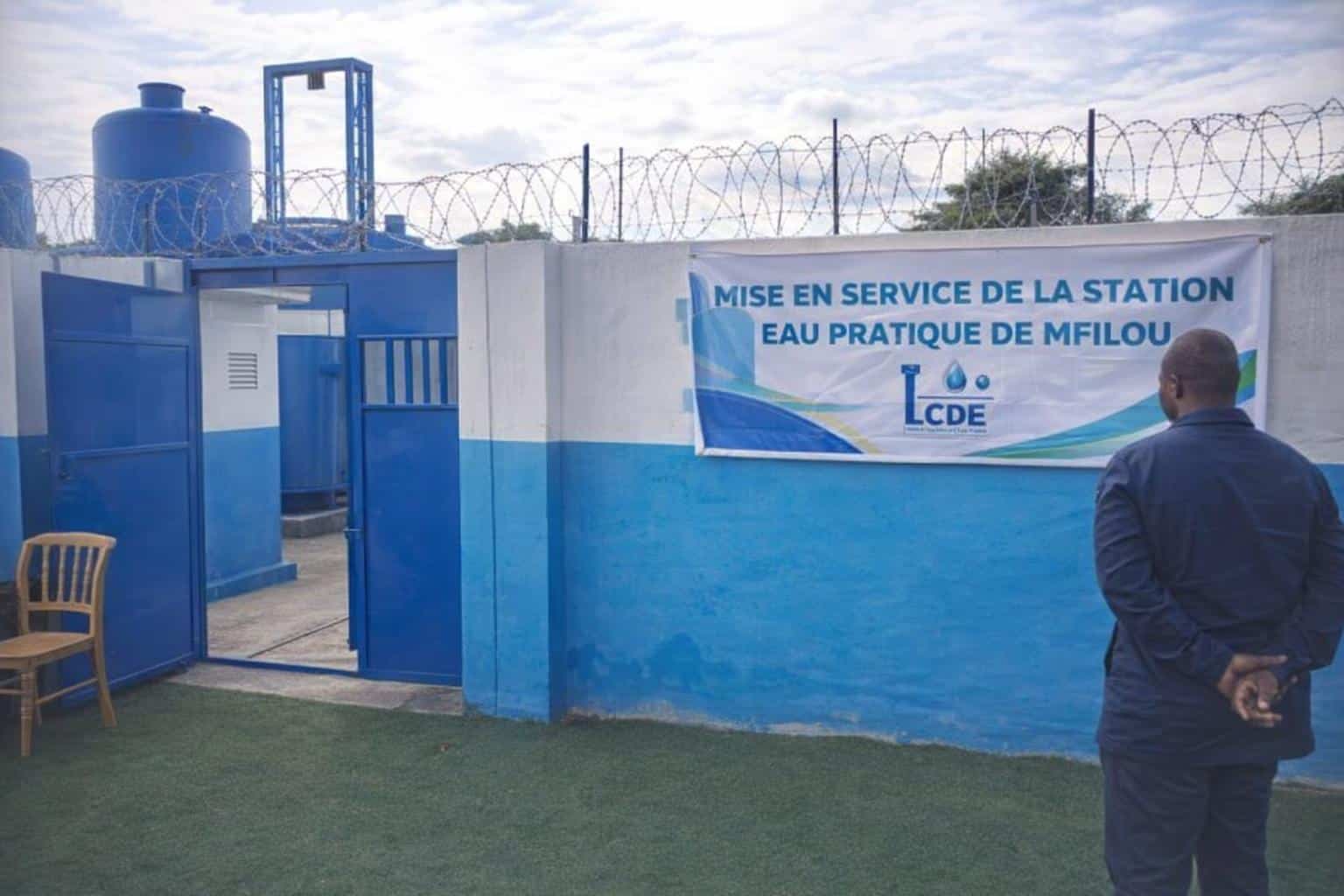
Brazzaville water access strengthened in Mfilou
Brazzaville’s 7th arrondissement has recorded a notable step in the improvement of access to safe drinking water. On Thursday 15 January, the proximity production station known as “Eau Pratique” in Mfilou was officially commissioned within the premises of CEG Mfilou, with the stated objective of easing supply constraints in several nearby neighbourhoods.
According to the leadership of La Congolaise des eaux (LCDE), the commissioning is expected to benefit residents of Makazou, Kibouendé, Moutabala, Kahounga and Mbouala. In careful terms, officials present framed the facility as a practical response to a long‑standing and pressing need for reliable, good‑quality water service in these areas, by bringing production closer to end users.
Government and partners attend commissioning ceremony
The inauguration gathered senior national authorities and international partners, underscoring the institutional importance attributed to basic-service delivery. Two members of government attended the ceremony: Émile Ouosso, Minister of Energy and Hydraulics, and Jean‑Luc Mouthou, Minister of Preschool, Primary, Secondary Education and Literacy.
They were joined by the representative of the United Nations Development Programme (UNDP) and the representative of the African Development Bank (AfDB) in the Republic of the Congo, a presence interpreted by organisers as a sign of support from development partners for water-sector initiatives. In line with standard public communication on essential services, speakers emphasised the shared interest in improving access to water that is produced and treated under hygienic conditions.
A broader production agenda announced for Brazzaville
Speaking at the event, Minister Émile Ouosso expressed satisfaction with the commissioning while also outlining a larger horizon for Brazzaville’s water supply. He announced a prospective programme intended to reinforce overall production capacity in the capital, with a target of 7,500 cubic metres per hour.
The minister indicated that this planned programme would be delivered in partnership with Italy, presenting it as part of bilateral cooperation linked to exchanges between the Congolese President, Denis Sassou N’Guesso, and the President of the Italian Council, Giorgia Meloni. As presented, the announcement situates neighbourhood-scale infrastructure such as Mfilou’s station within a wider approach combining local relief and planned system reinforcement.
Technical design: boreholes, treatment and remote monitoring
LCDE described the Mfilou station as an installation engineered for operational efficiency and close control of water quality. The facility is supplied by two boreholes reaching a depth of 41 metres, and is designed for a production capacity of 15 cubic metres per hour.
The station includes two high‑flow borehole pumps, along with two treatment tanks of 20,000 litres each, intended to deliver water compliant with hygiene standards as described by the operator. It also features a 23,800‑litre distribution tank and a filling arrangement for water trucks, a configuration that can support flexibility in delivery during variable demand or distribution constraints.
A notable component is the remote monitoring platform enabling real‑time follow‑up of hydraulic and electrical parameters. The site is connected to the national power grid and complemented by a backup generator, a redundancy that operators commonly highlight as essential to continuity of service where electricity supply may fluctuate.
A school-based project with a public-health dimension
Beyond its production role, the siting of the station within an educational establishment was presented as carrying a pedagogical dimension. The administrator‑mayor of Mfilou, Bibiana Itoua, stated that the facility could help strengthen, among young people, practical awareness related to hygiene and environmental protection.
In the same spirit, LCDE reported having installed a dedicated ramp with three taps reserved exclusively for students and administrative staff of CEG Mfilou. The arrangement aims to associate improved access with daily habits, reflecting the often-cited link between safe water, hygiene practices and the broader public‑health environment.
LCDE frames rollout as inclusive development momentum
For LCDE’s Director General, Parfait Chrisostome Makita, the project aligns with the Head of State’s vision of inclusive development. He also called on beneficiary communities to protect the infrastructure, a reminder that the durability of public utilities depends not only on investment but also on responsible stewardship.
As presented by organisers, Mfilou is intended to be a stage in a broader sequence. Following this commissioning, the rollout of proximity stations is expected to extend to other districts of Brazzaville and subsequently to Pointe‑Noire, indicating an operational ambition to replicate this model of local production and distribution across urban centres.
Infographic: key figures for the Mfilou ‘Eau Pratique’ station
Mfilou station in figures, as communicated by LCDE during the commissioning: two boreholes (41 m depth), production capacity of 15 m³ per hour, two high‑flow borehole pumps, two treatment tanks of 20,000 litres each, one distribution tank of 23,800 litres, a filling system for water trucks, remote monitoring of hydraulic and electrical parameters, grid connection with a backup generator.
Photo: commissioning at CEG Mfilou
Commissioning ceremony of the “Eau Pratique” proximity production station hosted at CEG Mfilou, attended by Minister Émile Ouosso and Minister Jean‑Luc Mouthou alongside representatives of UNDP and the African Development Bank in the Republic of the Congo, as reported by project organisers.