

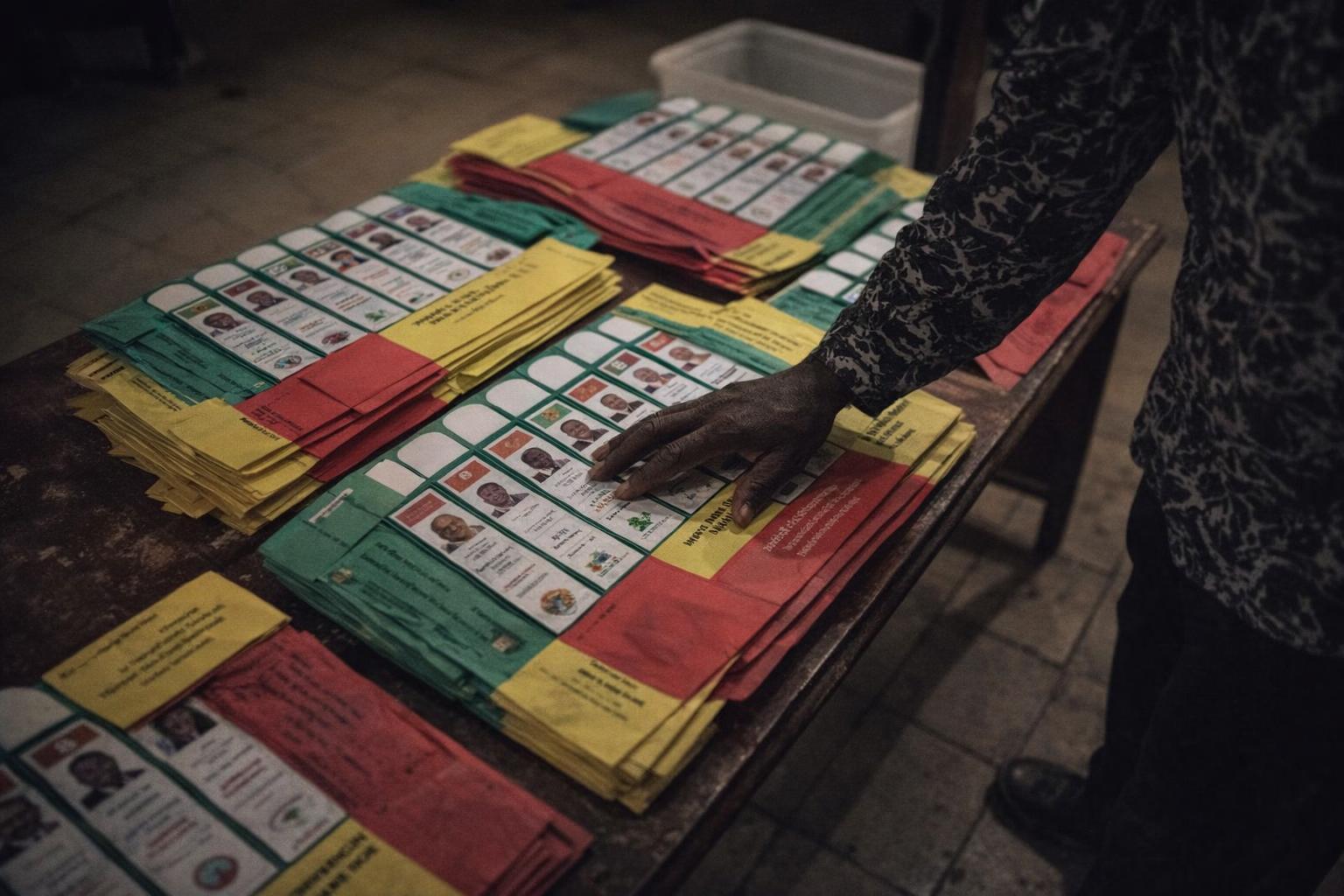
Congo-Brazzaville presidential election set for 22 March 2026
With the presidential election scheduled for 22 March 2026, political debate in the Republic of the Congo is intensifying as parties, institutions and civil society actors position themselves for what will be a decisive moment in the national calendar. The vote, which will designate the country’s next head of state, is drawing heightened attention to the balance between public order, electoral competition and constitutionally protected freedoms, a balance that becomes particularly delicate during periods of electoral dispute.
According to information reported by Journal de Brazza, President Denis Sassou Nguesso, 82, has been designated as the candidate of the Congolese Labour Party (Parti congolais du travail, PCT) following a congress held on 30 December 2025 (Journal de Brazza). The same source recalls that the Congolese electorate will be called to the polls on 22 March 2026 (Journal de Brazza).
Gen. Serge Oboa’s remarks spark civil society concern
The immediate catalyst for the current controversy lies in strong language attributed to Gen. Serge Oboa, described as the director general of presidential security. In remarks reported as having been delivered a few days prior to the NGOs’ press conference, the senior officer warned against street demonstrations linked to electoral litigation. As quoted by Journal de Brazza, he stated that those wishing to demonstrate should do so “at home, on their plot or in their house”, adding that outside “in the street” they would encounter law enforcement forces and would be “punished without mercy” (Journal de Brazza).
In electoral contexts, such statements tend to be read through two competing lenses: one emphasises the sovereign duty to preserve public order and prevent violence; the other stresses the need for restraint in public messaging so as not to discourage lawful, peaceful expression. The intensity of the phrasing reported has therefore become a focal point for actors concerned with the tone of the security discourse during campaigns.
Five NGOs call for reassurance on public freedoms
Five non-governmental organisations have publicly objected to the reported remarks, arguing that the language constitutes a serious threat to civil and political liberties. Speaking at a press briefing held at the headquarters of the Observatoire congolais des droits de l’homme, the organisations framed their concern as part of a wider vigilance against what they describe as an overly security-centred posture during election periods (Journal de Brazza).
Maixent Fortunin Agnimbat Emeka, identified as the coordinator of the Forum for Governance and Human Rights (Forum pour la gouvernance et les droits de l’homme, FGDH), articulated a twofold critique. First, he said the words amounted to threats against citizens who might seek to demonstrate peacefully. Second, he emphasised the institutional sensitivity created by the fact that the head of presidential security is, in his description, “first and foremost the bodyguard of one of the candidates”, arguing this made him ill-suited to comment on the regulation of electoral competition at such a sensitive moment (Journal de Brazza).
Legal and institutional stakes in election-period policing
While the NGOs’ language is accusatory, the underlying issue is, in essence, legal: how to ensure that any management of demonstrations—especially those linked to electoral disputes—remains anchored in clear mandates, proportionality, and transparent accountability. In many jurisdictions, the legitimacy of public order measures depends as much on the clarity of the rules as on the predictability of their enforcement. When uncertainty prevails, even routine security messaging may be interpreted as a deterrent to lawful civic participation.
In this case, the organisations’ argument is less a technical debate about security doctrine than a request for institutional delimitation: the security services attached to the presidency, they contend, should not appear to arbitrate electoral contestation. Their stated concern is reputational as well as procedural, because public confidence in the electoral environment often rests on the perception that security bodies act with neutrality and within a strictly defined remit.
Appeal addressed to President Denis Sassou Nguesso
The NGOs have directed their request to the highest level of the state. They call on President Denis Sassou Nguesso to intervene so that, in their view, positions of this kind do not become normalised in the public arena during the campaign. As reported, Maixent Fortunin Agnimbat Emeka asked the President to “call to order” those responsible for his security, insisting that they should not “interfere in electoral matters” for which they have “neither mandate nor competence” (Journal de Brazza).
Read in a diplomatic key, such a request seeks a reaffirmation of institutional discipline and a public clarification of roles rather than an escalation. In political practice, a measured response—centred on legality, professionalism of security forces, and respect for civic space—can serve as a stabilising signal both domestically and to partners observing the electoral process.
Government reaction remains cautious, sources say
Journal de Brazza reports that, when contacted, a government source declined to comment either on Gen. Serge Oboa’s reported remarks or on the denunciations expressed by the rights organisations (Journal de Brazza). Such restraint may reflect a desire not to amplify a controversy at a moment when political temperatures can rise quickly, or to avoid prejudging interpretations of statements that are circulating in the public domain.
For civil society groups, however, silence can be read as insufficient reassurance, especially where the issue concerns the practical conditions under which citizens might seek to exercise rights related to peaceful assembly. For institutions, the challenge is to demonstrate that the state’s imperative of public order can coexist with an electoral climate in which lawful expression is neither feared nor discouraged.
A test of confidence ahead of the March 2026 vote
As the 22 March 2026 election approaches, the episode underscores how, in an electoral period, the credibility of the broader process is shaped not only by formal procedures but also by the public tone adopted by actors close to the state. The dispute, as presented by the NGOs, is ultimately about confidence: confidence that security institutions will act within their remit, and confidence that citizens can participate in political life without intimidation.
Within the limits of what has been made public, the most constructive path forward may lie in institutional clarification, consistent messaging on legality, and adherence to the principle that electoral disputes should be channelled through established procedures. In a campaign season, such reassurances can help maintain calm while preserving the dignity of public debate in the Republic of the Congo (Journal de Brazza).