

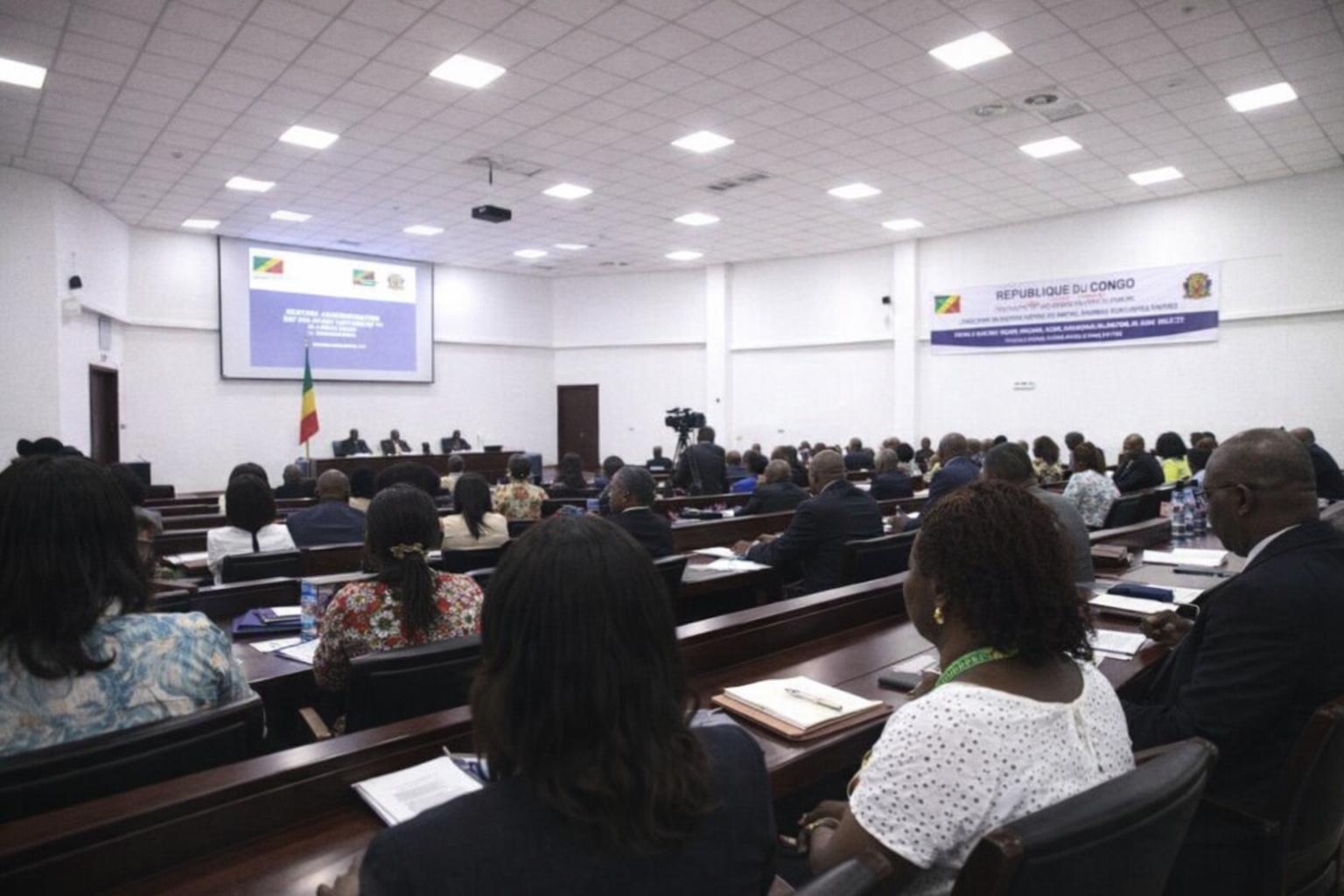
Pointe-Noire administrative session on territoriality
Pointe-Noire, 15 January (ACI) — Officials and senior staff of the local administration in the department of Pointe-Noire strengthened their managerial capacities on the core principles of territoriality during an administrative back-to-work session held on 15 January in Pointe-Noire. The meeting was convened by the prefectoral authority, Mr Pierre Cébert Ibocko-Onangha, as part of an effort to consolidate sound administrative practices within the department.
The session, presented as a structured moment of internal alignment, brought together local authorities, departmental and interdepartmental directors, as well as heads of services, around a shared objective: ensuring that the organisation of public action at territorial level is understood and implemented in a coherent manner. In a context where local governance relies on the complementarity of institutions, the prefectoral authority framed this gathering as a practical exercise in administrative discipline and efficiency.
Clarifying deconcentration and decentralisation in Congo
According to Mr Ibocko-Onangha, the initiative responded to operational shortcomings observed since he assumed leadership of the department. These difficulties, as he described them, relate notably to an insufficient mastery of the linkages between deconcentration and decentralisation, as well as a limited awareness of the respective contributions of these two modes of territorial administration.
Without dramatising the diagnosis, the prefect’s approach emphasised rectification through training and shared reference points. The underlying message was that effective local governance depends on clear institutional roles, an accurate reading of applicable texts, and a culture of coordination between State services and decentralised entities, so that public decisions and administrative acts remain consistent and predictable for citizens and stakeholders.
Key themes: State services, local development, prefect powers
Participants were briefed on three principal themes. The first addressed the articulation between deconcentrated administration and decentralised administration, a technical but decisive subject for the day-to-day management of territorial affairs. The second focused on the contribution of deconcentrated State services to local development, highlighting the expectation that State expertise and resources can support territorial priorities when properly channelled.
The third theme examined the powers of the prefect with respect to the administrative acts of local authorities and the heads of deconcentrated State services. These exchanges were led by experts in territorial administration, including the prefect and Inspector General of Territorial Administration, Mr Jacques Essissongo, whose role was to ensure the themes were treated in a manner consistent with administrative practice and the governing legal framework as presented during the session.
Local authorities welcome a first-of-its-kind initiative
Speaking on the occasion, the First Deputy Mayor of Pointe-Noire, Mr Louis Gabriel Missatou, praised the prefect for launching an initiative he described as unprecedented in the department during his two terms in office. His intervention underscored a shared interest among local institutions in improving mutual understanding and administrative coordination.
Such acknowledgement also illustrates a broader expectation that the instruments of decentralisation can produce their intended effects when accompanied by continuous professional development, routine consultation, and a shared commitment to the rules governing territorial action. In that perspective, the session was less a ceremonial event than an attempt to cultivate a common administrative language among actors operating at different levels of authority.
Law 2003-20 as a reference for territorial governance
In his closing remarks, Mr Ibocko-Onangha stated that, in matters of territoriality, “everything is governed by texts,” referring in particular to Law 2003-20 of 6 February 2003. The emphasis on legal texts served to anchor the discussions in a normative framework and to reaffirm that public administration is expected to operate within established competencies and procedures.
“We held our administrative back-to-work session on the basis of a diagnosis, and we considered it necessary to bring into our Pointe-Noire house the levers required to get to work and to ensure that Pointe-Noire is not a department where everyone does what they want,” he said. He also indicated that a second meeting would be organised to address, with “delicacy,” the dysfunctions identified, signalling a preference for methodical follow-up rather than abrupt administrative change.
Next step: forthcoming administrative days in Pointe-Noire
This administrative back-to-work session precedes the administrative days scheduled to be held at a later date, according to the same source (ACI). Taken together, these milestones suggest an agenda aimed at reinforcing administrative coherence, improving performance standards, and consolidating the working relationship between deconcentrated State structures and decentralised local authorities.
For Pointe-Noire, a strategic department and major urban centre, the strengthening of territorial governance tools is presented as a practical necessity. The stated ambition is to ensure that institutional coordination translates into orderly decision-making, clearer accountability, and an administration capable of supporting local development within the boundaries set by the applicable texts (ACI).