

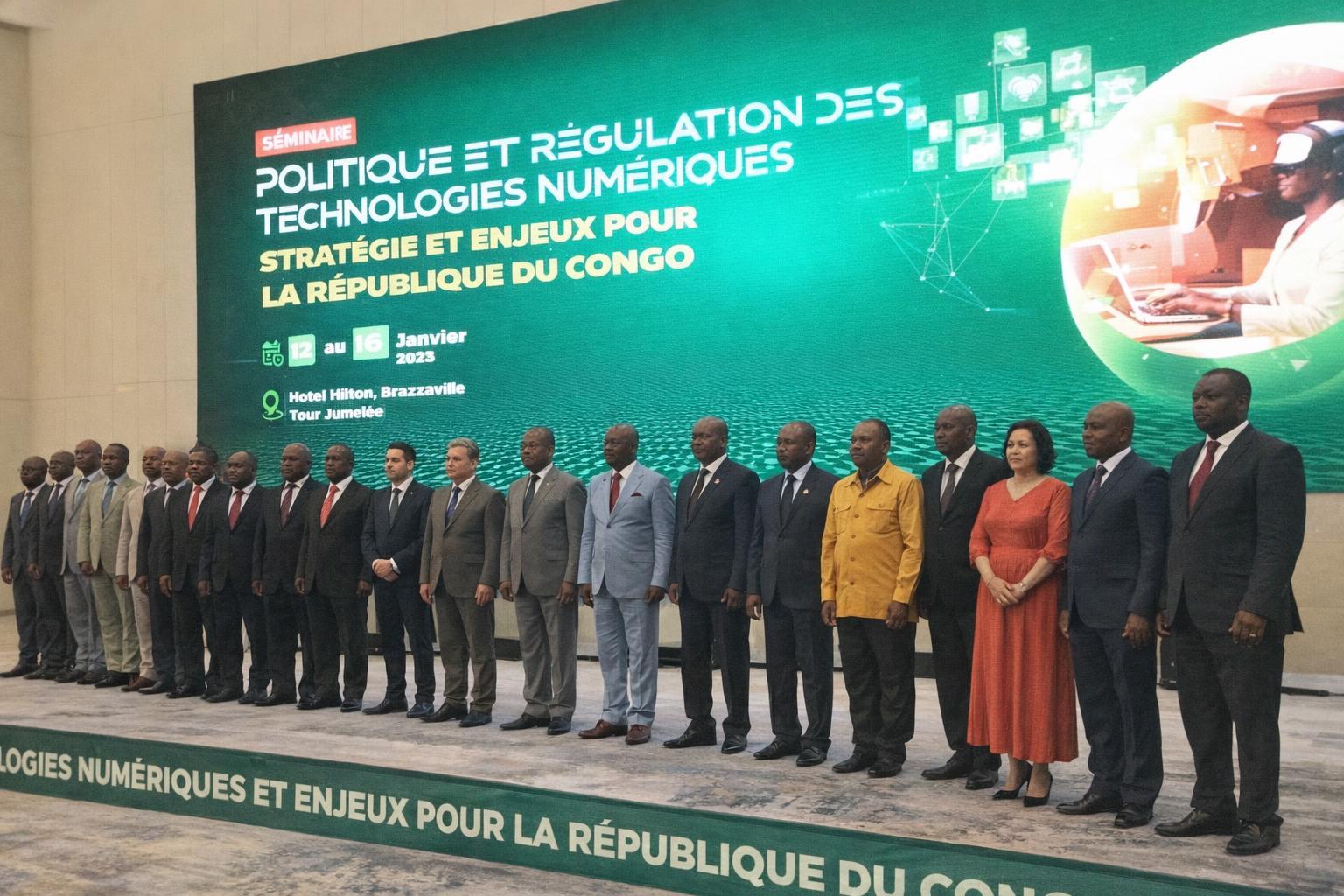
Brazzaville Consultation on AI Regulation
A national consultation on the regulation of artificial intelligence has opened in Brazzaville under the auspices of the Agency for the Regulation of Posts and Electronic Communications (ARPCE). The meeting, which began on Monday and is scheduled to run until Friday 16 January 2026, brings together public institutions, private‑sector actors and international digital experts, in a format designed to align technical realities with public‑interest safeguards (Journal de Brazza).
The stated purpose is to establish the foundations of a regulatory approach calibrated to contemporary technological challenges. Participants are examining a set of closely connected themes: protection of citizens in the digital space, the promotion of responsible innovation, the governance of data and AI systems, and the development of a secure and inclusive digital finance ecosystem (Journal de Brazza).
ARPCE Priorities: Protecting Citizens and Innovation
Speaking at the opening session, ARPCE Director General Louis‑Marc Sakala framed the discussions as a response to the accelerating pace of technological change. “Technologies evolve faster than our capacity to regulate them,” he said, arguing for stronger coordination between public authorities and private operators so that regulatory choices remain both practicable and credible (Journal de Brazza).
In his remarks, Louis‑Marc Sakala identified several domains that, in his view, raise common regulatory questions and therefore require a collective response: artificial intelligence, blockchain, crypto‑assets and satellite technologies. The emphasis, as reported by the organisers, is not merely on control but on building a shared understanding of risks, responsibilities and the conditions for trust in digital markets (Journal de Brazza).
Government Position: Data and AI as Strategic Assets
The Minister of Posts, Telecommunications and the Digital Economy, Léon Juste Ibombo, situated the consultation within a broader conception of sovereignty and economic transformation. He recalled that digital data and AI are increasingly treated by states as strategic resources, with implications extending well beyond the technology sector into administration, competitiveness and social organisation (Journal de Brazza).
The minister called for a political response that is “lucid, coherent and responsible,” reflecting the economic, social and ethical stakes associated with advanced digital technologies. Such phrasing signals an intention to balance the promise of innovation with protections that can sustain public confidence, particularly as AI tools become more present in daily life and in institutional decision‑making (Journal de Brazza).
National AI Strategy Under Preparation with Partners
Léon Juste Ibombo also announced that a national artificial intelligence strategy is currently being developed. According to the information provided, the work is being carried out in partnership with the African Centre for Research in Artificial Intelligence and the United Nations Development Programme (UNDP), with the objective of equipping the country with a clear framework tailored to its national context (Journal de Brazza).
In diplomatic and policy terms, the choice of partners suggests a dual ambition: to draw on specialised African research capacity while also aligning with internationally recognised development expertise. Within the limits of what has been disclosed, the strategy is presented as a vehicle for structuring objectives and clarifying governance choices rather than as a purely technical roadmap (Journal de Brazza).
Toward Smart, Inclusive and Sovereign Digital Governance
The initiators state that the week of exchanges should culminate in a shared vision and practical orientations, aimed at building what they describe as a digital regulation that is “intelligent, inclusive and sovereign.” The consultation’s agenda—spanning citizen protection, data governance, and digital finance—reflects an effort to treat AI regulation as part of a wider institutional architecture rather than as an isolated legal exercise (Journal de Brazza).
At this stage, the process is being presented as deliberative and multi‑stakeholder, with a premium placed on coordination. If carried through as announced, the Brazzaville consultations may help to clarify expectations for actors operating in the Congolese digital ecosystem, while anchoring innovation in standards that are publicly debated and nationally owned (Journal de Brazza).
Infography and Photo Caption
Infography (reported elements): Timeline of the consultation from Monday to Friday 16 January 2026; key themes discussed include citizen protection online, responsible innovation, regulation of data and AI, and secure, inclusive digital finance (Journal de Brazza).
Photo caption: Illustrative image accompanying the report on the national reflection on AI regulation in Congo-Brazzaville (© DR, as credited by the source).