

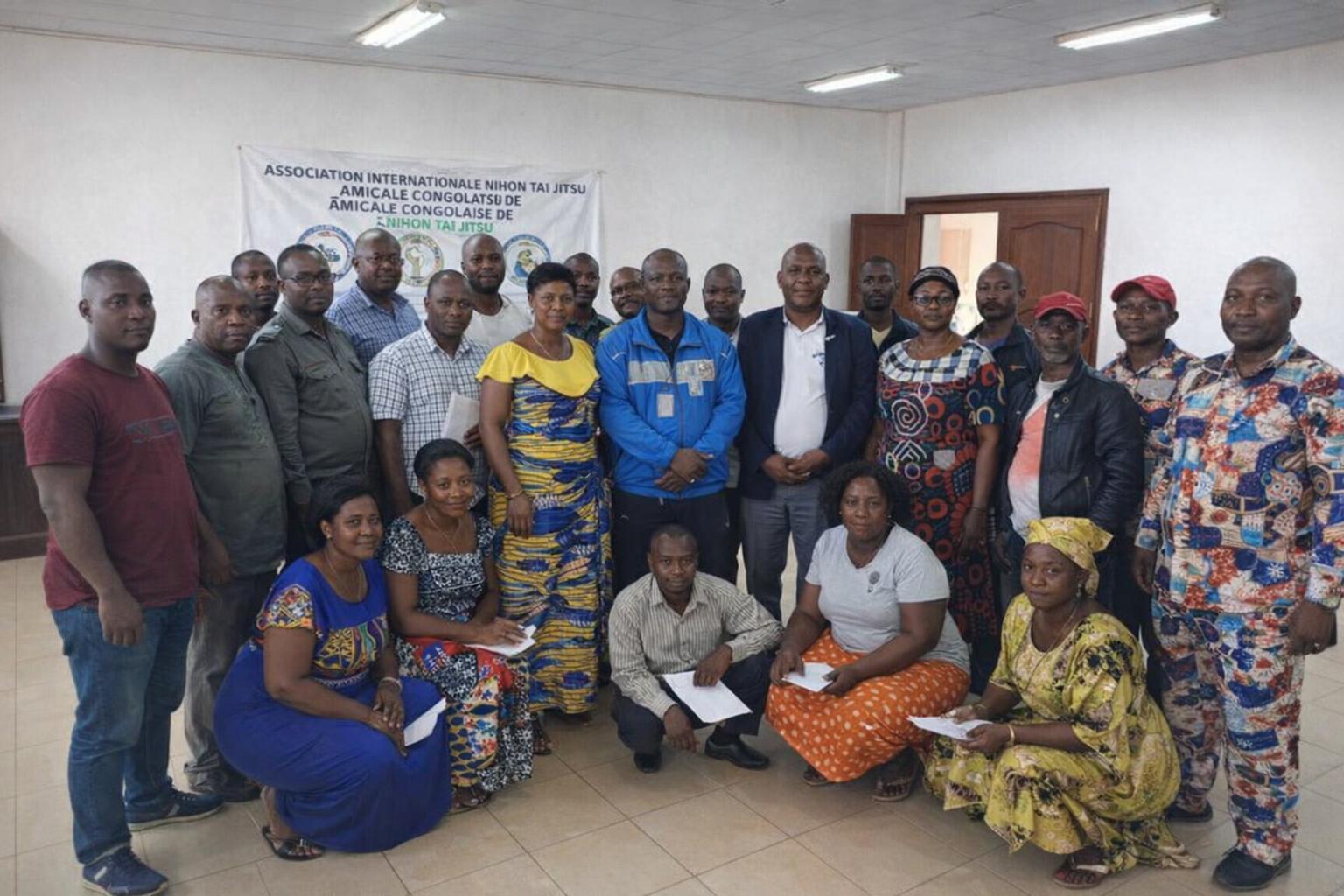
Nihon Taijutsu in Congo: ACNTJ Plans Wider Rollout
Having completed the installation of its organisational structures in the country’s southern area, the Congolese Association of Nihon Taijutsu (Amicale congolaise de Nihon Taijutsu, ACNTJ) is preparing, in the coming days, to extend its departmental commissions into additional parts of the Republic of Congo. According to information communicated by the association, the next targets include the Keni-Alima department, the Plateaux, and other localities likely to be covered in a subsequent phase.
ACNTJ operates under an affiliation with the Congolese Federation of Close Combat and Associated Disciplines (Fédération congolaise de close combat et disciplines associées, Fécoclose-Da). In the federation’s approach, the establishment of departmental commissions is presented as a cornerstone for the orderly development of the discipline, ensuring that activities are framed by bodies able to coordinate training, administration, and internal procedures at the local level.
December 2025 Southern Mission: Institutional Foundations
This upcoming stage follows an intensive field mission conducted in the south of the country, which ACNTJ describes as a decisive step in its national expansion. From 9 to 15 December 2025, a federal delegation travelled through the departments of Pointe-Noire, Kouilou, Niari, Lékoumou, and Bouenza.
The delegation was led by instructor Roland Francis Mahoungou and Fulgence Sieli, who acted as the representative of the national president, Serge Bikoua-Ebia. Their itinerary, as reported, aimed at consolidating the discipline’s governance in each locality through the formal creation of departmental structures. The association portrays this sequence of visits as both administrative and strategic, intended to anchor Nihon Taijutsu within a stable organisational architecture that can endure beyond episodic events or individual initiatives.
Legal and Administrative Framework: Constitutive General Assemblies
At the heart of the mission was the holding of constitutive general assemblies designed to provide each departmental structure with a functional legal and administrative framework. In practical terms, these assemblies served to establish leadership bodies and to define the mechanisms through which the commissions will operate, including internal accountability and oversight.
ACNTJ indicates that, at each stage, proceedings were carried out under the direct supervision of the departmental directorates in charge of Sports and Physical Education. Such supervision is presented as a factor of institutional credibility, aligning local structuring efforts with the public administration’s remit for organising and accompanying sports activities. In a context where the long-term vitality of sports disciplines often depends on clear governance and recognised interlocutors, this method also seeks to reduce uncertainty over representation and procedural legitimacy.
Governance Model: Executive Bureaus and Audit Oversight
The structuring process resulted in the establishment of departmental leadership bodies that appear to follow a standardised model. ACNTJ reports that commissions generally comprise an executive bureau of twelve members, complemented by an audit and accounts office of three members, tasked with financial oversight.
This dual structure, combining executive coordination with internal control, is intended to reflect good governance principles frequently emphasised in federated sports. It is also consistent with the association’s stated objective of ensuring that the discipline’s expansion is accompanied by robust administrative capacity, rather than relying solely on technical performance or sporadic competitions.
Key Appointments in Lékoumou and Bouenza
Among the appointments highlighted during the southern mission, ACNTJ notes that in Lékoumou, based in Sibiti, the departmental commission’s executive bureau is led by Jean Pierre Otounga. In Bouenza, headquartered in Madingou, Gloire Prefina Biyolo Kallah was appointed to head the departmental commission.
These nominations, presented as the outcome of the constitutive assemblies, are portrayed as pivotal for ensuring continuity on the ground. By placing identifiable leadership in charge of departmental coordination, the association seeks to facilitate communication with practitioners, local authorities, and the federation, while also creating a focal point for the planning of training sessions and organisational milestones.
Keni-Alima and the Plateaux: Next Steps in National Coverage
With the southern phase now completed, ACNTJ signals its intention to move toward the Keni-Alima and the Plateaux, among other departments. While the association has not detailed a comprehensive calendar for this new sequence, it frames the forthcoming deployments as a continuation of the same method: establishing commissions through formal assemblies and equipping them with defined governance bodies.
If implemented as described, the approach would allow Nihon Taijutsu’s organisational map to become more evenly distributed across the national territory, an element often considered essential for disciplines seeking sustainable development. For observers of Congo-Brazzaville’s sporting landscape, the initiative also illustrates how federated structures may combine technical dissemination with institutional engineering, ensuring that growth is accompanied by administrative and legal clarity.