

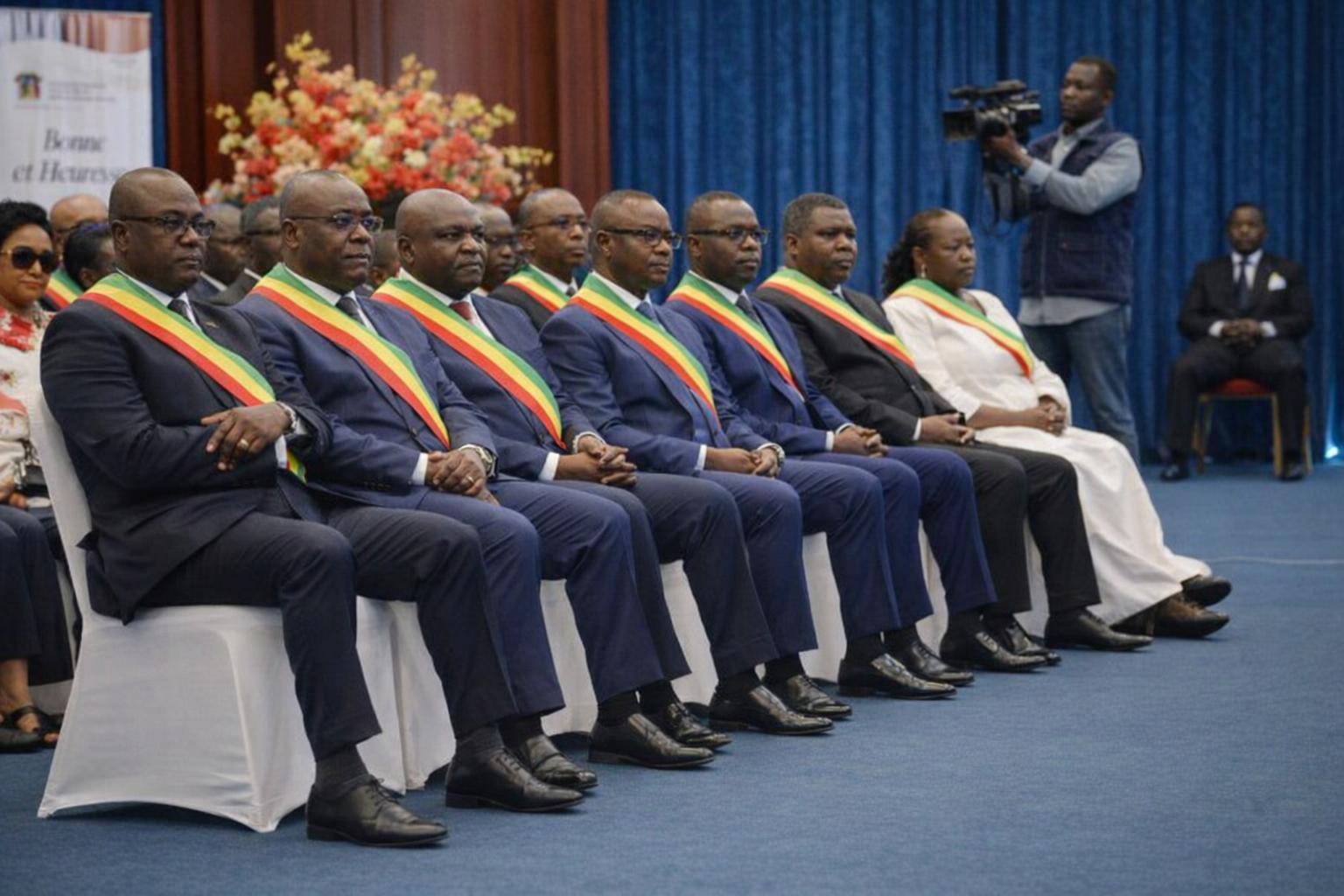
Brazzaville New Year Address Sets 2026 Tone
Speaking during the National Assembly’s New Year greetings ceremony in Brazzaville, the Speaker of the National Assembly, Isidore Mvouba, delivered a message framed around unity, institutional cohesion and public action. In remarks reported by Journal de Brazza, he called on members of parliament to reinforce their collaboration with the government, presenting such alignment as a lever to consolidate the Republic of the Congo’s macroeconomic balances and to advance improvements in governance (Journal de Brazza).
In a political environment where expectations toward public institutions are often articulated in terms of results and continuity, the Speaker’s intervention positioned the legislature as a stabilising component of the state architecture, and as an actor expected to accompany the executive in the implementation of development-oriented policies (Journal de Brazza).
Macroeconomic Balance and Governance in Parliamentary Focus
At the core of Isidore Mvouba’s appeal is an explicit linkage between legislative responsibility and the wider economic and administrative trajectory of the country. By urging deputies to work more closely with the government to consolidate macroeconomic balances, the Speaker implicitly highlighted the importance of a predictable policy environment, institutional coordination and disciplined public decision-making as prerequisites for sustainable development (Journal de Brazza).
The formulation used in the reported address remains programmatic rather than technical: no specific fiscal measures or sectoral reforms are cited in the source. Nevertheless, the stress on governance suggests an emphasis on effectiveness in public administration and on reinforcing the credibility of institutional processes, with parliament expected to contribute through lawmaking and oversight within its constitutional remit (Journal de Brazza).
2025 Legislative Record: A Year of Work and Trials
Looking back at the previous year, Isidore Mvouba described 2025 as a period marked by sustained legislative activity, while also characterising it as a year of labour and trials. In the account relayed by Journal de Brazza, he argued that the National Assembly maintained its course despite challenges, and that the texts adopted during the year helped strengthen the country’s institutional foundations, reflecting a parliamentary commitment to progress and stability (Journal de Brazza).
This retrospective framing serves a dual purpose. It pays tribute to the deputies’ work while presenting the Assembly’s output as part of a broader narrative of institutional consolidation. In the Speaker’s perspective as reported, each law adopted is not merely a procedural achievement but an element contributing to the architecture of public authority and the continuity of state action (Journal de Brazza).
Key Figures Cited by Fernand Sabaye on Lawmaking Output
A quantified assessment of parliamentary activity was presented by the First Secretary of the National Assembly, Fernand Sabaye, underscoring the dynamism highlighted by the Speaker. According to the figures cited, 48 legislative initiatives were registered in 2025, including five originating from parliament itself. Of these, 44 texts were examined and adopted, yielding an adoption rate of 91%, described in the source as highly satisfactory (Journal de Brazza).
These figures, as reported, provide a concrete indicator of the institution’s throughput over the year. The source does not specify the thematic distribution of the adopted legislation, nor the respective timelines of examination. Nonetheless, the high adoption rate is presented as evidence of sustained institutional capacity and of the Assembly’s ability to process a substantial legislative agenda (Journal de Brazza).
Institutional Cohesion and Development Actions Ahead of 2026
Projecting forward, Isidore Mvouba urged both parliamentarians and the Assembly’s staff to stand alongside the executive in order to energise development actions while preserving stability and national cohesion. In the same intervention, he reaffirmed the National Assembly’s commitment to serving the sovereign people and to helping chart trajectories of progress, in terms consistent with the institution’s representative vocation (Journal de Brazza).
Within the limits of the information available, the message appears to prioritise continuity and unity as the principal political resources for 2026. The emphasis on cohesion suggests a preference for coordinated public action and for the maintenance of institutional confidence—two factors often invoked by officials as essential to policy implementation and to the preservation of social equilibrium (Journal de Brazza).