

US visa restrictions effective 1 January 2026
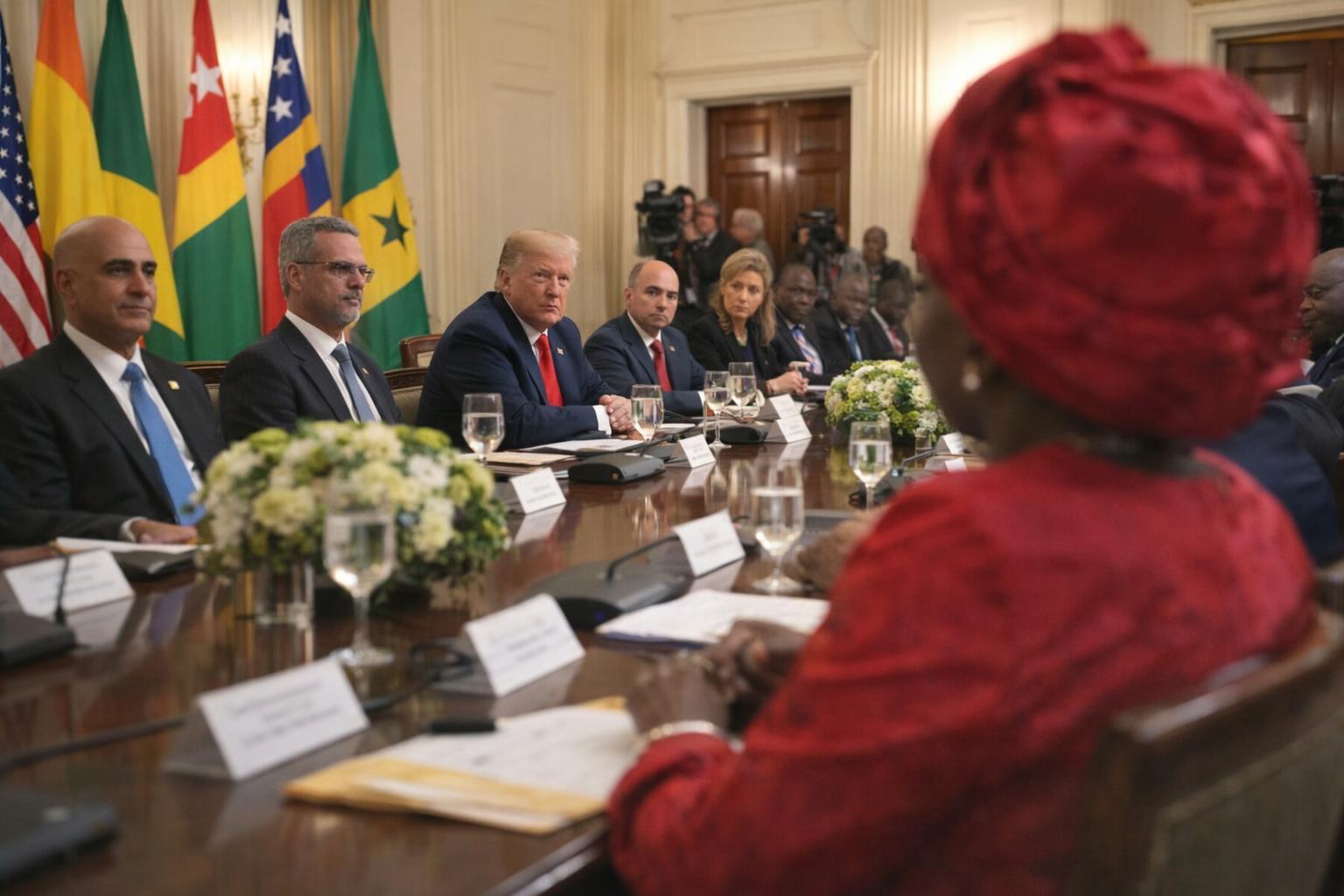
The United States administration has introduced new visa restrictions, scheduled to take effect on 1 January 2026, affecting in particular several African states. In practice, access to US territory is presented as an instrument of migration management and national security; in diplomatic terms, it also functions as leverage, capable of reshaping bilateral relations well beyond consular policy.
According to the information available in the source text, the framework has evolved in successive phases. From June 2025 onward, the administration of President Donald Trump imposed a ban on the issuance of visas for a number of countries, including several in Africa. The scheme was then expanded in January 2026 through the addition of new states, thereby widening the geographic and political scope of the policy.
Countries targeted: full bans and partial restrictions
The measures described differentiate between total prohibitions and partial restrictions. Mali, Burkina Faso and Niger are cited as being subject to a comprehensive visa ban. Other countries, including Côte d’Ivoire and Senegal, are said to appear for the first time on a list of states exposed to partial limitations, a classification that signals differentiated treatment depending on the level of restriction applied.
Such segmentation is significant. Even where the policy is framed in uniform terms of control, the practical distinction between “total” and “partial” restrictions tends to generate distinct diplomatic incentives: a full ban invites more urgent political engagement, while partial constraints can be treated as a warning mechanism whose parameters may be contested or renegotiated. The source text, however, does not specify the precise consular categories affected, the administrative criteria applied, or the duration envisaged for each tier.
Security rationale and a broader transactional diplomacy
Officially, the restrictions are justified by imperatives of migration control and national security. The same source nonetheless depicts an “unofficial” reading that situates these decisions within a broader pattern of transactional diplomacy, in which the visa regime becomes a bargaining chip rather than a purely regulatory tool.
Within this perspective, negotiations undertaken to mitigate or exit the scheme do not remain confined to documentation, vetting, or border procedures. They can become intertwined with questions of market access, strategic cooperation, and economic positioning. In the language of the source, talks may extend to openings for US businesses, security cooperation, and access to raw materials, including critical minerals, indicating an agenda that blends mobility governance with economic statecraft.
Congo-Brazzaville’s preference for bilateral negotiation
The source text mentions Congo-Brazzaville among the African countries that, wary of an open confrontation with Washington, would be inclined to prioritize bilateral negotiation. This approach is described as pragmatic: rather than embracing public escalation, authorities seek channels capable of delivering technical adjustments or political understandings that might change a country’s status under the restrictions.
In that process, the source indicates that some governments retain Washington-based lawyers and lobbyists, at considerable cost. The text does not provide names, figures, or contractual details; it nonetheless illustrates how visa policy, once elevated to a strategic issue, can catalyse an ecosystem of intermediaries, compliance expertise, and influence networks operating within the US capital’s established advocacy market.
US-China competition as an underlying strategic horizon
Beyond the immediate consular impact, the source situates the policy within a wider contest for influence on the African continent. It presents the containment of China’s expanding footprint as a principal objective “in the background” of the White House’s posture. In this reading, visa leverage is not only about the movement of people, but also about the movement of capital, contracts and strategic alignments.
The same framing suggests that countries facing restrictions may find themselves navigating a dense set of expectations, as their diplomatic choices are interpreted through the prism of great-power rivalry. While the source does not document specific Chinese projects or US counterproposals in particular countries, it emphasizes the structural logic: mobility tools can become part of an influence toolkit alongside investment, security partnerships and resource diplomacy.
Reciprocity responses: Chad and the Alliance of Sahel States
Not all states respond with quiet bargaining. The source contrasts negotiation-oriented approaches with a firmer line grounded in reciprocity. Chad is presented as having been subject to a full visa ban since 2025, and as choosing to answer within a reciprocal framework. The same stance is attributed to the three countries of the Alliance of Sahel States, which, according to the source, have also opted for a harder response.
This posture, the text argues, can generate a measure of discomfort in Washington. The underlying tension is strategic: the United States, while applying restrictive measures, simultaneously seeks to preserve influence and security cooperation in a region portrayed as strategic, in order not to leave space for other powers. The source does not describe specific incidents or negotiations; it highlights instead the policy dilemma inherent in combining pressure instruments with the desire to sustain partnerships.
Diplomatic consequences and the limits of the available data
The information provided depicts a visa regime that functions as both gatekeeping and signalling. For African governments, it introduces immediate practical constraints on travel while also shaping perceptions of their international standing. For Washington, it projects resolve on migration and security, while potentially inviting quid pro quo bargaining in the areas that matter to US economic and strategic interests.
At the same time, a rigorous reading must acknowledge the limits of the source. The text offers no official US documents, no detailed country-by-country annexes, and no verifiable quantitative assessment of the human or economic impacts. Any evaluation therefore remains necessarily circumspect: what can be established from the source is the chronology, the named countries, and the political interpretation that frames the restrictions as part of a wider diplomatic strategy, including competition with China.