

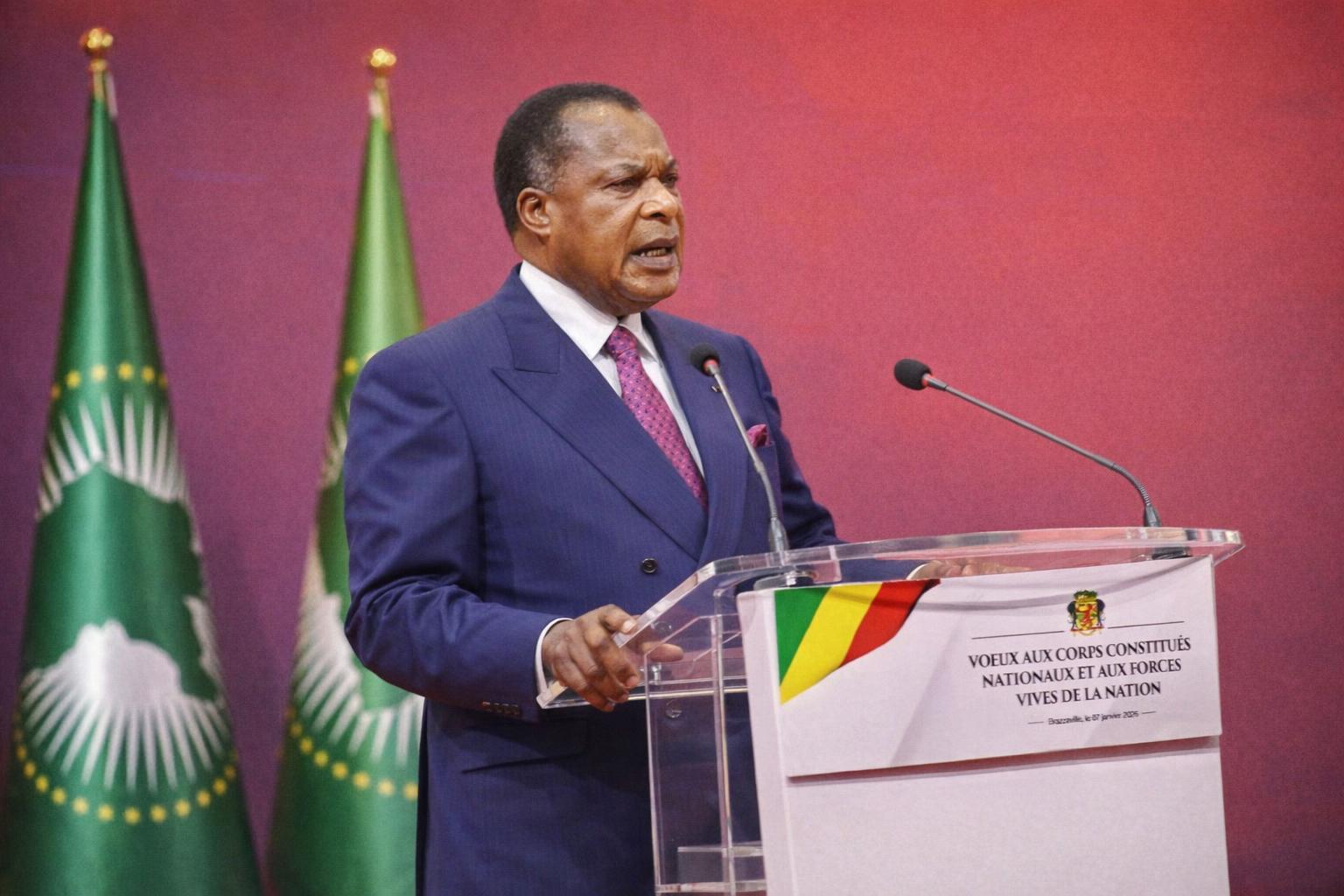
Brazzaville address on unity ahead of the presidential election
Brazzaville, 8 January (ACI) — President Denis Sassou-N’Guesso on 7 January in Brazzaville appealed to what Congolese public life commonly designates as the “living forces of the Nation” to preserve unity, peace and national cohesion as the country moves toward the presidential election scheduled for March.
The Head of State delivered this appeal while responding to the traditional New Year greetings addressed to him by the national institutions and the country’s broad civic constituencies. He framed the forthcoming vote as a major democratic appointment, explicitly calling for it to unfold “in peace and concord”, and he linked the credibility of the process to mutual understanding and respect among citizens and political actors (ACI).
Democratic stability and the vocabulary of concord
In his remarks, President Sassou-N’Guesso placed particular emphasis on the idea that democratic success is not merely procedural, but also relational. He underscored that the quality of public life depends on the willingness of actors to recognise one another as legitimate participants in a shared national project. In that spirit, he invited stakeholders to privilege calm deliberation over antagonism, and to treat the electoral moment as an opportunity to consolidate the Republic rather than to fracture it (ACI).
Such language, frequently used in contexts of high political salience, reflects a broader understanding that elections are as much about social cohesion as they are about competition. By insisting on “concord”, the President encouraged a civic ethic in which disagreement can be articulated without undermining collective peace, and in which institutional continuity is protected through restraint and reciprocity (ACI).
Congo’s diversity presented as a national asset
The President further recalled that Congo’s cultural, political and religious pluralism constitutes a resource. This diversity, he noted, should be respected as a means of strengthening “living together” and consolidating cohesion within the national community (ACI).
By approaching pluralism as an asset rather than a risk, the Head of State invited citizens and organised groups to interpret difference through a unifying lens. The message places responsibility not only on political leaders, but also on social intermediaries—community figures, associations, and other civic actors—whose everyday practices help translate constitutional principles into lived stability (ACI).
Role of “forces vives” in safeguarding peace and cohesion
President Sassou-N’Guesso described the “forces vives” as essential components of the national community, each called upon, at its respective level, to contribute to the consolidation of peace (ACI). The expression, in Congolese public discourse, typically encompasses institutional representatives, political stakeholders, civil society organisations, socio-professional groups, and other organised segments of society.
In emphasising shared responsibility, the President’s message situates peace not as an abstract aspiration but as a public good that depends on collective discipline. It implies that national cohesion is reinforced by civic conduct in daily life as well as by the tone of political mobilisation, especially during sensitive electoral periods (ACI).
Religion, tolerance and the secular character of the State
Addressing religion’s place in Congolese society, President Sassou-N’Guesso acknowledged its contribution to the promotion of peace, love of one’s neighbour and tolerance, while reaffirming the principle of State secularism. In this regard, he referred to the teachings of Christianity and Islam—presented as the country’s predominant religions—as moral reference points that can encourage social cohesion (ACI).
This articulation sought to balance two pillars of the Republic’s self-understanding: the neutrality of public institutions vis-à-vis belief, and the recognition that faith communities can, through their ethical traditions, foster civic virtues. In diplomatic terms, the emphasis on tolerance and cohesion signals an expectation that religious authorities remain partners in social stability while respecting the secular framework that governs the State (ACI).
Dialogue, civility and the national motto as guiding principles
Beyond religious communities, the Head of State also called on political actors, associations and non-governmental organisations to deepen dialogue, attentive listening and civility, described as essential pillars of a stable and solidaristic society (ACI). The insistence on these terms points to an ideal of public debate anchored in restraint and mutual consideration, particularly as electoral competition intensifies.
Finally, the President addressed all components of the Nation—political and administrative leaders, religious and customary authorities, women and young people—urging them to promote the values embodied in the national motto “Unity – Work – Progress”. He concluded by extending his wishes for a happy and prosperous year 2026 to all Congolese citizens (ACI).