

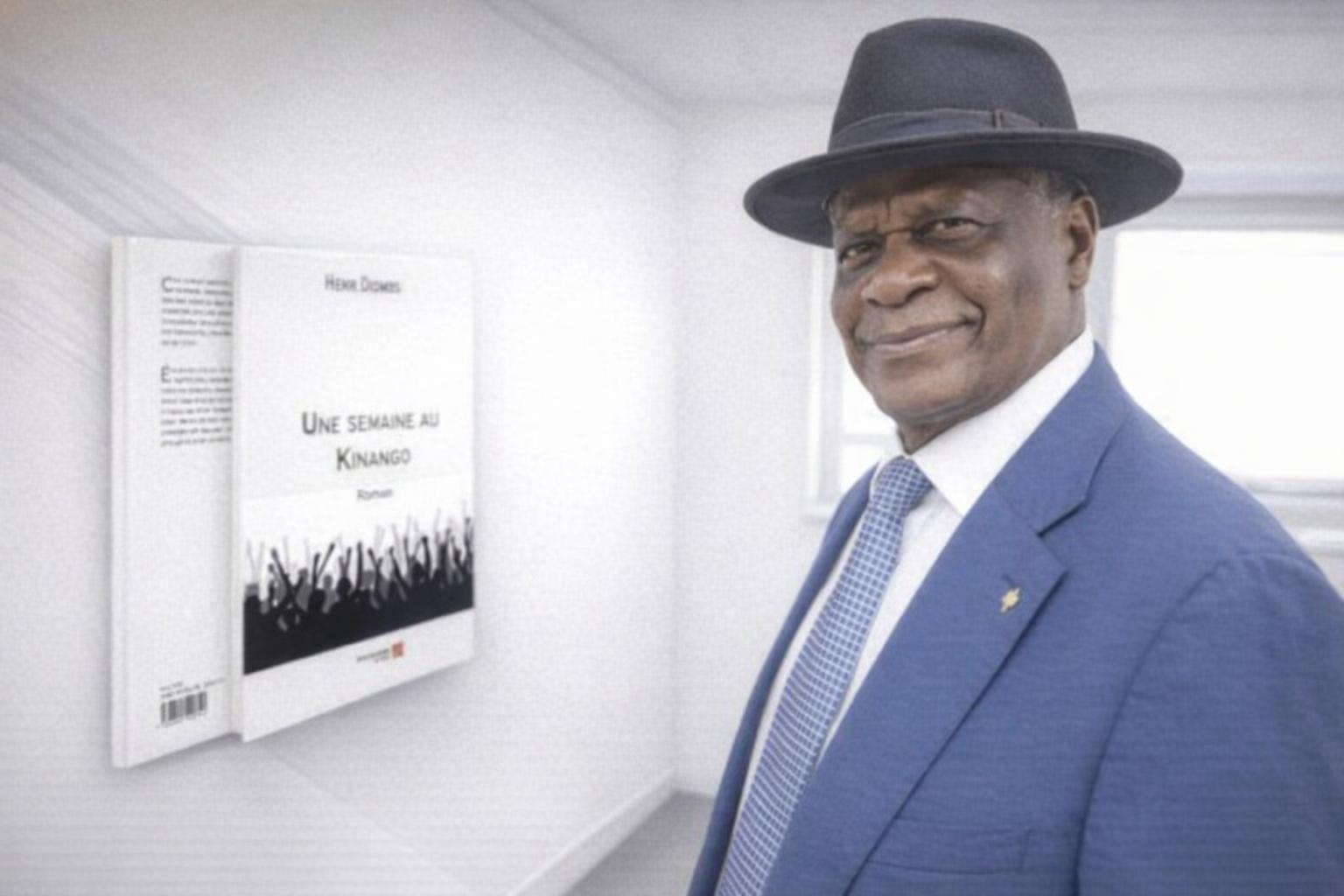
Paris Book Event Highlights Congolese Literature
Brazzaville, 8 January (ACI) – Congolese writer and statesman Mr Henri Djombo is scheduled to present and sign his new novel, Une semaine au Kinango, on 17 January in Paris, France. The work was published in October 2025 by Éditions Net, and the Paris meeting is expected to bring the book to a wider francophone readership, particularly within cultural circles attentive to Central African literary production.
The announcement positions the event less as a mere promotional appointment than as a moment of encounter between author and audience. In the Parisian context, where debates on African narratives and their global circulation are intense, a public presentation serves as an opportunity to situate Congolese literary voices within broader conversations on contemporary society, memory, and reform-minded visions of the future, while remaining faithful to the novel’s own internal universe.
A New Title in an Established Literary Oeuvre
Une semaine au Kinango is a 185-page volume and is described as Mr Djombo’s eleventh narrative work. According to ACI, the author has previously produced ten novels, around a dozen plays, and a collective essay, a body of writing that reflects sustained engagement with multiple genres and audiences.
This continuity matters for readers seeking to understand the novel not as an isolated publication but as part of a long-standing intellectual itinerary. Mr Djombo’s work, spanning fiction and theatre, suggests an interest in dialogue, voices, and social staging—elements that, by ACI’s account, also underpin the thematic architecture of Une semaine au Kinango (ACI).
Kinango Society Through the Visible and the Unseen
In this novel, the author is said to set out both the visible and invisible situations that shape Kinango society. The narrative foregrounds dialogue among different forces, generations, and nations, while drawing attention to social vulnerabilities. Such framing indicates a literary approach attentive to nuances: what is openly displayed in social life, and what remains implicit, unspoken, or structurally embedded.
ACI further reports that the book explores factors conducive to “reasoned reforms,” fair relations among people, and dynamic transformations affecting Africa and the world. Read in diplomatic and academic terms, these themes resonate with a long tradition of African political literature that uses fiction to examine civic ethics and social cohesion without reducing complex realities to slogans. The ambition, as presented, is not simply descriptive; it is diagnostic, and, in a measured manner, reflective about pathways toward balanced change (ACI).
From Brazzaville and Yaoundé to a Paris Audience
Before the forthcoming Paris event, Une semaine au Kinango has already been presented and signed in Brazzaville, Republic of the Congo, and in Yaoundé, Cameroon, according to ACI. This sequence of presentations suggests a circulation that begins within the sub-region—where cultural proximity can sharpen the reception of social references—and then extends to Paris, a long-standing hub for francophone publishing and literary debate.
For Congolese communities abroad, such a Parisian presentation can also function as a cultural rendezvous, bringing together readers interested in the evolution of Congolese letters. For the broader public, it offers an additional vantage point on how contemporary Congolese authors engage the global present through fiction while retaining the specificity of local social textures (ACI).
Author Profile: Economist, Former Minister, Award-Winning Writer
Mr Djombo is presented by ACI as an economist by training, a former minister, and an honorary Doctor of the Institut supérieur des métiers de l’audiovisuel (IMA) in Benin. This profile—at the intersection of public service, academic recognition, and literary practice—helps explain why his novels may attract readers interested not only in storytelling but also in the social and institutional questions that fiction can illuminate.
ACI also states that the author has received multiple literary prizes in his country, as well as international distinctions including the Toussaint-Louverture and Camara-Laye prizes. Such acknowledgements, while never replacing critical reading, indicate a degree of sustained recognition for his contribution to letters and may contribute to the attention surrounding the Paris presentation of Une semaine au Kinango (ACI).
Verification Notes and Additional Source Avenues
Given the public nature of a book-signing in Paris, further confirmation may typically be sought through the publisher’s official communications and the hosting venue’s programme, as well as through any public notices disseminated by cultural institutions involved in francophone literary events. In this instance, the present article relies on the information provided by ACI, and any supplementary confirmations would ordinarily aim to corroborate the date, location, and practical modalities of attendance without altering the underlying facts reported (ACI).
A Literary Appointment Framed by Dialogue and Reform
As outlined by ACI, Une semaine au Kinango proposes a narrative space where dialogue across generations and nations is central, and where social fragilities are acknowledged rather than ignored. The forthcoming Paris presentation on 17 January thus appears poised to extend the conversation beyond the initial audiences in Brazzaville and Yaoundé, offering readers an occasion to engage directly with the author’s thematic preoccupations.
Within the francophone literary landscape, such events often contribute to a broader recognition of Central African writing as a field capable of addressing universal questions—justice between individuals, the possibility of reform, and the tempo of transformations—through the distinctive lens of a particular society. In that sense, the Paris meeting is not only a celebration of a new publication; it is a cultural moment in which Congolese literature asserts its place in international public discourse (ACI).