

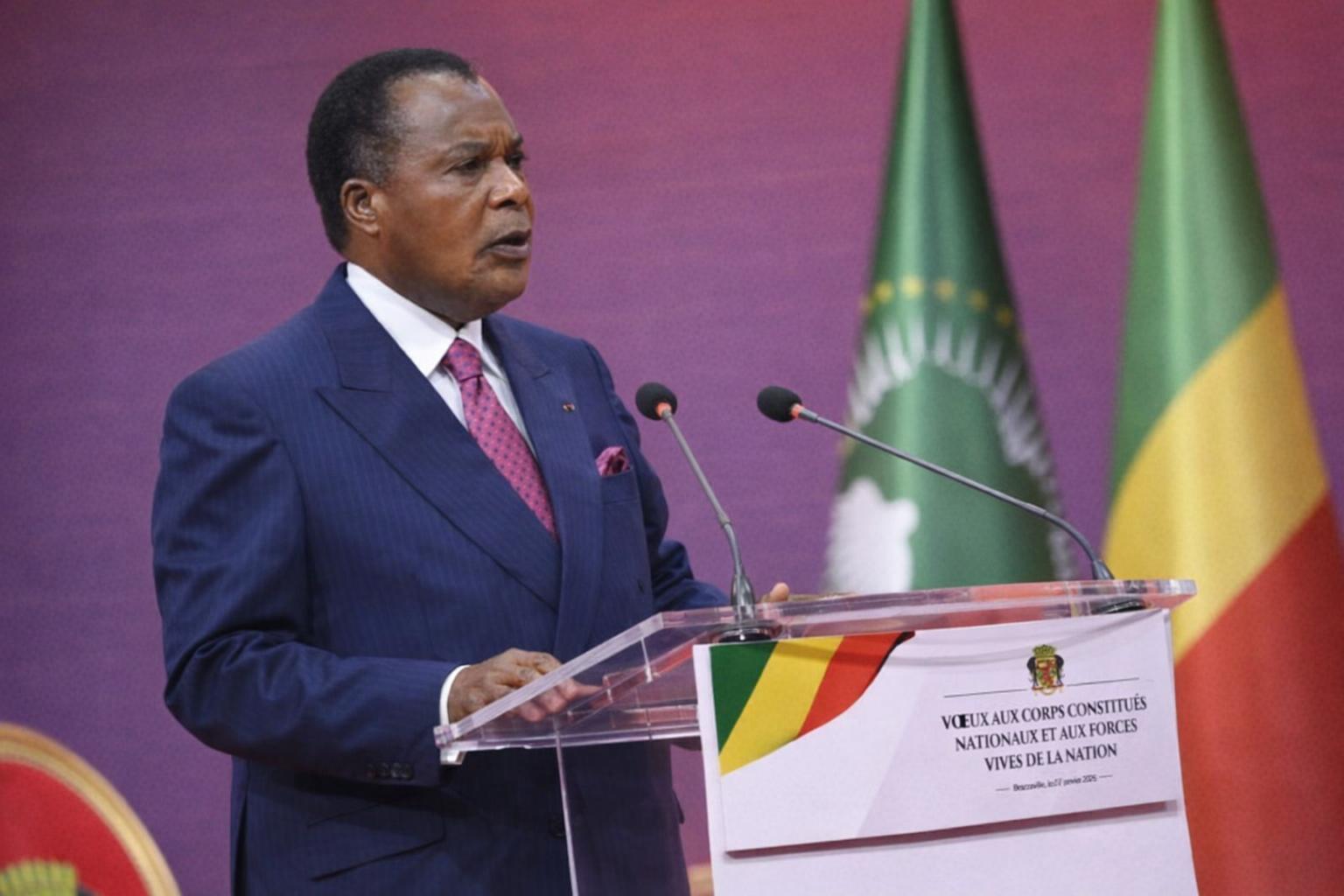
Brazzaville ceremony underscores national cohesion
The New Year greetings offered by the constitutional bodies and the nation’s “forces vives” to the presidential couple, held on 7 January at the Palais des Congrès, unfolded as a carefully choreographed moment of civic communion. Across the successive interventions, a shared vocabulary prevailed: peace, stability and development. The setting and tone were consistent with a long-standing republican tradition in which institutions and representative components of society publicly reaffirm their attachment to the state, the continuity of public action and the primacy of social harmony.
In a political calendar that already looks toward the presidential election scheduled for March, the ceremony also served as a reminder of the stakes that many Congolese associate with calm public life: the consolidation of institutions, the protection of social cohesion, and a stable environment in which economic and administrative reforms can be pursued. The emphasis placed by speakers on concord and collective responsibility reflected an understanding that political competition, to be meaningful, must remain framed by shared rules and a commitment to the public interest.
Peace and “living together” framed through faith traditions
In his address, President Denis Sassou N’Guesso chose to anchor his appeal for unity in the moral teachings of Christianity and Islam, the two principal religions practiced in the Republic of the Congo. By invoking these traditions, the Head of State placed the notion of “living together” within an ethical register that resonates beyond partisan affiliations, presenting peace not merely as the absence of conflict but as a civic virtue to be actively cultivated.
The President’s message was explicit in its intent: preserve the country’s climate of peace in the months preceding the March presidential election. Without dramatizing the context, his call nonetheless highlighted the centrality of stability to the nation’s trajectory. In this reading, social tranquillity is not an abstract ideal; it is the condition that allows families, businesses, schools and public services to function predictably, and it is the prerequisite for any credible development agenda.
Institutions voice expectations for development projects
Speaking on behalf of the constitutional bodies and the nation’s “forces vives”, the President of the Constitutional Court, Auguste Iloki, articulated an expectation frequently heard in public debate: the desire to see the Government implement “structuring projects” that can help the country advance on the path to development. Framed in measured terms, his remarks conveyed what he described as a thirst among Congolese for visible, transformative initiatives—those capable of improving daily life while strengthening the productive base of the economy.
In the institutional logic of such ceremonies, this intervention carried a dual significance. It reaffirmed the role of constitutional bodies in embodying the continuity of the Republic, while also echoing social priorities that, in many countries, tend to intensify as elections draw nearer. The emphasis on development was presented not as a partisan demand, but as a national horizon to which public authorities and stakeholders are collectively invited to contribute.
Election timetable and the premium placed on stability
With the presidential election anticipated in March, the messages delivered at the Palais des Congrès illustrated a recurring feature of Congolese political life: the premium placed on stability as a foundation for democratic and economic processes. The repeated references to peace and serenity suggested that, for many actors, an orderly climate is inseparable from the credibility of institutional deadlines and from citizens’ confidence in public life.
At the same time, the ceremony’s development-oriented discourse pointed to a broader policy expectation: that political stability should translate into concrete progress through projects deemed “structuring”. In diplomatic terms, the sequence is clear and widely accepted: peace enables planning, planning enables investment, and investment—public and private—creates the conditions for sustained development. The 7 January gathering thus functioned as both a symbolic reaffirmation of cohesion and a pragmatic reminder that stability is most persuasive when it is accompanied by tangible results.
A civic moment with an implicit policy agenda
Taken as a whole, the New Year greetings ceremony was less a mere ritual exchange than a civic moment in which institutions, social forces and the presidency converged around a unifying narrative. President Denis Sassou N’Guesso’s call to safeguard peace, articulated through shared religious references, sought to elevate national cohesion as a common duty ahead of the electoral season. Auguste Iloki’s remarks, for their part, channelled a developmental aspiration: that the implementation of major projects should continue to guide the action of public authorities.
If the language remained consensual—as is customary in such settings—the priorities it highlighted were nonetheless precise. In the months leading to March, the ceremony’s dominant themes offer a succinct portrait of what many citizens and institutions appear to value most: a calm political climate, resilient public institutions, and a development agenda capable of translating stability into broadly felt progress. (Source: the text provided by the user.)