

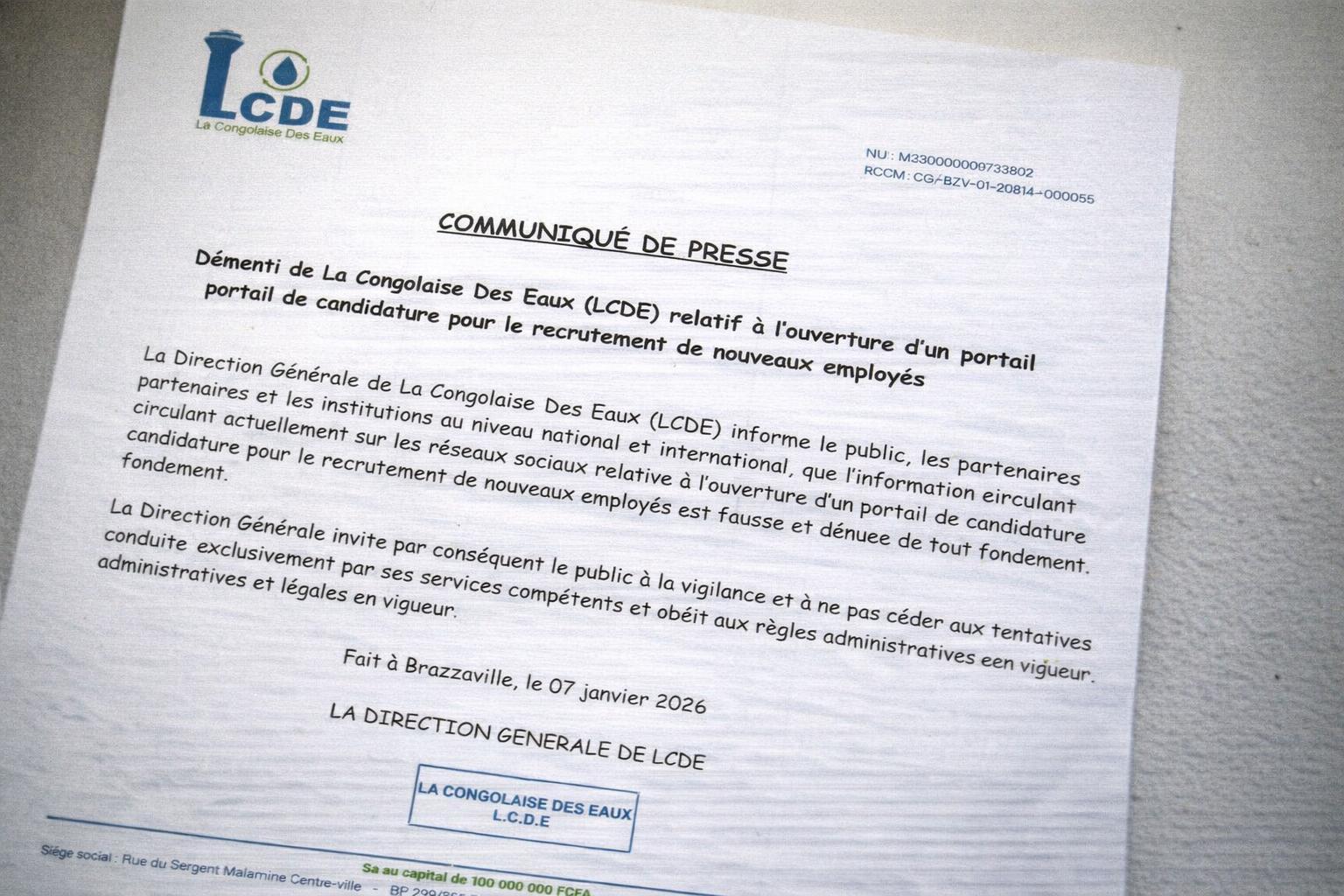
Brazzaville: LCDE issues formal denial of viral posts
La Congolaise Des Eaux (LCDE), the national water distribution company, has publicly refuted claims of an alleged “mass recruitment” campaign after a wave of messages circulated widely on social media over recent days. In a statement dated Wednesday 7 January and released in Brazzaville, LCDE’s General Management described the purported recruitment announcements as entirely false and insisted they did not originate from any of the company’s services.
The clarification came as many users continued to relay a link presented as a “candidate portal” allegedly offering job opportunities within the company. LCDE’s response, framed as a warning to citizens and partners alike, underscores the growing operational and reputational risks that major public-facing enterprises may face when misinformation spreads rapidly online.
Fake “application portal” suspected to be a cyber-fraud mechanism
According to the company’s communication, the content circulating on platforms such as WhatsApp and Facebook should be treated as suspect, notably where it invites job seekers to submit sensitive documents or provide banking information. LCDE warned that such schemes are commonly designed either to harvest personal data or to extract money from applicants in search of employment.
Without attributing the act to any identified individual or group, the company’s statement situates the episode within a broader pattern of digital deception that exploits the credibility of established institutions. In the current climate, where online information is frequently shared before being verified, LCDE’s insistence on caution appears intended to protect the public, including young job seekers, from preventable harm.
Official LCDE recruitment procedures: legal and administrative safeguards
LCDE reiterated that its recruitment processes remain governed by strict internal controls and by the administrative and legal rules in force. “Any recruitment procedure is conducted exclusively by its competent services and complies with the applicable administrative and legal rules,” the statement said.
This reminder serves a dual purpose. First, it reinforces the notion that employment opportunities—when they exist—follow defined procedures rather than informal online shortcuts. Second, it clarifies that third-party links or unofficial “portals” should not be assumed to reflect the company’s practices, regardless of how convincingly they may be presented in forwarded messages or copied visual formats.
Public advisory: how to reduce exposure to recruitment fraud
LCDE urged institutions, partners and the broader public to ignore suspicious links disseminated via social networks and messaging applications. The company further advised citizens not to transmit bank coordinates, identity documents or other personal information through non-official platforms claiming to represent LCDE.
The statement also invited the public to rely exclusively on LCDE’s official communication channels for any employment-related information. In practical terms, this guidance is aimed at reducing the likelihood that individuals—especially those actively seeking opportunities at the beginning of the year—become targets of fraud that often leverages urgency, scarcity of jobs and the perceived authority of large public enterprises.
A timely warning as digital scams intensify in early-year periods
While LCDE did not quantify the scale of attempted fraud or specify whether any victims had been identified, its decision to issue a prompt and unequivocal denial signals the seriousness with which it views the matter. The company’s message aligns with a broader public-interest imperative: encouraging verification, slowing the reflex to share unconfirmed announcements, and treating requests for money or sensitive data as immediate red flags.
In the absence of a verified recruitment campaign, LCDE’s position remains unambiguous. Any employment communication not issued through its authorised services should be considered unreliable, and the safest course for citizens is to privilege official sources and administrative clarity over viral claims.