

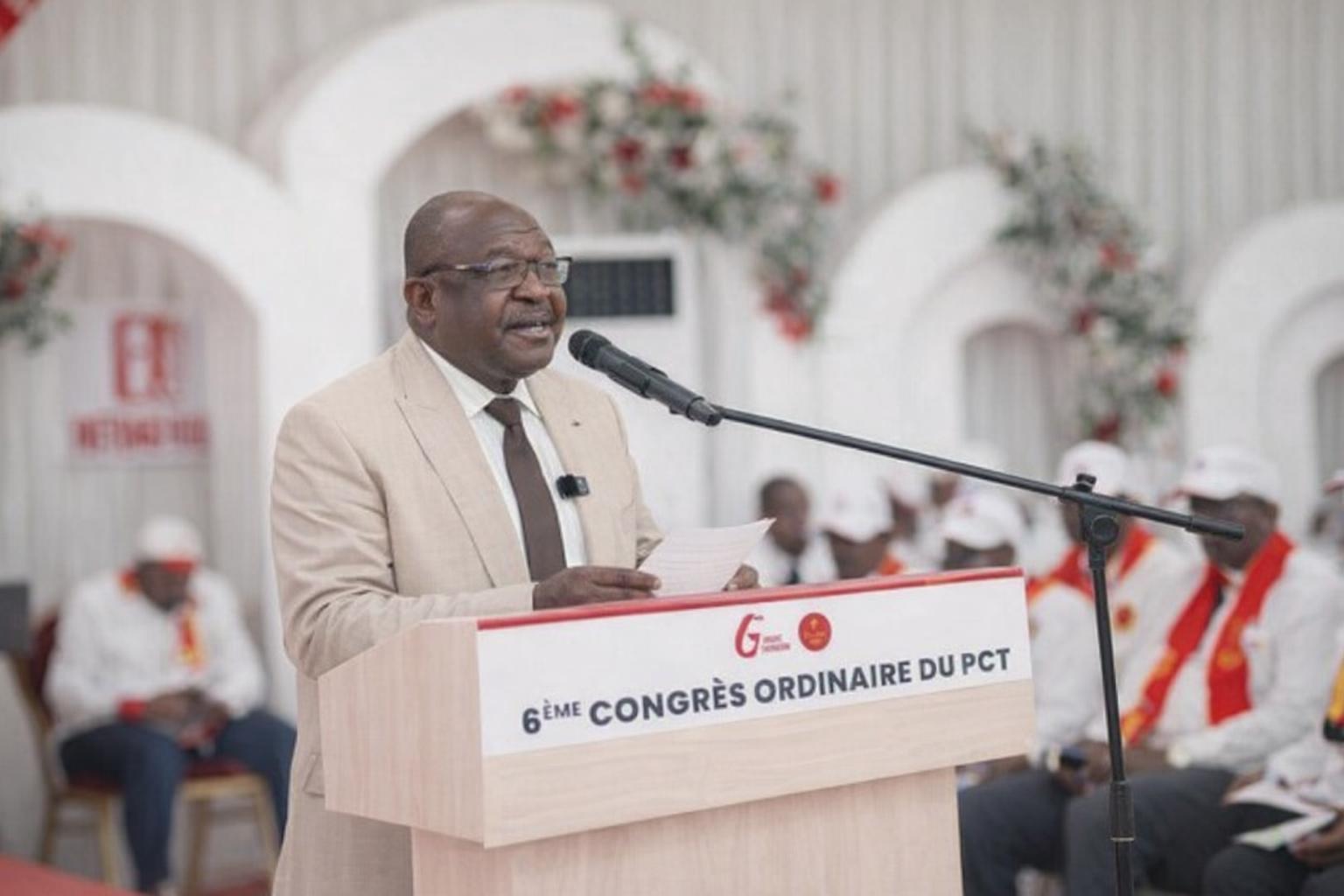
Congo-Brazzaville 2026 election: a majority line reaffirmed
The curtain has fallen on the sixth ordinary congress of the Congolese Labour Party (Parti Congolais du Travail, PCT), a political gathering that served not merely as an internal party milestone but as a platform for the broader presidential majority to restate its shared orientation ahead of the March 2026 presidential election. Among the congress’s various resolutions, one dominated the political horizon: the call for President Denis Sassou N’Guesso to present his candidacy for 2026, a position described in the proceedings as unanimous among the PCT and its allied parties.
In the language of coalition politics, such moments are less about surprise than about consolidation. The congress, as presented by the participating actors, functioned as an instrument of collective discipline, intended to project coherence, continuity and readiness to govern. Within that framework, allied parties used the national spotlight to reaffirm what they described as the guiding principles of their political bloc, in a tone that emphasised stability and responsibility rather than ideological contestation.
PCT 6th congress: the presidential majority speaks with one voice
According to the account delivered from the congress rostrum, the presidential majority’s parties sought to underline a “community of views” that, in their telling, naturally produced an unambiguous choice of a common candidate for 2026. The name advanced was that of President Denis Sassou N’Guesso, whose potential candidacy was presented as the central point of convergence for the coalition.
It is in this context that the intervention of Euloge Landry Kolelas, speaking as president of the Congolese Movement for Democracy and Integral Development (Mouvement Congolais pour la Démocratie et le Développement Intégral, MCDDI), acquired particular significance. His statement aligned with the congress’s dominant message while also offering a justification rooted in coalition durability and the political vocabulary of national cohesion. The intervention underscored that the endorsement was not framed as a tactical gesture, but as an expression of a longer-term alliance logic.
MCDDI endorsement: peace, unity and coalition stability
Addressing the congress, Euloge Landry Kolelas described the alliance binding the MCDDI to the PCT as “without doubt a solid political foundation,” and expressed the wish that the congress would result in a strengthened presidential majority capable of steering the country’s course “with determination, responsibility and under optimal conditions.” His remarks insisted on the importance of a disciplined governing coalition, presented as a prerequisite for effective public action and political continuity.
The MCDDI leader further reaffirmed what he termed an “unwavering attachment” to peace, national unity and social cohesion, elevating these as shared values and collective obligations. In a political environment where the stability of institutions is often portrayed as a strategic asset, the vocabulary deployed is notable: peace is not treated as an abstract ideal, but as a national resource that, in the speaker’s framing, must be preserved through coordinated political conduct.
Kolelas also pledged to maintain and deepen “frank and loyal” cooperation with the PCT, in a spirit of mutual respect, ongoing dialogue and political responsibility, oriented toward development and the well-being of citizens. Such declarations, while customary in coalition settings, carry a particular weight during party congresses, where commitments are made publicly and recorded as part of a broader narrative of unity.
Denis Sassou N’Guesso candidacy call: ‘the choice of reason’
The decisive moment of the MCDDI’s intervention came with an explicit invitation to President Denis Sassou N’Guesso to stand as a candidate in the March 2026 presidential election. In a formulation designed to combine political assessment and affective resonance, the MCDDI president argued that, for his party, “a single personality” with experience, patriotism and a reputation as a “man of peace” is able to lead the Congo’s national trajectory: President Denis Sassou N’Guesso.
Kolelas then urged the Head of State to “make an act of candidacy” for 2026, adding that the party was convinced this would be “the choice of reason” as well as “the choice of the heart.” The statement is politically telling in its dual appeal. It aims to legitimise an electoral option both through rational arguments about experience and governance, and through a language of collective sentiment, often deployed to reinforce loyalty among supporters and allied structures.
MCDDI–PCT alliance: a historical narrative of national unity
Beyond the immediate electoral horizon, the MCDDI justified its position by invoking the history of its alliance with the PCT, described as an anchoring that has entered the national political story as a “foundation of national unity.” This framing suggests a deliberate effort to place the endorsement within a longer arc: not simply an endorsement for a single cycle, but a reaffirmation of a political architecture presented as stabilising for the state.
In that narrative, the figure of Bernard Bakana Kolelas, identified as the MCDDI’s founding president, is referenced as providing a guiding legacy. The text portrays his vision as continuing to illuminate the present, thereby turning political continuity into a form of moral inheritance. In practical terms, this kind of historical anchoring functions as an internal argument to party constituencies: it offers continuity of leadership and alliance as fidelity to foundational principles rather than mere expedience.
From a strictly factual standpoint, the congress account indicates that the call for Denis Sassou N’Guesso’s candidacy was advanced as a coalition consensus and presented publicly as such. In institutional terms, the next political steps would ordinarily depend on the decisions and procedures that govern the formal designation of candidates and the electoral calendar. In the meantime, the message emerging from the PCT congress, as reported here, is that of a majority seeking to enter the 2026 sequence with cohesion and a clear line of leadership.