

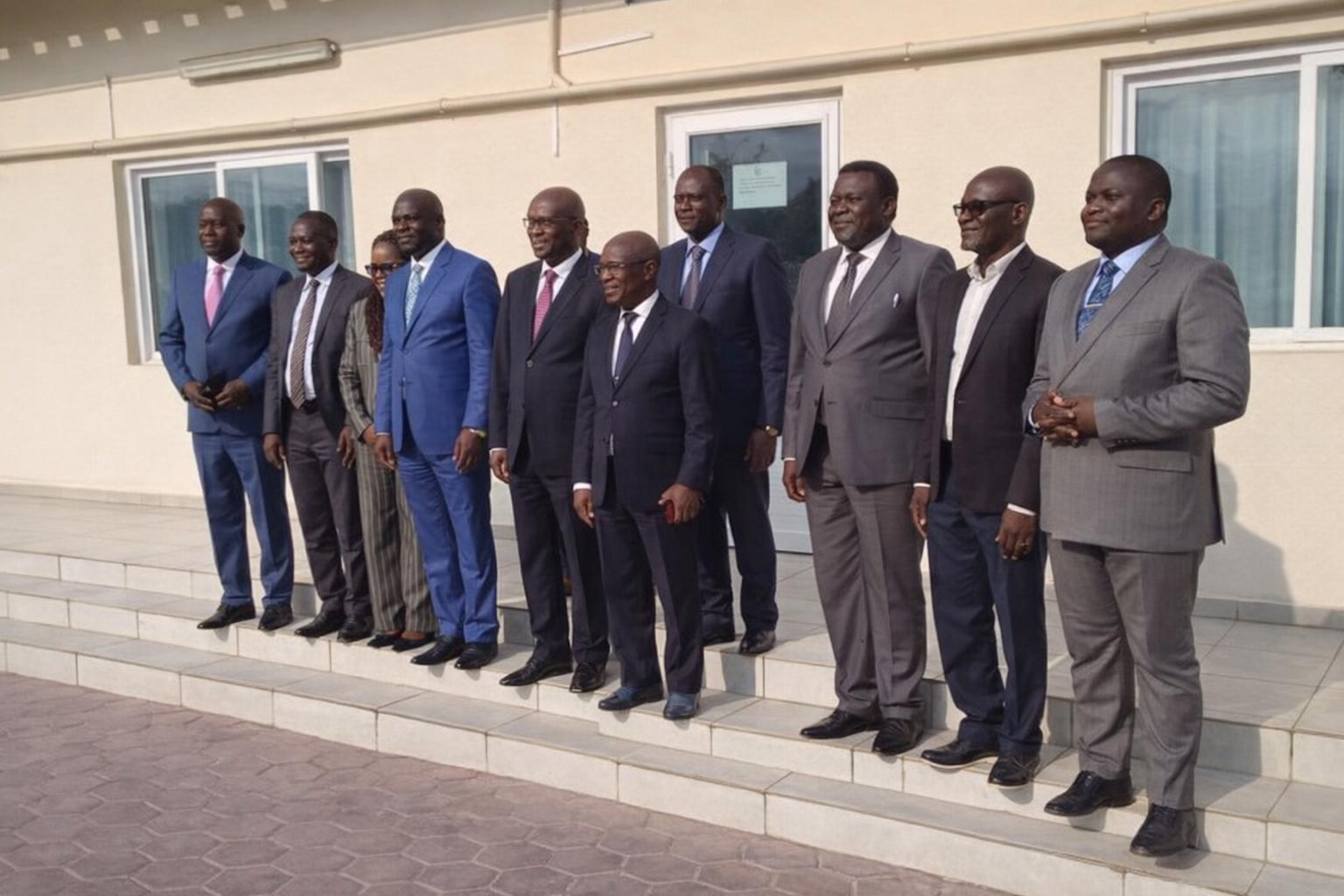
CNFSDP adopts a CFA 2bn 2026 budget in Brazzaville
The National Centre for Training in Statistics, Demography and Planning (CNFSDP) convened its second steering committee meeting on 5 January in Brazzaville, closing the session with the approval of its 2026 budget. The financial plan is balanced in both revenue and expenditure at CFA 2 billion, a level presented as commensurate with the institution’s ambition to consolidate its role within the National Statistical System and to modernise its training offer.
The meeting was held under the aegis of the chair of the steering committee, Gabriel Batsanga. According to the information shared at the end of the deliberations, roughly ten agenda items were examined, reflecting a governance sequence that combines budgetary authorisation with performance review and forward planning—an increasingly standard approach among public administrative institutions seeking to align resources, outputs and accountability.
Government and World Bank co-financing frames priority investments
The steering committee validated that the CFA 2 billion envelope is co-financed by the Government and the World Bank, through the HISWACA project, presented in full as Harmonizing and Improving Statistics in West and Central Africa. Within the parameters described to participants, the budget is designed first and foremost to support capital expenditure: the construction of training infrastructure and the installation of modern, fit-for-purpose equipment.
This allocation signals a policy preference for strengthening the material conditions of learning and research, in a field where robust infrastructure—classrooms, computing facilities, secure data environments and specialised teaching tools—often determines the quality and credibility of statistical production. In the Congolese context, such investments may also be read as a practical complement to broader public-sector objectives centred on better planning, stronger evidence-based decision-making and improved administrative performance, without overstating what the budget alone can deliver.
MOOC platform and digital library: a strategic pivot to e-learning
Beyond bricks-and-mortar priorities, a significant share of the resources is earmarked for a digital platform described as a MOOC, intended to provide online training to students. The same budget line also provides for the installation of a digital library, an instrument that can widen access to reference materials and facilitate continuous learning for both enrolled students and, potentially, professionals undertaking in-service training.
Johs Stephen Yoka Ikombo, Director-General of the CNFSDP, framed these choices as the operational translation of the steering committee’s endorsement. “We have received the blessing of the steering committee which validated the 2026 budget year that will serve the digitalisation of our services and all the different training pathways,” he said. He added that another flagship action will involve the construction of additional training infrastructure, while reiterating expectations of continued support from the Government and the World Bank through HISWACA.
2026 activity programme approved alongside prior-year reporting
In the same sitting, the steering committee approved the institution’s 2026 activity programme, described as a set of actions intended to improve CNFSDP’s functioning over the year. The stated objective is to position the Centre as a reference institution in statistics, demography and planning beyond the sub-region—a formulation that underscores aspirations for regional visibility while remaining anchored in the Centre’s core mandate.
Participants also approved the 2025 activity and financial report, as well as the 2024 financial statements. The sequencing of approvals—forward-looking programming combined with retrospective reporting—provides a measure of continuity in oversight, and signals that resource mobilisation is being paired with documented management of previous cycles.
Academic performance: 96.7% success rate and new intakes
The steering committee further welcomed the academic performance recorded during the 2024–2025 year, highlighted by a reported success rate of 96.7%. While such a figure should be interpreted within the specific evaluation framework of the institution, it was presented as an indicator of the effectiveness of teaching and student follow-up.
For the 2025–2026 academic year, the CNFSDP is recruiting 59 new students into bachelor-level tracks and higher technician programmes. This intake reflects the Centre’s dual orientation toward forming senior-level cadres and providing technically skilled profiles—two categories frequently in demand in both public administration and private organisations that rely on reliable data and planning capacities.
A public administrative institution at the heart of the national statistical system
CNFSDP is an administrative public establishment mandated to provide both initial and continuing education for high-level staff working in public and private administrations within the National Statistical System. In practical terms, this places the Centre at an intersection between training, public policy needs and institutional capacity-building.
By endorsing a 2026 budget that prioritises infrastructure, equipment and digital learning tools, the steering committee has effectively laid out an investment pathway consistent with the Centre’s public-service mission. The outcome, as presented, is less a political statement than a managerial and educational choice: to modernise training modalities, broaden access to learning resources and reinforce the institutional base that underpins professional statistics, demography and planning in Congo-Brazzaville.