

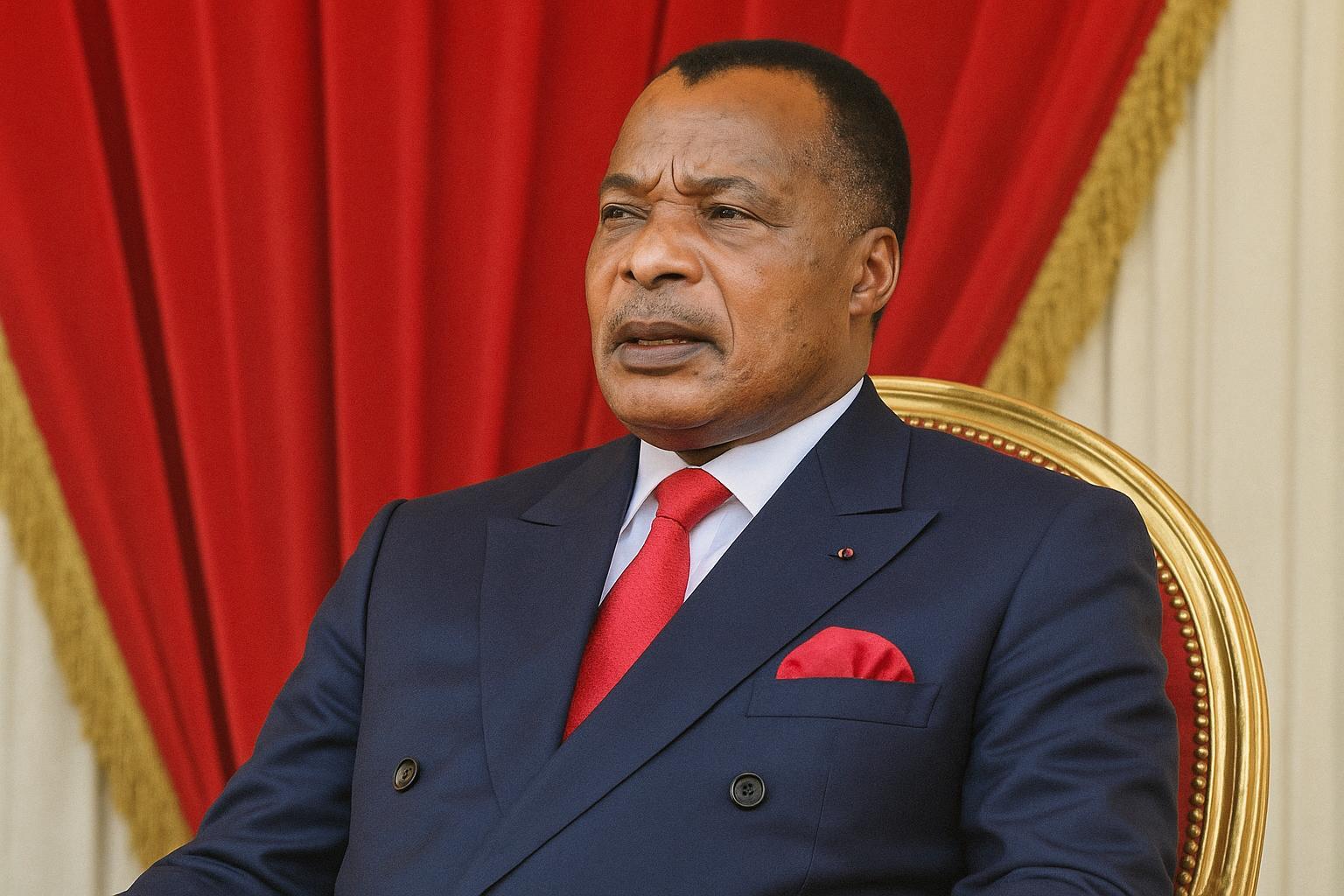
A Congress Stage Set for Continuity
Brazzaville’s Palais des Congrès, draped in the red of the Congolese Party of Labour, provided the setting for a carefully choreographed moment of political theatre. Delegates closing the sixth ordinary congress on the thirty-first rose in unison to acclaim President Denis Sassou Nguesso, answering the call issued at the opening session for him to stand once more in the presidential race scheduled for March 2026. The endorsement was subsequently formalised through an investiture motion, transforming collective acclaim into an official party mandate.
“We Still Need His Experience”
Explaining the decision, PCT Secretary-General Pierre Moussa reminded the audience that, in his words, “we have yet more need of his experience in this world full of uncertainties.” The formula, applauded at length, framed the nomination less as a matter of routine leadership renewal than as a strategic response to volatility beyond Congo’s borders. By characterising global affairs as unpredictable, the secretary-general placed the emphasis on seasoned stewardship at the helm of the state, a rhetorical device that simultaneously recognises external risk and presents domestic continuity as the safest bulwark against it.
Allied Formations Close Ranks
The PCT’s choice did not remain an internal affair. The Congolese Movement for Democracy and Integral Development, once led by the late Bernard Kolelas, and the Club 2002-Party for Unity and the Republic swiftly echoed the ruling party’s stance, each designating the same candidate for the coming ballot. Their convergent announcements signalled a tightening of coalition lines that have underpinned previous electoral cycles. For observers of Congo’s political choreography, such synchronised declarations illustrate a shared calculus: a unified ticket may prove more persuasive to an electorate accustomed to coalition platforms.
A Timetable Anchored to March 2026
With the presidential poll less than two years away, the party’s early nomination confers organisational advantages. Campaign structures can be re-activated without the distraction of a primary contest, while messaging is likely to revolve around the overarching theme of stability articulated by Pierre Moussa. In practical terms, the investiture closes the question of leadership inside the movement, allowing strategists to concentrate on voter outreach, logistical planning and the consolidation of alliances first formalised at congress.
Signals from Brazzaville to the Provinces
The congress itself served as a national sounding board. Delegates from urban centres and remote districts alike saw their presence recorded on the plenary scoreboard, a ritual underscoring the party’s claim to territorial representativeness. By projecting unity in the capital, organisers aimed to send a calibrated message to far-flung sections of the electorate: the governing coalition enters the pre-electoral phase without visible fissures. Whether that signal translates into sustained grassroots mobilisation will depend, as in previous cycles, on the effectiveness of local structures in carrying the congress’s resolutions home.
Experience as an Electoral Argument
Invoking experience is not merely a tribute to longevity. It functions as an electoral argument in its own right, positing that accumulated governance know-how constitutes a public good. Within this narrative, candidate and office converge: the individual history of Denis Sassou Nguesso is portrayed as inseparable from the institutional trajectory of the Republic of Congo. Supporters contend that, in uncertain times, voters may privilege the predictability associated with a known figure over the novelty of untested leadership.
Next Steps on the Road to the Polls
Although the congress vote resolves the question of candidacy within the PCT and its principal allies, statutory procedural milestones remain. The official opening of the electoral campaign will be determined by the national electoral calendar, and the constitutional bodies charged with registration and validation of candidatures have yet to issue their formal communiqués. Nonetheless, the early designation affords the ruling coalition ample lead time to refine policy platforms, secure endorsements and prepare the logistical apparatus required for a nationwide campaign.