

A decisive appeal from the ruling party
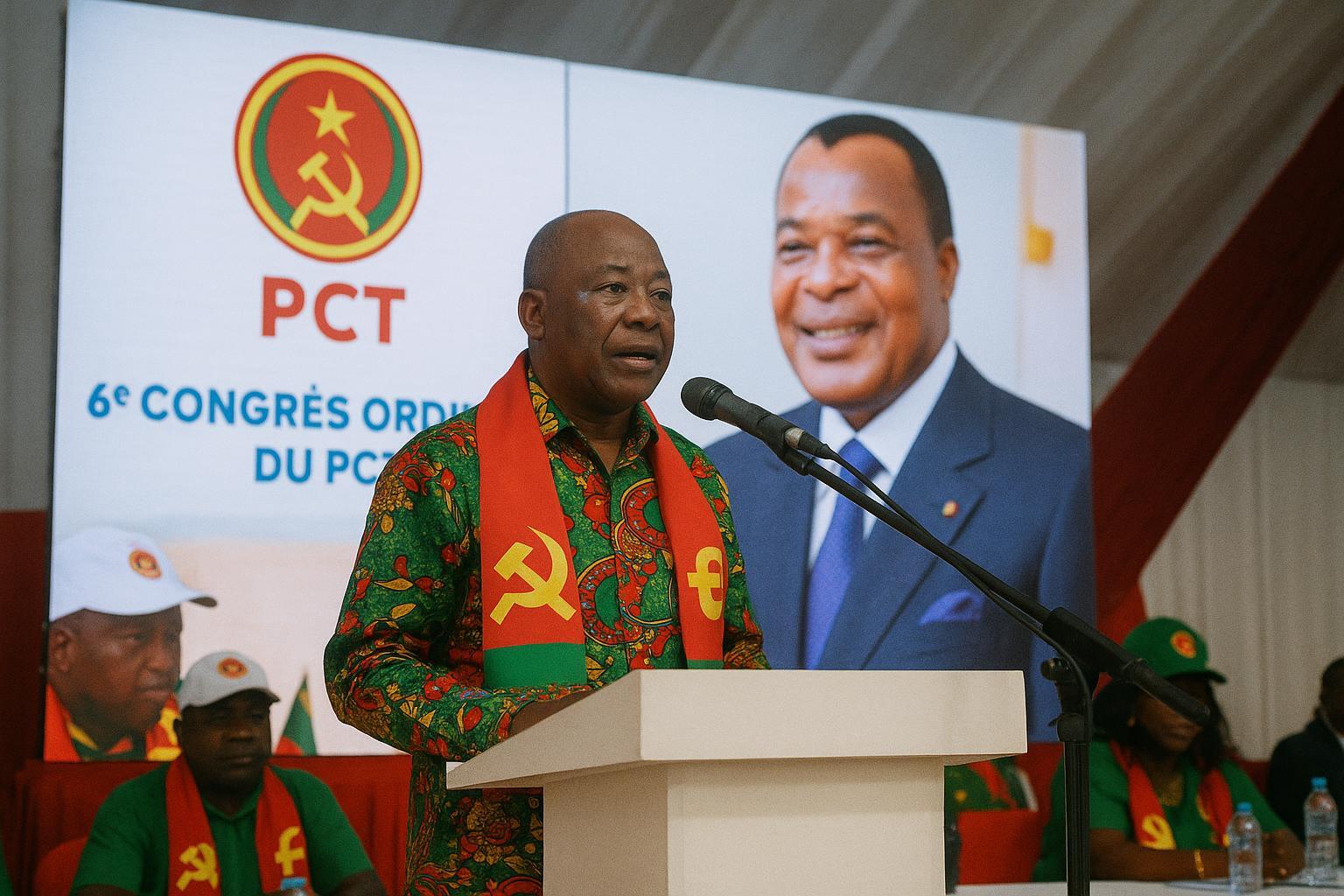
In a packed conference hall on the banks of the Congo River, the Congolese Labour Party used the opening session of its sixth ordinary congress on 27 December 2025 to deliver a direct and unambiguous message. Flanked by the party’s highest bodies and delegates from allied formations, Secretary-General Pierre Moussa proclaimed that only one candidacy could, in the eyes of the party, guarantee continuity and calm ahead of the presidential ballot scheduled for March 2026. “The candidacy of our champion of all times, Comrade President Denis Sassou-Nguesso, is the only one capable of ensuring stability for the country,” he declared to sustained applause.
Congress dynamics in Brazzaville
The congress, which gathers every five years to review the party line and fine-tune its electoral machinery, drew militants, sympathisers and representatives of foreign sister parties. Bright red banners bearing the hammer and hoe emblem framed the rostrum, while a meticulous protocol underscored the gravity of the deliberations. According to the programme adopted by acclamation, delegates will devote a full session to the question of nomination in order to “leave no ambiguity” about the ticket the PCT intends to defend. Such choreography is familiar to observers, yet the stakes remain high as the country edges toward the constitutional deadline for announcing candidates.
Constitutional framework and eligibility
Within the constitutional architecture currently in force, the incumbent Head of State is entitled to seek what would be a fifth mandate. Party speakers underscored that legal avenue, presenting it as an institutional safeguard rather than a mere procedural opening. By situating their request squarely inside the constitutional perimeter, PCT cadres aim to pre-empt legal or rhetorical challenges and to cast the potential candidacy as an exercise in lawful continuity rather than an extension of political privilege.
Stability rhetoric and leadership narrative
Pierre Moussa’s speech placed particular emphasis on the theme of stability. In his words, Denis Sassou-Nguesso “has national unity in his very genes” and remains “the guarantor of peace in the country”. The formulation evokes a narrative in which personal leadership and national cohesion are intertwined, especially “in this world full of uncertainties”. By elevating the stability argument, the party also draws a contrast—implicit yet potent—with what it portrays as the unpredictability of rivals. The underlying message is that electoral continuity is less a partisan aspiration than a patriotic imperative.
Mobilising the party base
The secretary-general did not limit himself to exhortations; he issued a call for what he termed “total mobilisation” as well as “serious discipline and unshakeable loyalty” in order to deny opponents any opening. In concrete terms, the instruction translates into an imminent cascade of activities: neighbourhood meetings, youth outreach, and voter-registration drives, all intended to reinforce the party’s numerical strength ahead of the campaign period legally set to begin once candidacies are formally recorded. The insistence on discipline signals an awareness that internal cohesion, no less than external messaging, will shape the party’s prospects.
Awaiting the President’s signal
As the congress proceeds, the spotlight turns toward the Palace. For the moment, Denis Sassou-Nguesso has not publicly indicated whether he will accept the nomination. In the choreography of Congolese politics, the party’s appeal serves as a formal invitation, granting the President both deference and room for reflection. Should he confirm his availability, the electoral calendar foresees a short but intense stretch leading to the March 2026 vote. Until then, the PCT’s unanimous call constitutes the clearest indication yet of the ruling coalition’s strategic direction—and of the central figure around whom it continues to rally.