

Brazzaville at the centre of party politics
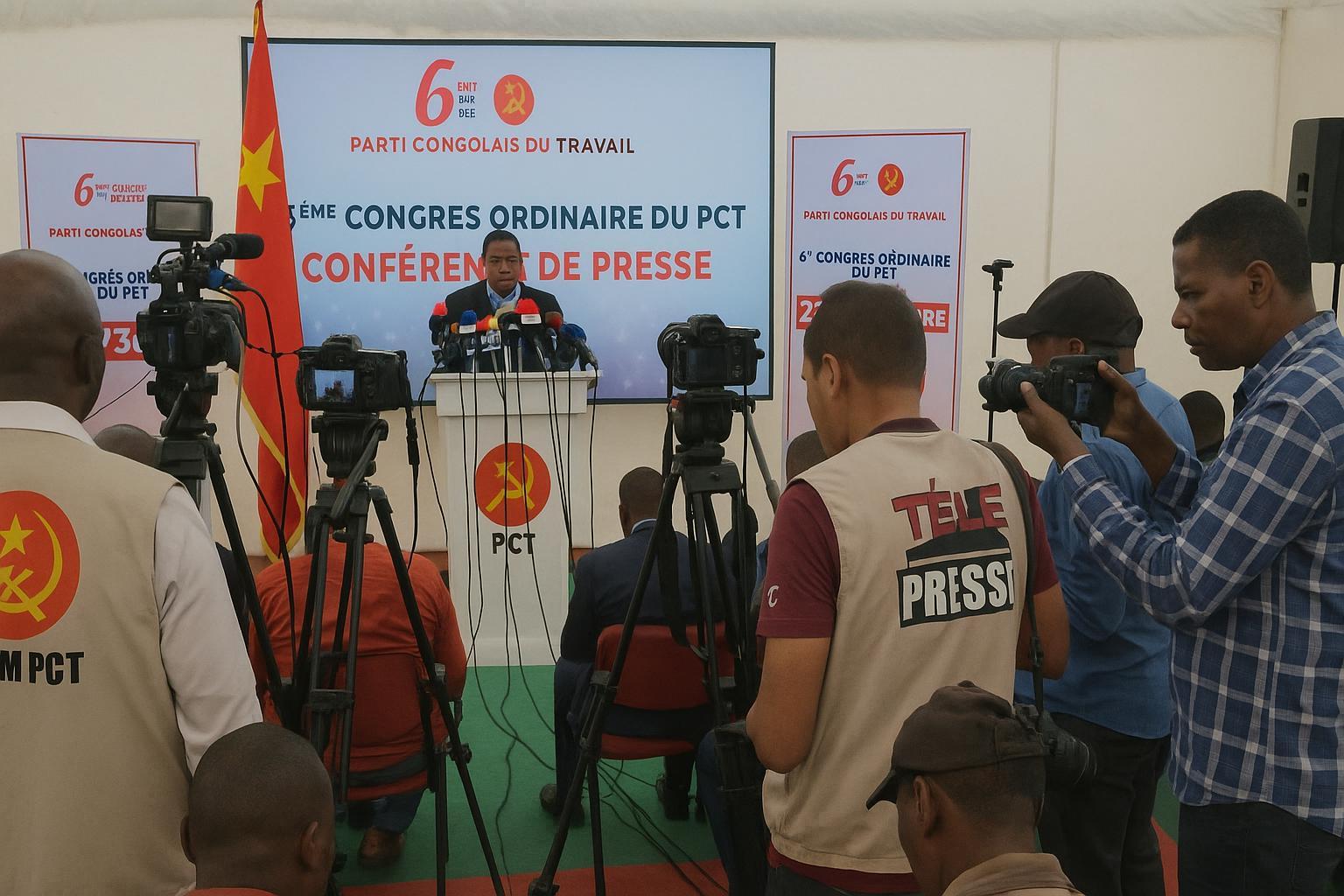
The gardens of Ben’tsi, a lush enclave in Brazzaville’s Mpila district, are poised to host the sixth ordinary congress of the Congolese Labour Party (Parti congolais du travail, PCT) from 27 to 30 December 2025. Party spokesperson and congress rapporteur Parfait Romuald Iloki told reporters at a pre-event briefing on 24 December that more than three thousand accredited participants – including delegates, statutory members and invited personalities – had already begun arriving in the capital. In his words, “We are ready.” (party press briefing, 24 December).
Held under the motto “Cadres, militants and sympathisers of the PCT, in unity, cohesion and discipline, forward to consolidate peace, national unity and democracy, towards faster development,” the gathering preserves the five-year periodicity enshrined in party statutes while allowing the organisation to showcase its organisational capacity at a deliberately ceremonial venue steeped in national symbolism.
A statutory rendezvous with history
Beyond the ritual of banners and slogans, the congress answers a constitutional obligation internal to the party: every five years the PCT must review its performance and adjust its strategic compass. The 2025 meeting comes at a moment of pronounced self-confidence. Mr Iloki reported that the organisation now claims one million registered members, a symbolic threshold that situates the PCT among Africa’s most sizeable political movements. The 3 000 delegates therefore represent roughly 0.3 percent of the active card-holding base, a proportion that, according to the spokesperson, ensures both manageability and representativeness.
The delegate roll is carefully calibrated. There are 1 340 elected representatives from the fifteen departments and from the France-Europe federation, 1 158 statutory members drawn from the Central Committee, the Oversight and Evaluation Commission and the Committee of Honorary Members, and 502 guests. More than thirty foreign delegations are also expected, underscoring the congress’s diplomatic dimension and the PCT’s ambition to project itself as a credible interlocutor well beyond Congo’s borders.
Logistics of a continental gathering
Organisers stress that transport, accommodation and security arrangements have been finalised in coordination with municipal and national authorities. Most provincial delegates travelled by rail or commercial coach in staggered convoys to ease congestion on National Road 1. The party’s communications unit has mobilised a multilingual press centre for local journalists and foreign correspondents, while an online streaming platform will carry plenary sessions in real time. This hybrid format, introduced during the 2021 pandemic-era extraordinary conference, continues to broaden access for militants unable to travel to Brazzaville.
The choice of Mpila, already modernised through recent urban-renewal projects, allows the congress to present a tangible illustration of infrastructural progress. Local hoteliers report occupancy rates approaching full capacity, providing an incidental boost to the capital’s service economy.
Renewal of mandates and ideological alignments
A measure of suspense surrounds the internal elections that traditionally close the final day’s proceedings. Delegates will vote in secret for a revamped Central Committee and, by extension, for the Political Bureau that steers daily strategy. Under rules adopted in 2015, names of successful candidates are not disclosed until the closing ceremony, generating disciplined anticipation while discouraging factional bargaining. Analysts note that several senior figures have reached the age ceiling introduced in 2020, a reality that may accelerate generational renewal without abrupt rupture.
Ideologically, the PCT remains anchored in social democracy. Its 2023 admission into the Socialist International—56 years after the party’s founding—supplied an external endorsement of that positioning. Mr Iloki argued that membership “opens new avenues of doctrinal exchange and policy benchmarking,” a view echoed in francophone think-tank reviews (Crisis Group commentary, January 2024).
Eyes on the 2026 ballot
Above all, the congress is expected to designate, by acclamation or competitive ballot, the PCT’s candidate for the March 2026 presidential election. The spokesperson did not reveal names, stating only that the party would present “a bearer of continuity and innovation.” Observers widely anticipate the endorsement of the incumbent, although alternative scenarios have not been ruled out at this stage. Whatever the outcome, the nomination aims to provide clarity well in advance of the official campaign calendar set by the Independent National Electoral Commission.
In electoral terms the PCT approaches the contest from a position of strength. It secured 112 of 151 seats in the National Assembly in 2022, 59 of 72 seats in the Senate in 2023 and 652 of 1 154 municipal councillorships nationwide. These results translate into a nationwide network that can mobilise voters and monitor polling stations with granular precision. “Our organisational backbone has been stress-tested and proven,” Mr Iloki remarked, listing voter-education caravans and legal-compliance seminars held since May 2024.
International resonance and party diplomacy
More than thirty foreign delegations will attend, including sister parties from the CEMAC region, European social-democratic formations and representatives of emerging Asian partners. Their presence offers the PCT a platform to deepen economic and cultural ties, aligning with Brazzaville’s ‘diplomacy of complementarities’ articulated in recent white papers. Workshops on infrastructure financing, digital inclusion and climate-responsive agriculture will run alongside political sessions, reflecting the party’s intent to anchor ideological debate in practical policy exchange.
Diplomats contacted in the run-up to the meeting interpret the congress as a signal of stability. One Central African envoy noted that “regular statutory meetings reinforce predictability for investors,” a sentiment echoed by regional chambers of commerce monitoring Congo’s planned diversification of its hydrocarbon-based economy.
Measured optimism within Congolese polity
Public discourse in Brazzaville resonates with cautious optimism. Civil-society researchers point to the party’s public-information kiosks, where draft resolutions are displayed for comment, as evidence of growing participatory reflexes. Critics, while calling for broader pluralism, nevertheless acknowledge the congress’s potential to clarify governance priorities at a time when external shocks—from commodity-price volatility to climactic disruptions—demand coherent national responses.
Should the congress fulfil its triple mandate—statutory evaluation, leadership renewal and presidential nomination—it will reaffirm the PCT’s centrality in the Republic of Congo’s institutional architecture. Equally, by foregrounding themes of cohesion, peace and accelerated development, the conclave aspires to situate political competition within a narrative of shared national purpose. As delegates file into the Ben’tsi gardens, Congo’s political calendar enters a high-tempo phase whose resonance will extend well beyond the party faithful.