

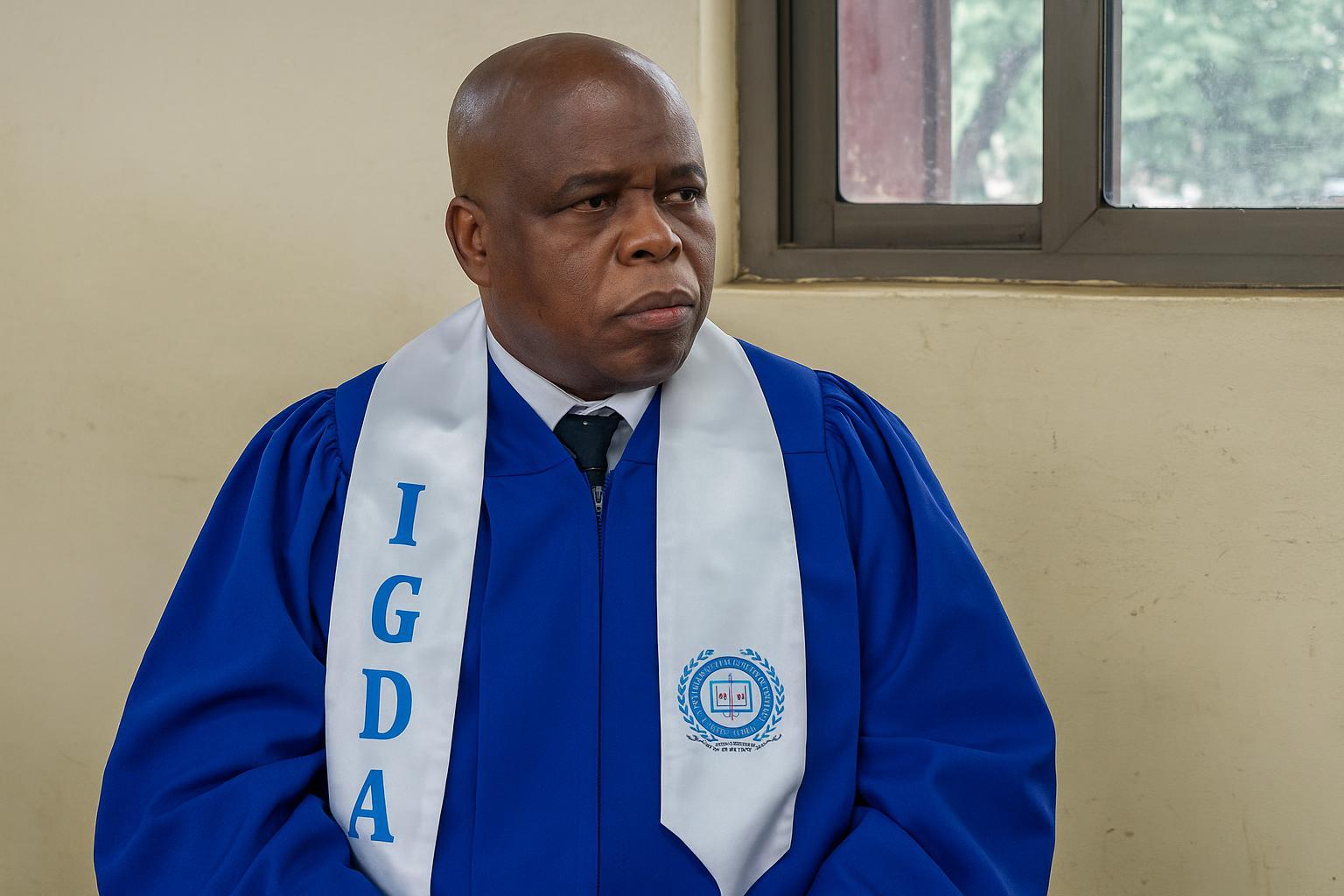
A Stellar Academic Achievement
On 20 December in Brazzaville, the amphitheatre of the Institut de Gestion de Développement et d’Entreprise fell silent as Emerson Massa Ekeabéka defended his master’s dissertation in Human Resources and Coaching, a programme delivered by the Université Supérieure du Commerce du Sénégal. The young Congolese scholar, who is visually impaired, obtained the remarkable mark of 18 out of 20 with the distinction “excellent”, winning unanimous praise from the examining board chaired by Dr Cyrille Ngouloubi and Dr Arsène Akouelé.
Ekeabéka’s oral presentation lasted a disciplined fifteen minutes, yet it was long enough to reveal a command of public-sector governance issues and, above all, a personal resilience that transfixed the audience. His fingers glided across braille pages with near-musical cadence, underscoring that disability need not curtail intellectual ambition.
Dissecting Civil-Service Access for Persons with Disabilities
The dissertation, entitled “Modalities of the Recruitment Process for Persons Living with Disability within the Congolese Civil Service”, addresses a policy question often relegated to the margins of administrative reform debates. Supervised by Associate Professor Wolf Martial Barthélemy Bangogoye, the candidate employed a descriptive research design centred on thirty public servants who themselves live with disabilities. Through interviews and document analysis, he charted the pathway each respondent navigated from the publication of a vacancy to appointment, mapping procedural bottlenecks and human factors with the precision of a seasoned auditor.
This qualitative sample, though modest, was selected to reflect various impairments and ministerial departments, giving the findings a resonance beyond a single institution. By foregrounding lived experience, Ekeabéka joins an emerging scholarly movement that treats disability not as a marginal topic but as a vector for redefining merit-based recruitment.
Identified Obstacles to Inclusive Recruitment
The study records a cluster of recurrent challenges. Foremost is an information deficit: several respondents learnt of competitive examinations only after deadlines had lapsed, suggesting that official notices do not always reach specialised schools or advocacy groups. Physical accessibility also poses difficulties, particularly when dossier submission points or examination halls lack ramps, tactile signage or adapted lighting.
Interviewees further cited implicit bias, noting that some recruiters remain unfamiliar with reasonable accommodation measures and therefore hesitate to shortlist candidates with disabilities. Lastly, the researcher observes that the absence of a codified national strategy allows these difficulties to persist unevenly across ministries, creating a lottery effect in which success depends more on individual goodwill than on systemic guarantees.
Policy Proposals Grounded in Pragmatism
Rather than limiting his work to diagnosis, Ekeabéka advances solutions calibrated to the realities of the Congolese civil service. He advocates sustained information campaigns through mainstream and community media, secondary schools and vocational centres, so that potential candidates grasp timelines and eligibility criteria well in advance. He also recommends the routine availability of examination papers in braille and the presence of sign-language interpreters during oral assessments, along with minor infrastructural adjustments—ramps, widened doorways, high-contrast signage—that would benefit a broad range of users without imposing prohibitive costs.
Crucially, the dissertation frames these investments not merely as social interventions but as contributions to administrative efficiency, arguing that a more diverse workforce enriches problem-solving capacity and public legitimacy.
Towards a Dedicated Institutional Anchor
In the closing pages of his thesis, the graduate voices a wish shared by many interviewees: the establishment of a ministerial portfolio specifically devoted to persons living with disabilities. Such an entity, he reasons, could consolidate scattered initiatives, act as a clearing house for accessibility guidelines and serve as a focal point for dialogue between government and civil society. The proposal stops short of prescribing a bureaucratic blueprint, mindful that constitutional arrangements and fiscal realities must guide any future reform.
Speaking to journalists after his defence, Ekeabéka struck a tone of constructive realism. “Our authorities have shown openness to evidence-based policy,” he said, “and the data we have gathered offer them an additional compass. Inclusion is less a slogan than a process that calls upon each of us.” The applause that followed suggested that, at least within the walls of the university, his message had found willing listeners.
An Agenda Aligned with National Ambition
The Republic of Congo’s drive to modernise its public administration aspires to place competence and fairness at the heart of human-resource management. By illuminating the specific hurdles faced by citizens with disabilities and articulating workable remedies, Emerson Massa Ekeabéka’s dissertation aligns squarely with that agenda. The work neither admonishes nor exonerates existing structures; instead, it supplies the analytical rigour on which sound policy can flourish.
The immediate accolade—an excellent master’s degree—belongs to the young scholar. Yet the broader legacy may accrue to Congo’s civil service, should his findings inspire the incremental adjustments that transform lives silently and durably.