

A strategic shift from fallow to fertile ground
On the red lateritic soils of the Lekoumou plateau, a discreet transformation is under way. Guided by the directives of President Denis Sassou Nguesso and orchestrated by Minister of Agriculture Paul Valentin Ngobo, three protected agricultural zones—Mayéyé 2, Moulimba 2 and Kolo—are being repositioned as engines of national revival. Where seasonal plots once alternated between short-cycle subsistence crops and lengthy fallow, secure land tenure and targeted public investment now anchor what officials describe as a forward-looking pact between the State and family farming.
Presidential vision anchored in protected zones
Launching the latest coffee campaign, Minister Ngobo recalled the political genesis of the programme. “We are delivering on a promise of the Head of State to restore Lekoumou’s coffee heritage,” he told growers assembled near Sibiti. The commitment rests on two arguments repeatedly underlined by the minister: first, the readiness of local planters to generate dividends for the country; second, the consensual roadmap adopted after a technical workshop in Sibiti, during which producers endorsed large-scale cultivation. By formally designating the three sites as Zones Agricoles Protégées, the government offers producers long-term access, delineated boundaries and the prospect of pooled infrastructure.
Coffee cluster of Kolo: 325 farmers, one ambition
The Kolo enclave, situated a short drive from the departmental capital, concentrates 325 registered producers on an initial surface of 131 hectares devoted exclusively to coffee. The private operator Eveco, retained as technical partner, provides clonal coffee seedlings, durable perimeter fencing and hands-on training modules that range from pruning to post-harvest handling. A satellite nursery destined for the forthcoming ZAP of Kenge is already under preparation, signalling the scalability of the model.
Local authorities have matched the enthusiasm with land. The sous-préfet has placed 1 000 additional hectares at the project’s disposal, opening the door to an eventual agro-industrial corridor. Farmers speak with measured confidence: “Many development policies passed through without rooting,” one planter noted, “but now we feel a genuine fit between rural realities and national policy.”
Maize and cassava belts of Mayéyé and Moulimba
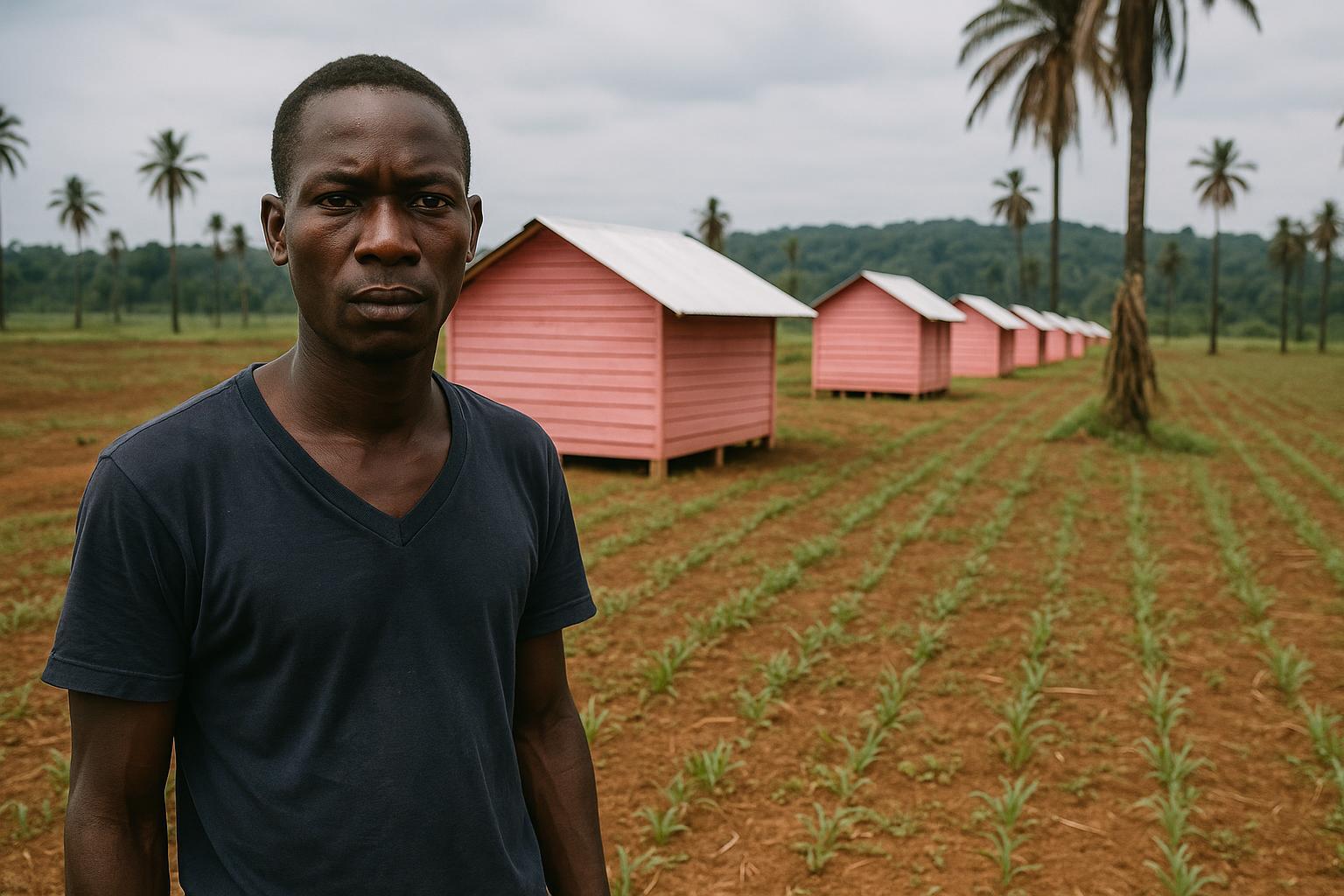
If coffee captures headlines, staple crops still underpin household resilience. In Mayéyé 2, 249 growers cultivate maize and cassava on a basin that has already become the district’s second protected zone after Boudou. Young maize plants stand over 1.20 metres, a visible symbol of renewed soil fertility. Further south in Moulimba II, 358 farmers amplify the same dual focus. Their motivation is pragmatic: within two to four months, projected revenues of one to two million CFA francs per grower could insulate families from market volatility while reducing the nation’s import bill for basic foods.
“We thank the government for thinking of us,” a Moulimba farmer declared, inviting the minister to return at harvest time. Predictable volumes, he argued, will persuade peers to expand acreage, rendering local supply both regular and measurable.
Training, inputs and predictable yields
Beyond land availability, three levers appear decisive. First, access to certified planting material mitigates the genetic fatigue that once undermined yields. Second, Eveco’s provision of durable fencing shields young orchards from roaming livestock, a chronic hazard in the plateau’s mosaic landscape. Third, continuous extension support aligns field practices with market standards, from spacing densities to moisture thresholds at drying.
Minister Ngobo stressed that the approach converts past fragmentation into an organised cluster system. By grouping smallholders around shared nurseries and storage sites, the scheme lowers entry barriers and compresses logistics costs. In the words of a local cooperative leader, “We plant knowing the buyer, the price range and the collection calendar—transparency we rarely had before.”
Toward export revenues and food sovereignty
While maize and cassava primarily target the domestic market, Kolo’s 325 hectares herald a foreign-exchange prospect. Congolese coffee long enjoyed niche recognition abroad; a revived supply chain could again earn convertible currencies and diversify the country’s revenue beyond hydrocarbons. The Ministry projects that export-grade parchment coffee from Kolo may reach commercial volumes within three years, a horizon considered short in perennial agriculture.
Crucially, the initiative preserves a careful balance between export ambition and food security. By coupling coffee orchards with robust staple belts, the Lekoumou model seeks to transform rural livelihoods without compromising caloric self-sufficiency. That dual track echoes the broader governmental objective of sovereignty—securing domestic plates while positioning Congolese products on external shelves.
For now, the evidence is empirical: freshly stumped coffee seedlings, waist-high maize and communities galvanised by tangible prospects. In the shaded nurseries of Mayéyé, Moulimba and Kolo, the intersection of policy, private expertise and farmer commitment is nurturing more than crops; it is cultivating confidence in the rural future of Congo-Brazzaville.