

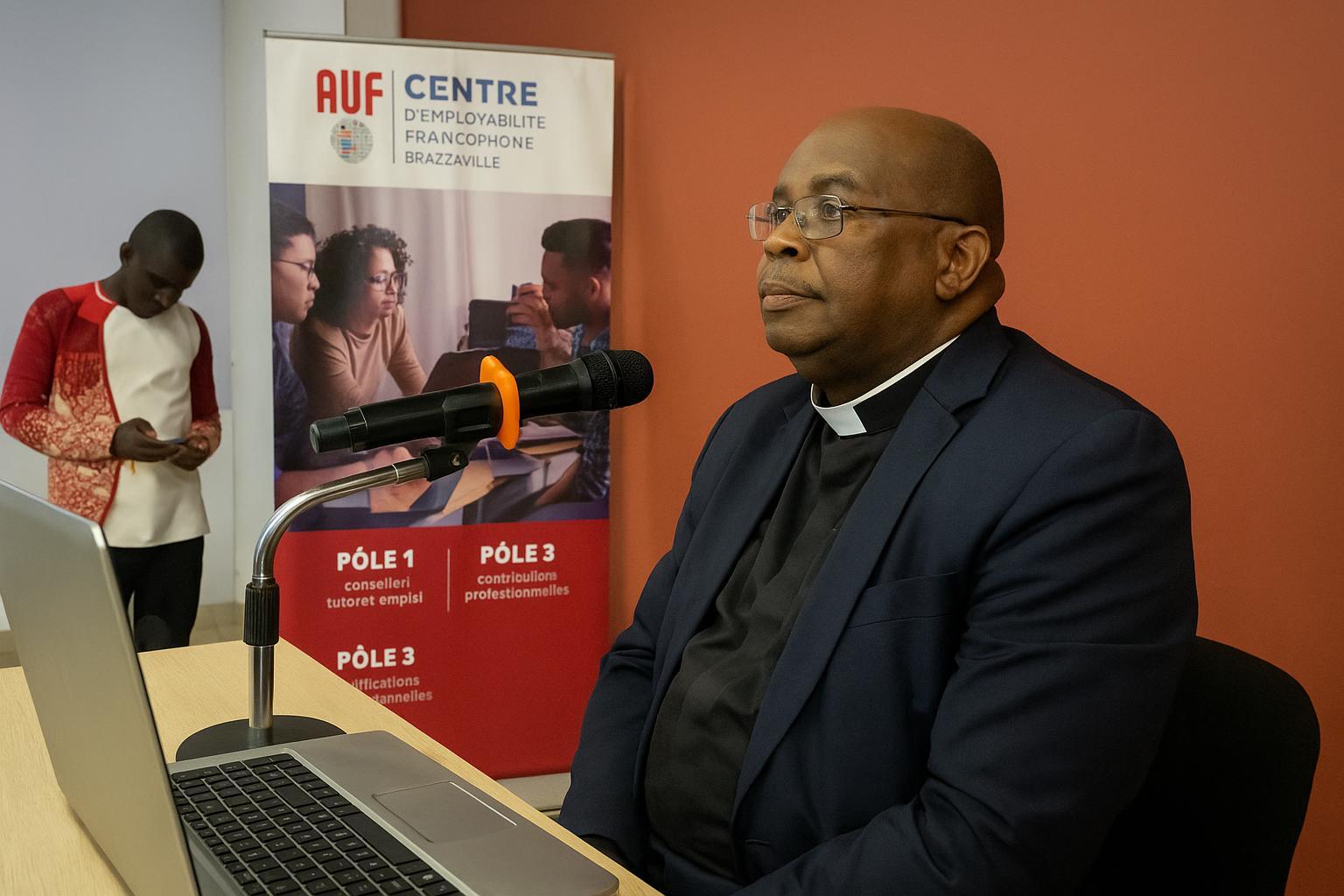
A doctoral defense that resonated beyond the lecture hall
On a sun-bathed Saturday in Brazzaville, 13 December 2025, the Aula Magna of Université Marien Ngouabi turned into a forum of high intellectual voltage. Before an international panel chaired by Professor Charles Zacharie Bowao, the Reverend Father Benjamin Samanou of the Archdiocese of Pointe-Noire unveiled a 450-page dissertation that probes the very grammar of education. By unanimously conferring the coveted doctorate in philosophy of education with the highest distinction, the jury signalled that the debate on rationality in schooling has found a vigorous new Congolese voice.
Habermas’s communicative reason under Congolese scrutiny
Entitled “Jürgen Habermas and the Contemporary Epistemological Controversy on Rationality and Education”, the study pursues a twofold ambition: to dissect the architectonics of Habermas’s communicative action and to test its pertinence for twenty-first-century classrooms. Samanou diagnoses what many scholars term the ‘instrumental drift’ of modern school systems, captivated by rankings, standardised testing and employability indices. Echoing UNESCO’s 2021 Global Education Monitoring Report while advancing his own hermeneutic lens, he asserts that such metrics often eclipse the broader humanistic mission of nurturing critical, autonomous citizens.
From instrumental logic to the ethics of dialogue
At the heart of the thesis lies a sustained argument that education must pivot from a technoscientific logic toward a conversational ethic. Habermas’s paradigm, centred on reason achieved through dialogue and mutual justification, is mobilised as a normative compass. Yet Samanou does not genuflect before the German philosopher; he submits the model to an ‘internal criticism’, pointing out that the categorical child remains somewhat invisible in Habermas’s discourse. By foregrounding the learner as a co-author of meaning, the Congolese scholar extends communicative rationality into the realm of childhood agency, thereby engaging with recent work by child-rights theorists at the University of Cape Town.
The palaver tree as a living laboratory of reason
One of the manuscript’s most original gestures is its dialogue with African traditions of deliberation. The palaver tree—symbolic site of consensual decision-making from the savannas of the Pool region to the forest fringes of the Niari—emerges as an indigenous template of communicative action. Samanou contends that these ritual conversations, governed by turn-taking and public accountability, prefigure Habermas’s ideal speech situation. By weaving this cultural fabric into his theoretical tapestry, he situates Congo at the crossroads of global philosophical debate, illustrating that epistemic innovation can flow south-north as well as north-south.
Implications for Congo’s education reforms
The timing of the thesis is notable. Brazzaville’s current Education Sector Plan 2022-2030 calls for curricula that reinforce civic culture and social cohesion. Ministry officials present during the defense discreetly welcomed the research as a conceptual resource for teacher training modules under development. Dr Laurent Gankama, co-supervisor and adviser to the ministerial task-force on pedagogical renewal, remarked in the margins that “Father Samanou gives us a vocabulary to link competency-based syllabi with democratic citizenship.” Such alignment could reinforce ongoing government endeavours to bolster human capital while cultivating an ethic of participation consonant with national development goals.
An ecclesial scholar in service of the republic
Beyond academia, the priest-philosopher’s accomplishment carries pastoral significance. Mgr Abel Liluala, Archbishop of Pointe-Noire, stressed the Church’s historical commitment to schooling in Congo and praised the thesis for grounding that mission in dialogical ethics rather than didactic paternalism. Observers note that this intellectual investment dovetails with broader societal conversations on peaceful coexistence and youth empowerment, themes championed by civil-society platforms and regional bodies such as ECCAS.
Toward a renewed humanism in Central African classrooms
By fusing Habermasian theory with the wisdom of the palaver tree, Benjamin Samanou sketches a roadmap for classrooms that function as micro-public spheres. In that vision, the blackboard becomes less a one-way conduit of knowledge than a commons where arguments are weighed and shared meaning painstakingly forged. The doctoral laurel, therefore, signifies more than personal triumph; it gestures toward the possibility of an educational renaissance in which Congolese learners become articulate protagonists of their collective destiny.