

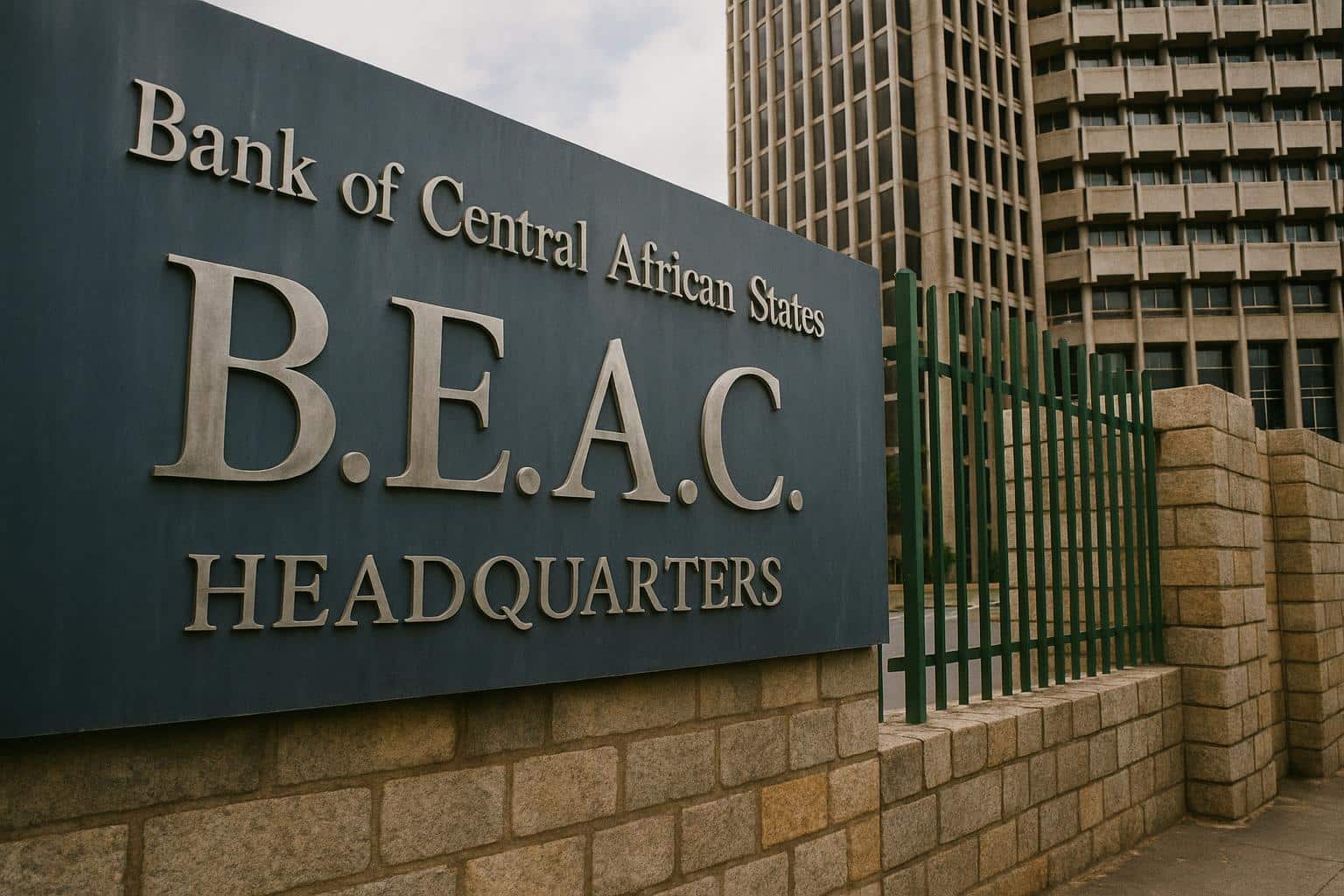
External Reserves Slide Raises Regional Vigilance
The Banque des États de l’Afrique centrale (BEAC) has sounded an unmistakable note of caution after recording a new deterioration in CEMAC’s external buffers. As of 31 October 2025, the stock of foreign-exchange reserves held on behalf of Cameroon, Gabon, Equatorial Guinea, Chad, the Central African Republic and Congo-Brazzaville reached 6.203 trillion CFA francs, down 146 billion year-on-year and 1.133 trillion relative to end-December 2024. Net external assets tracked on a daily basis, which incorporate gold holdings and Special Drawing Rights, shrank by 7.1 percent year-on-year by 25 November 2025, extending a steady decline since the March 2025 peak, according to internal BEAC dashboards.
Trade Imbalances and Oil Dynamics Core Drivers
At the heart of the contraction lies a string of negative net transfers amounting to roughly 1.3 trillion CFA francs. The region’s chronic merchandise-trade deficits, a softening in international crude prices and the accelerated settlement of external liabilities jointly weighed on the region’s capacity to accumulate foreign currency. The central bank further attributes the decline to substantial imports of refined petroleum: Cameroon has stepped up shipments to meet domestic demand, while Gabon’s prolonged refinery outage has forced it to turn massively to the international market for finished products. The combined import bill siphoned precious hard currency from the communal reserve pool.
Country Cases Highlight Sector-Specific Stresses
Although the shock is regional, its fingerprints differ by member state. In Gabon, the shutdown of the national refinery has lengthened, making refined-product imports an unavoidable stopgap. Cameroon, for its part, continues to serve as the sub-region’s major logistical hub, thereby absorbing an outsized share of fuel-import costs. Across the zone, dividend remittances by corporates and larger outbound electronic payments have intensified the drawdown in reserves. Congo-Brazzaville’s external accounts mirror this pattern, yet Brazzaville has maintained relative stability by pacing its external obligations and by preserving fiscal prudence, a stance discreetly acknowledged by BEAC officials in recent technical briefings.
Fiscal Pressures and Debt Service Weigh on Buffers
Budgetary dynamics compound the external challenge. Several governments increased recourse to foreign currency to honour debt-service obligations and to plug financing gaps, particularly where revenue profiles remain tied to hydrocarbon receipts. While the annual change in net external assets remains marginally positive at two percent, BEAC warns that the prevailing downward trajectory is unmistakable and signals a gradual erosion of the region’s external position. The central bank nonetheless underscores that statutory convergence criteria are not currently breached, an observation intended to reassure investors and development partners.
Medium-Term Forecasts Signal Gradual Recovery
Looking ahead, BEAC’s baseline scenario foresees a rebound to 6.566 trillion CFA francs in 2026, enough to cover 4.15 months of imports of goods and services. The stock is projected to climb to 6.983 trillion in 2027 and to top the symbolic 7 trillion mark—approximately 12.5 billion US dollars—by 2028, thereby stabilising import cover close to 4.2 months. Monetary authorities stress that the forecast hinges on continued fiscal consolidation, a disciplined approach to foreign-currency outflows and a cautious optimism about oil-price trajectories. In the words of one senior BEAC economist, “the current tension on reserves is serious but not irreversible; prudent macro-management and timely structural reforms can restore adequate buffers.”
Market observers note that forthcoming reforms to tighten dividend-payment scheduling, improve oil-sector reliability and deepen intraregional trade could reinforce the projected upturn. For Congo-Brazzaville, whose hydrocarbon sector retains considerable potential, a firming of crude prices would offer welcome relief and strengthen public-finance resilience. Maintaining the present commitment to external-debt servicing, while expanding non-oil revenue mobilisation, is expected to keep Brazzaville’s contribution to the pooled reserves on a constructive path.