

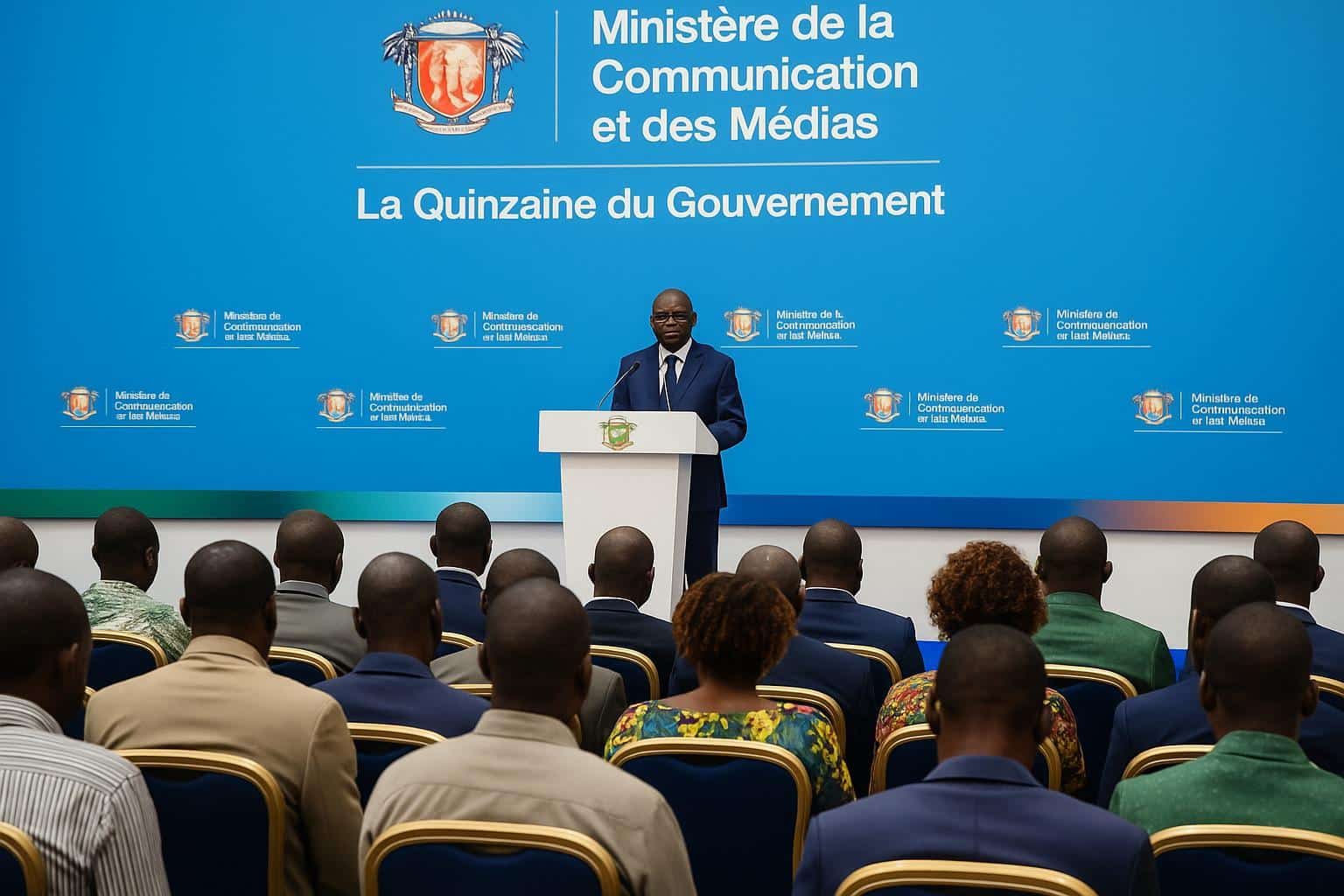
A fortnight of accountability before the press
The closing edition of the Government Fortnight for 2025 gathered an audience uncharacteristically large even for this now-institutionalised exercise in public communication. At the Hilton Twin Towers in Brazzaville, Prime Minister Anatole Collinet Makosso, flanked by several cabinet members and senior advisers, took the lectern on 20 December and devoted more than two hours to questions from local and foreign journalists. The session, opened by Minister of Communication Thierry Lézin Moungalla with a minute of silence for two recently deceased journalists, unfolded in a climate of solemnity that underscored the administration’s stated commitment to transparency.
The book as political instrument and civic ledger
At the heart of the dialogue stood a compact, 153-page volume produced by Focus Médias and printed in Turin: “En toute transparence : 2021-2026, le bilan du quinquennat”. Prefaced by President Denis Sassou-Nguesso, the book consolidates fifteen thematic fact-sheets and accompanying graphics designed, in the words of its preface, to let the Head of State “render account to the Congolese people” of the mandate entrusted to him. Makosso insisted that the publication is neither campaign brochure nor triumphalist narrative, but rather a civic ledger exposing achievements and unfinished business alike. “Readers will find the figures, the methodology and, where relevant, the limits we have encountered,” he stressed, repeatedly urging journalists to consult the document rather than rely on sound-bites.
Energy metrics anchor development narrative
Energy security provided the most quantifiable illustration of progress. Drawing on the national energy pact launched in 2021, the government reports that installed capacity rose from 600 MW to 980 MW in four years, while the proportion of households with access to electricity climbed from 49 percent to 59 percent. Urban penetration now stands at 75 percent, rural at 25 percent—figures Makosso acknowledged remain “an incentive rather than a destination” given the target of 1 500 MW and universal access by 2030. Independent analysts present in the room pointed to improved distribution in Pointe-Noire and Dolisie, but still-frequent load-shedding in remote districts. The Prime Minister countered that new transmission lines under the Sino-Congolese cooperation framework are scheduled to come on stream in 2027, easing current bottlenecks.
Social policy: modest relief, structural hurdles
Turning to social indicators, Makosso conceded that the population’s perceptions are shaped less by macro-ratios than by the punctual arrival of salaries and pensions. He confirmed that the second tranche of arrears owed to university lecturers had been authorised for payment and that a special fund has stabilised pension disbursements for 34 000 retirees since October. The book claims a reduction in youth unemployment to 19 percent and a global unemployment rate hovering around 40 percent, a figure the Premier described as “unacceptably high, yet discernibly lower than in 2020”. He further cited an 18-percent rise in allocations to the Santé Famille programme, arguing that poverty mitigation has cushioned the inflationary pressures generated by successive external shocks.
Infrastructure corridors and the logistics dividend
Infrastructure received attention not merely as a public-works showcase but as a lever for regional competitiveness. According to the quinquennial balance sheet, thirty kilometres of the strategic corridor connecting Brazzaville to Pointe-Noire are currently under reconstruction, with Italian and Moroccan contractors working under public-private partnership arrangements. Complementary upgrades on the CFCO rail line are, in Makosso’s analysis, “critical for inter-modal fluidity” and for positioning the country as a transit hub between the Atlantic seaboard and the CEMAC hinterland. While no definitive traffic projections were released, the Prime Minister argued that reduced haulage times will boost non-oil exports, an objective echoed in the National Development Plan 2022-2026.
Governance discourse ahead of the 2026 vote
Beyond sectoral data, the Fortnight inevitably acquired a political resonance. With the presidential election slated for March 2026, the cabinet is keen to frame the past five years as a continuum leading towards what the head of state calls a “Pact for the Future of Congo”. In this perspective, the newly released book is presented as both a closure and a prologue: it certifies prior commitments while outlining the scaffolding for the next development phase anchored in digital transformation, green growth and human-capital investment. Makosso refrained from commenting on potential constitutional amendments, stating only that “the institutional calendar will unfold in strict conformity with the law”.
A calibrated message of resilience and continuity
The exchange ended with the Premier invoking, almost verbatim, the final lines of the volume: “In a fractured world, beset by unstable winds, the Congo needs steady hands on the helm”. The remark signalled continuity rather than rupture, resilience rather than radical overhaul. For sceptical observers, the self-assessment may appear selective; for supporters, it supplies empirical vindication of a governance model that privileges incremental gains over disruptive spectacle. What was indisputable in the Hilton conference hall, however, was the administration’s resolve to anchor the forthcoming electoral debate in tangible metrics rather than polarised rhetoric. In that sense, the Fortnight did more than present a book; it rehearsed a narrative that is likely to shape Congolese public discourse in the months ahead.