

A delicate year-end as salary arrears stir discontent
Only a few days before the traditional Christmas break, tension rippled through Congo-Brazzaville’s classrooms. Community teachers, already pillars of the public system, warned that they could down tools unless several months of unpaid study grants were released. The ultimatum, arriving amid seasonal examinations, threatened to interrupt the learning trajectory of hundreds of thousands of pupils and to strain families preparing for the festivities.
The Ombudsman’s office launches a preventive mission
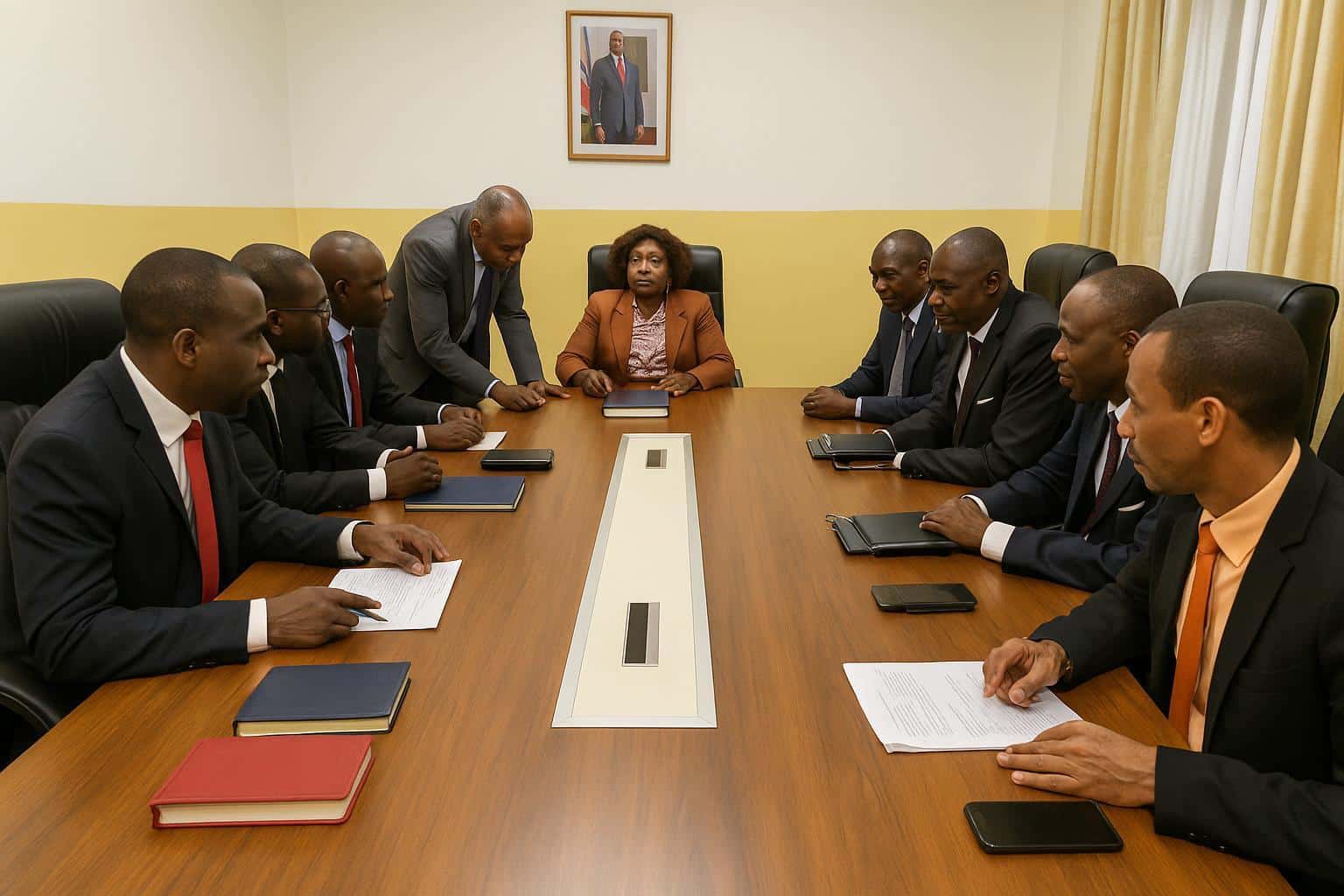
Sensing the urgency, the Mediator of the Republic, Valère Gabriel Eteka-Yemet, dispatched on 17 December a high-level team led by his legal adviser, Eugène Mbanzoulou, to the ministries responsible for general and technical education. The mandate was explicit: collect first-hand information, listen to grievances and chart a consensual path forward. “Good progress has been made and prospects will be laid out,” Mbanzoulou declared at the end of the initial hearings, inviting teachers “to bear with patience” while institutional solutions are crafted.
Unpaid stipends and index points headline the claims
Beyond the immediate demand for overdue stipends, unions are calling for the national index point to be lifted to 450 for all staff, a recruitment quota of four thousand new civil-service positions and the settlement of arrear salary adjustments. For teachers who often supplement modest earnings with community support, the combination of financial and career uncertainties feeds a perception of professional limbo.
Government embraces dialogue as constitutional reflex
The delegation assured educators that the matter had already been escalated to ministerial and cabinet levels. “The President of the Republic, a proponent of dialogue, generally invites all parties to engage constructively,” Mbanzoulou emphasised, recalling the Ombudsman’s successful suspension of an earlier strike notice in October. At the Ministry of Pre-school, Primary, Secondary Education and Literacy, Chief-of-Staff Régine Tchikaya-Oboa reiterated that open channels remain “not merely procedural, but a cultural constant” of public governance.
Technical education: reviving dormant commissions and schools
The conversation took a specialised turn at the Ministry of Technical and Vocational Education, where teachers lamented the delayed convening of joint administrative commissions—key fora for promotions—and the apparent closure of the iconic Collège d’Enseignement Technique Féminin 8-Mars. Cabinet Director Mamadou Kanté acknowledged the backlog of 800 personnel files and urged rapid submission to avert statutory lapses, while Inspector David Anga clarified that the college is being upgraded into a professional high school focused on social-economy vocations, correcting what he described as an “issue of misunderstanding rather than abandonment”.
Toward a negotiated settlement and structural overhaul
After a day of fact-finding, the Ombudsman’s envoys voiced cautious optimism. They pledged to brief Valère Gabriel Eteka-Yemet comprehensively and to pursue further consultations with all departments involved. The calendar is tight, yet precedent favours conciliation: in October the same mediation architecture preserved the fresh 2025-2026 school year from disruption. Teachers, for their part, weigh patience against household economics, but many acknowledge that constructive engagement may yield more durable gains than a strike whose costs are paid above all by pupils.
Although the outstanding financial envelopes remain subject to fiscal arbitration, the reaffirmed commitment to dialogue signals a maturing institutional culture wherein social partners are progressively integrated into decision-making circuits. Observers note that the ability to pre-empt work stoppages through such engagement enhances both the credibility of the education sector and the broader climate of national stability.