

A strategic handshake from the Horn to the Gulf of Guinea
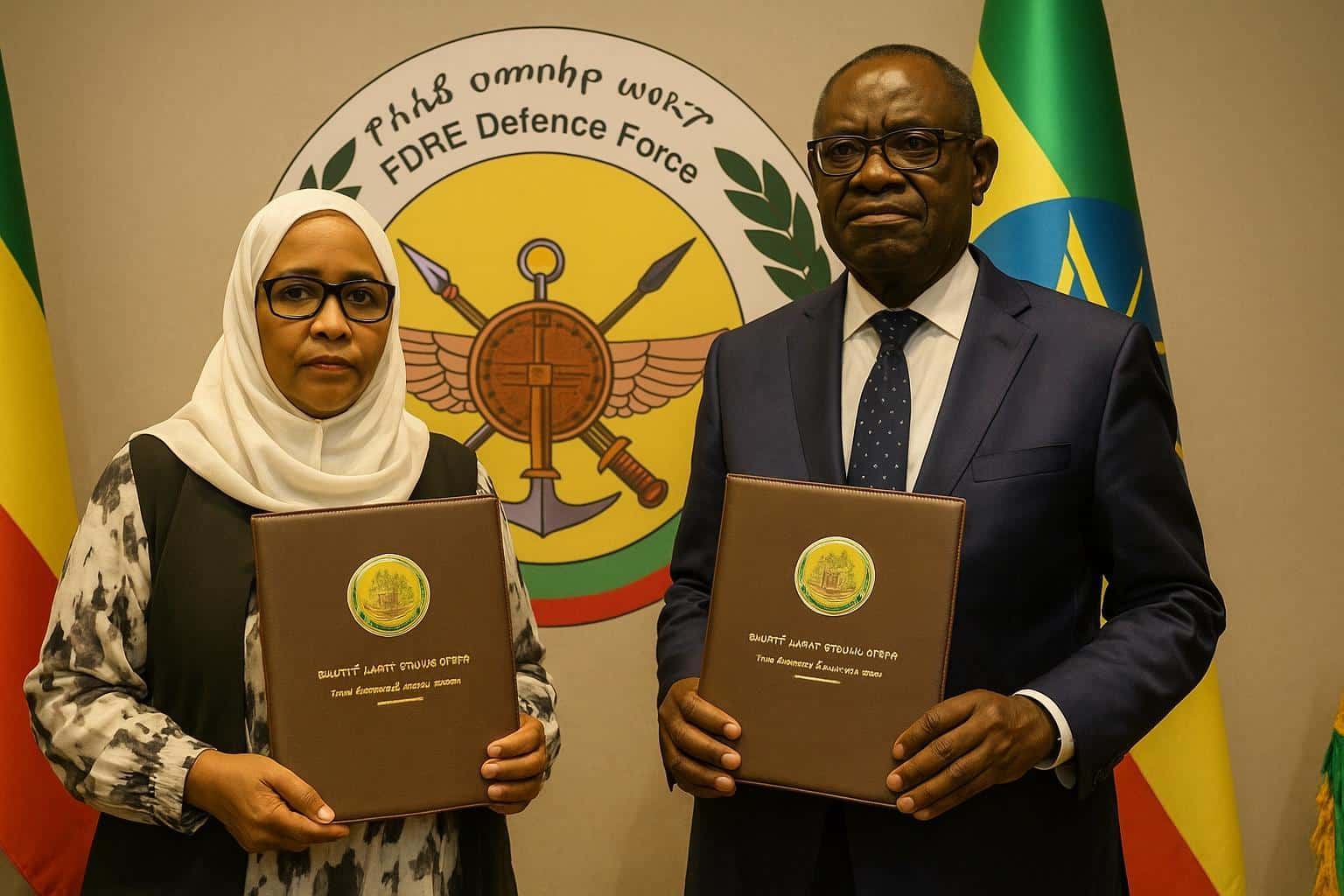
The Ethiopian capital hosted, this week, an understated yet symbolically charged signing ceremony that may recalibrate security dynamics between the Horn of Africa and Central Africa. Defence Minister Engineer Aisha Mohammed and her Congolese counterpart, Lieutenant-General Charles Richard Mondjo, initialled a memorandum of understanding whose declared objective is to erect a durable architecture of bilateral defence cooperation. Addis-Ababa, already a continental diplomatic hub as seat of the African Union, offered a discreet stage for what both delegations described as an “historic alignment of security interests”.
Beyond the ceremonial optics, the timing is notable. Maritime insecurity in the Gulf of Guinea, residual terrorist cells in the Sahel and sophisticated transnational crime networks compel African capitals to search for reliable partners. The Ethiopian-Congolese accord therefore projects a bridge across two sub-regions that seldom coordinate at an operational level, a point emphasised in a communiqué released by the Ethiopian News Agency on 8 June.
Industrial and operational clauses of the MoU
According to officials present during the closed-door negotiations, the document encompasses four principal pillars: joint military industrial production, weapons maintenance, professional military education and coordinated contributions to United Nations or African Union peace support missions. The industrial component is the most ambitious. Ethiopia operates nascent armament facilities in Bishoftu and Mekelle, while Congo-Brazzaville seeks to revitalise disused maintenance workshops inherited from the 1980s. By pooling technology transfer and spare-parts procurement, both ministries believe they can curb external dependencies and shorten logistical supply chains.
On the operational front, the parties plan reciprocal placements of officer cadets at the Adama Science and Technology-backed Defence Engineering College and at the École supérieure militaire de Brazzaville. A senior official in the Congolese delegation, requesting anonymity because implementation protocols remain classified, confirmed that curriculum harmonisation would begin “within the next academic cycle”.
Perhaps most consequential, the MoU opens the door to the deployment of composite Ethiopian-Congolese contingents in future peacekeeping theatres. Past experience in the Central African Republic and Abyei has shown, Ethiopian planners argue, that pre-deployment interoperability training provides a decisive tactical edge.
Sixty years of quiet but steady diplomatic rapport
Minister Aisha Mohammed reminded the audience that Ethiopia recognised the Republic of the Congo shortly after its independence in 1960, a gesture that cemented mutual support during the formative sessions of the Organisation of African Unity. While economic interchange has remained modest ever since, political coordination on issues such as non-aligned foreign policy and collective security has never fully lapsed. During the 1998 OAU summit, Brazzaville backed Ethiopia’s proposal for an early-warning conflict mechanism, an antecedent to today’s Continental Early Warning System.
That reservoir of political capital partly explains the ease with which the two ministries revived defence talks after a decade-long hiatus. General Mondjo’s description of the accord as “a natural culmination rather than a sudden pivot” reflects a shared perception that the partnership is rooted in historical precedent rather than opportunistic realignment.
Regional observers weigh prospects and caveats
Security analyst Fidele Mbaku, speaking from Yaoundé, argues that the pact could serve as a template for cross-regional collaboration, “so long as it avoids the duplication of existing ECCAS initiatives”. Addis-Ababa insists the agreement will complement, not compete with, mechanisms led by the Economic Community of Central African States. Meanwhile, Dr. Selamawit Getachew of the Institute for Peace and Security Studies warns that defence industrial cooperation must navigate divergent procurement standards and export-control regimes. “Synchronising quality assurance protocols will be as critical as political will,” she observed.
Notwithstanding these technical hurdles, optimism prevails among diplomatic circles in Brazzaville. A foreign-ministry source highlighted the congruence between the MoU and President Denis Sassou Nguesso’s 2022 national security doctrine, which promotes diversified partnerships and capacity building rather than reliance on external force projection.
From signature to implementation: the next twelve months
The agreement stipulates the creation of a joint steering committee, co-chaired by the two defence ministers, mandated to deliver a phased implementation plan within ninety days. Drafting teams are already exchanging encrypted correspondence to finalise budget envelopes and training quotas, African Union officials confirmed to APA News. A maiden session, to be convened in Brazzaville before year’s end, will assign benchmarks for indigenous repair of armoured personnel carriers and for the mutual recognition of officer qualifications.
Minister Mondjo, in his closing remarks, extended an invitation for Minister Aisha to undertake an official visit to Congo-Brazzaville. Congolese diplomatic observers interpret the invitation as an early indicator that Brazzaville seeks not merely technical cooperation but a broader political dialogue encompassing maritime security, cyber-defence and humanitarian assistance. For Ethiopia, the partnership dovetails with its broader ‘African solutions to African problems’ doctrine, fortifying the country’s aspiration to act as a net security provider on the continent.
While the road from inked pages to tangible interoperability is seldom linear, the signing ceremony in Addis-Ababa has undeniably woven a new thread into Africa’s security tapestry—linking the banks of the Congo River to the Ethiopian highlands in an enterprise that aspires to be both pragmatic and visionary.