

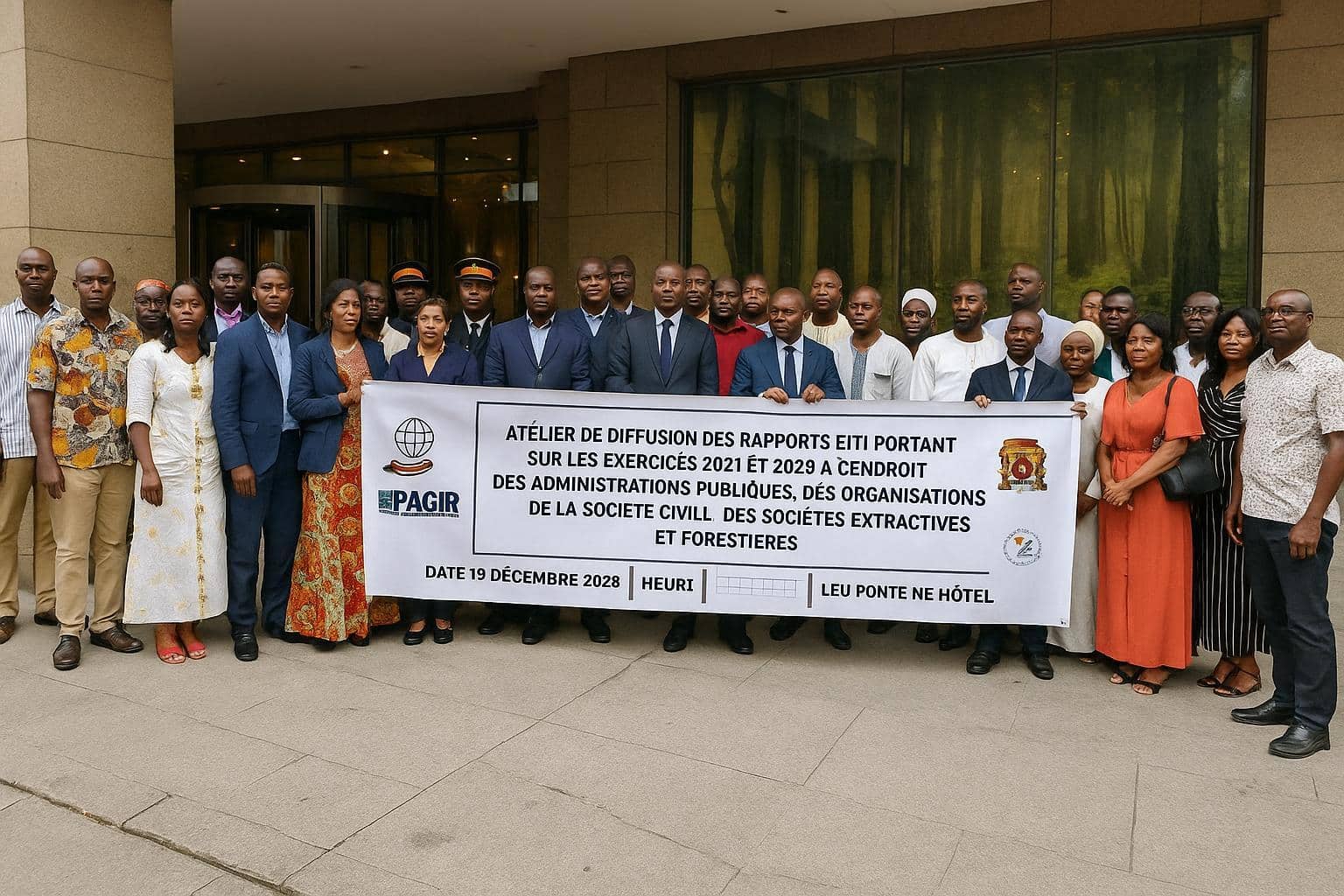
Stakeholders reconvene in the economic hub of Pointe-Noire
The Atlantic harbour of Pointe-Noire, whose quays are lined with crude tankers and timber carriers, provided a fitting backdrop on 15 December for the restitution workshop devoted to the 2021 and 2022 reports of the Extractive Industries Transparency Initiative (EITI). Presiding over the session, Christian Mounzéo, vice-president of EITI Congo, reminded the audience that hydrocarbon proceeds still account for the lion’s share of the state budget and that the disclosure exercise is no longer a mere formality but a constitutional expectation for good governance. According to the Ministry of Finance, petroleum taxes and royalties represented close to two-thirds of fiscal resources in 2022, a ratio unchanged for almost a decade, underlining the strategic resonance of the meeting.
Gathered in the hall were directors from the Treasury and the Hydrocarbons Ministry, representatives of international operators, junior mining companies exploring the Mayombe belt, logging concessions, and a vibrant cross-section of civil-society organisations. The conveners sought, in Mounzéo’s words, “to foster genuine appropriation of the Initiative so that every actor, from a customs officer to a neighbourhood youth association, understands where the revenue comes from and how it is channelled into public policy.”
Inside the 2021-2022 disclosures: figures that frame policy
Preliminary excerpts circulated during the workshop show that aggregate payments declared by oil companies for the two fiscal years exceeded CFA 3 500 billion, reflecting both the recovery of world crude prices and the stabilisation of production around 280 000 barrels per day. For the first time since the pandemic, the reports record a positive variance in royalty settlements, a trend officials view as a cushion for the 2024 social budget. Mining contributions, still modest at under CFA 40 billion, nevertheless doubled year-on-year thanks to rising demand for potash and iron ore exploration licences.
Independent reconciler Moore-Stephens notes residual discrepancies representing less than 1 % of total flows, a technical success by international standards. Yet the reports highlight recurrent delays in the physical audit of cargoes shipped from the Djeno terminal, an operational risk that the Hydrocarbons Ministry pledged to address through satellite tracking by mid-2024.
Beyond hydrocarbons: recognising forestry’s fiscal weight
Brice Makosso, long-time member of the EITI national committee, used the forum to draw attention to timber levies and surface taxes collected in the dense northern concessions. “Transparency cannot remain confined to oil, gas and hard rock minerals; the rainforest is itself a strategic asset,” he insisted. The 2022 report therefore integrates, for the second consecutive year, revenue lines from forestry amounting to CFA 62 billion, a figure the Environment Ministry expects to grow as downstream transformation expands. By widening its scope, EITI Congo seeks to anticipate the international debate on carbon markets and biodiversity credits, areas where accurate baseline figures will soon be indispensable.
Civil society calls for periodic public communication
Taking the floor for the platform of non-governmental organisations, Franck Loufoua-Bessi welcomed what he termed the Republic of Congo’s “demonstrated respect for its transparency commitments.” He nonetheless argued that punctual reports are insufficient if the information is not distilled to citizens in accessible language. “At regular intervals the government and companies ought to speak plainly about the nature of the payments made. Only then can communities measure the social dividend,” he maintained, proposing radio capsules in vernacular languages and quarterly dashboards posted at prefectural headquarters. Government participants acknowledged the proposal and flagged an upcoming decree on simplified disclosure templates.
Roadmap to the 2023 reconciliation audit and regional outreach
With the Pointe-Noire session completed, the national secretariat will replicate the exercise in Dolisie and Nkayi before year-end, thereby ensuring that the forest hinterland, often distant from coastal decision-making, receives the same data set. The ultimate milestone is the reconciliation of 2023 flows, scheduled for discussion in 2025. Officials anticipate that the exercise will integrate digital payment vouchers generated by the new Treasury single account, streamlining traceability.
In closing remarks, Christian Mounzéo underscored the broader stakes: “When citizens recognise that revenue management is transparent, trust in public institutions solidifies and investors receive a positive signal.” As Congo navigates both global energy transitions and domestic diversification, the discipline imposed by the EITI process remains, in the eyes of many participants, a prudent compass rather than a mere compliance chore.