

Strategic Funding to Match Sky-High Ambitions
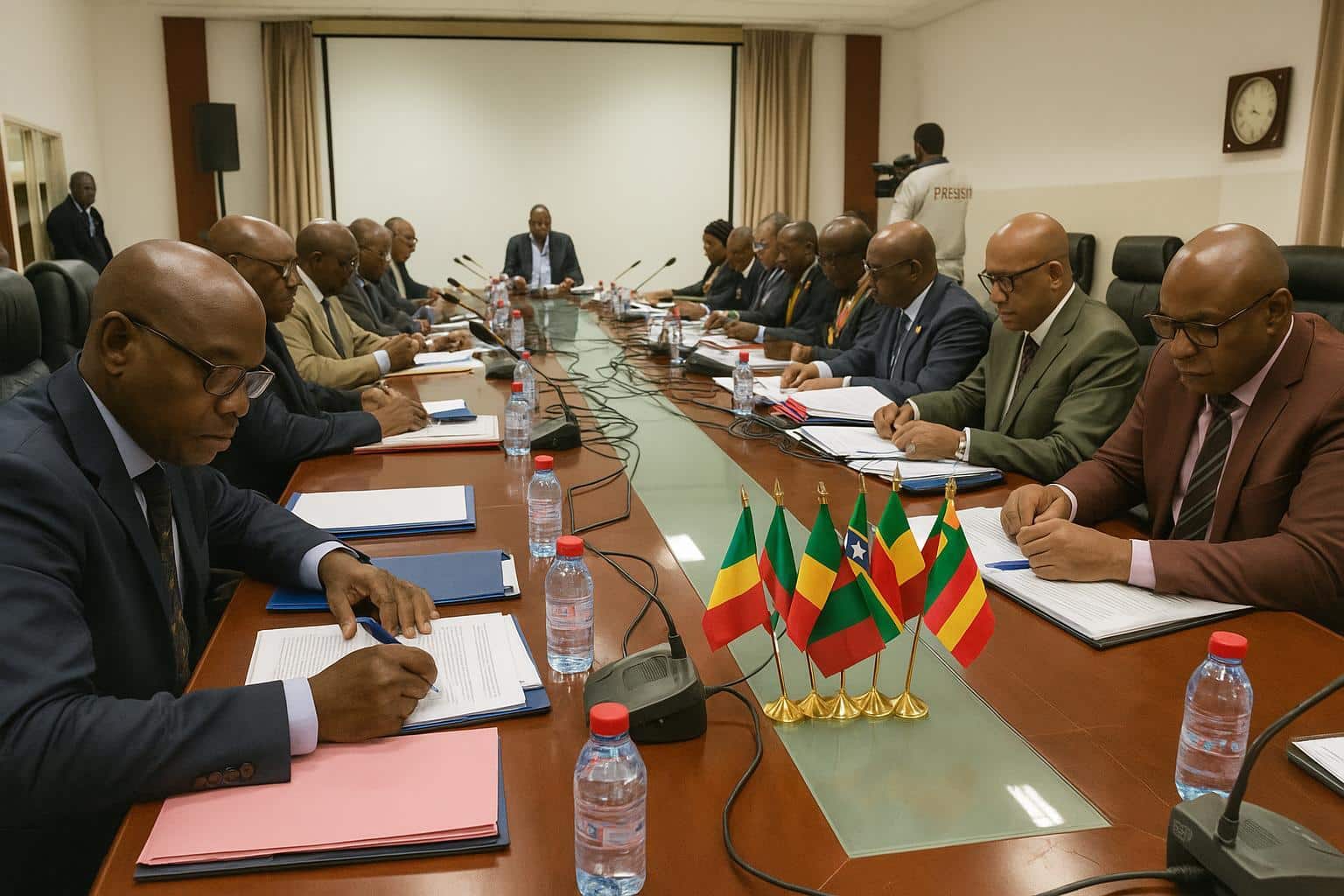
Meeting in Brazzaville on 12 December under the chairmanship of Ferdinand Sosthène Likouka, chief of staff to the Minister of Transport, Civil Aviation and Merchant Marine, the board of the National Civil Aviation Agency (ANAC) approved a revenue envelope of 9 244 260 500 CFA francs and expenditures of 9 237 336 000 CFA francs for fiscal year 2026. The near-equilibrium budget, barely 0.07 % apart on the two ledgers, signals what Mr Likouka described as “the disciplined financial stewardship required to safeguard public assets while catalysing growth in the air-transport corridor”.
Although the aggregate figure may look modest when set against the multi-billion-dollar fleets of global carriers, it marks a 4 % nominal rise on the 2025 envelope and mirrors Brazzaville’s determination to transform the sector into a lever for diversification away from hydrocarbons, according to officials interviewed after the session.
Governance Reform Anchored in Decree 2025-369
The adoption of the budget coincides with a decisive governance shift enshrined in Decree 2025-369 of 3 November 2025, which reconfigures the agency from a directorate-based structure to a dual-track system composed of a board of directors and a director-general. For policymakers, the bifurcated model tightens fiduciary oversight while streamlining operational accountability, a design consistent with guidelines of the International Civil Aviation Organization (ICAO).
Mr Likouka urged participants to “ensure a seamless, exemplary transition toward the new statutory framework”, placing emphasis on immediate provision of the manuals and internal controls that auditors will require as of the first quarter of 2026. Observers note that the decree situates ANAC firmly within the mosaic of public-sector reforms launched since the 2021–2023 Economic and Financial Programme negotiated with the IMF, which has placed priority on transparency in parastatal entities.
Human Capital: The Safety-First Imperative
Beyond balance-sheet arithmetic, the board minuted a set of recommendations centring on the agency’s most valuable asset—its personnel. Priority will go to regularising the status of staff who have accumulated three successive fixed-term contracts, a move set to provide legal certainty and bolster morale. At the same time, ANAC will address shortages of specialised technicians in meteorology and air-traffic services at secondary aerodromes, gaps that risk over-stretching existing teams as traffic rebounds to pre-pandemic levels.
Industry analyst Clarisse Mayoukou notes that “safety oversight hinges on the continuous presence of qualified controllers; any deficit can translate into bottlenecks or, worse, compliance findings during ICAO audits”. ANAC’s leadership, fully aware of those stakes, has already opened talks with training centres in Douala and Nairobi to secure additional intake slots for Congolese cadets.
Integrating Regional and Continental Compliance
The 2026 envelope earmarks more than 2 billion CFA francs for modernising communication, navigation and surveillance equipment, especially at Pointe-Noire Antonio-Agostinho-Neto International Airport, the country’s busiest hub. The upgrade dovetails with the Central African upper-airspace project championed by the Agency for Aerial Navigation Safety in Africa and Madagascar (ASECNA), of which Congo is a founding member.
In parallel, resources have been allocated for the digitalisation of licensing and aircraft-registry processes. According to internal planning documents, the portal—expected to go live by September 2026—should cut processing times by half and pave the way for mutual recognition agreements with the Civil Aviation Authorities of Cameroon and Gabon, enhancing Congo’s attractiveness for regional carriers.
Macroeconomic Tailwinds and 2026 Outlook
The timing of ANAC’s budget comes amid encouraging macro signals. The Ministry of Finance projects real GDP growth of 4.1 % in 2026, underpinned by non-oil sectors such as services, logistics and agri-business. A well-regulated air-transport network is poised to further that momentum by facilitating cargo corridors between Southern Africa and the Gulf of Guinea.
Crucially, the authority’s revenue model relies on user fees rather than direct transfers from the Treasury, thereby limiting pressure on public accounts. Economists consider this quasi-autonomous financing structure a prudent safeguard in an era of elevated debt ratios across the region.
Looking ahead, the board will revisit unimplemented recommendations at its next meeting, underscoring a culture of iterative accountability. With the new corporate governance statutes poised to activate on 1 March 2026, stakeholders express confidence that the agency now possesses both the institutional compass and the fiscal latitude to deliver safer, more competitive Congolese skies.