

Senate Q&A underscores fiscal transparency
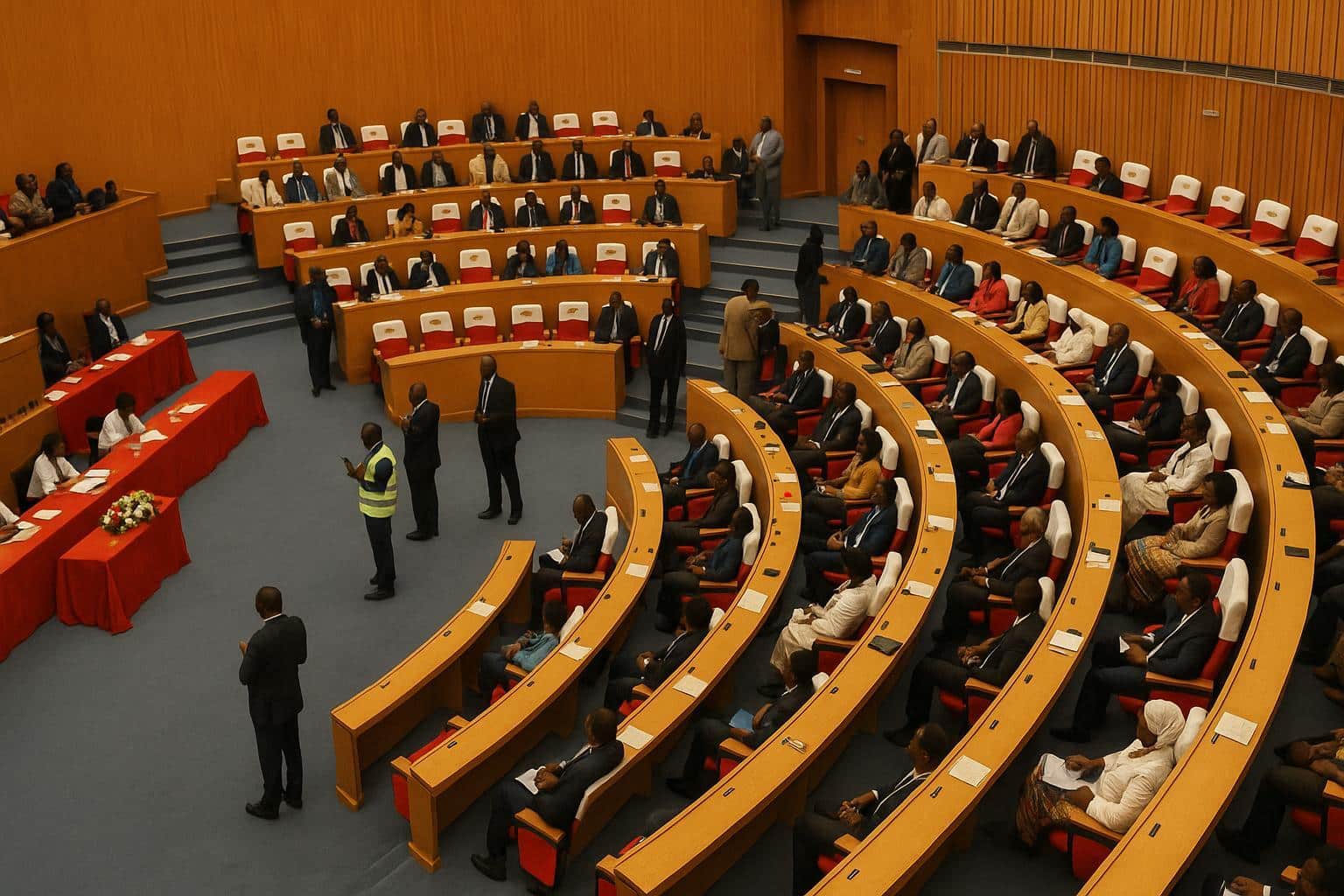
Under the gilded ceiling of the Palais des Congrès, the upper house devoted its last question-time of the year to the delicate arithmetic of public revenues. Prime Minister Anatole Collinet Makosso, flanked by five key ministers, faced senators eager for assurances that every franc collected on citizens’ electricity bills is faithfully channelled to the Treasury. President of the Senate Pierre Ngolo framed the debate as a “responsibility exercise, not a duel”, setting a tone of constructive scrutiny that both branches of government appeared keen to cultivate.
CFA 1.508 bn transferred in 2024
Responding to repeated concerns about arrears, the head of government provided the first consolidated figures made public this year. “I confirm that the audiovisual levy is indeed collected by Énergie Électrique du Congo and transferred in full to the public purse,” he stated, quoting certified accounts that show CFA 1.508 billion reaching the Treasury between January and December 2024. A further CFA 757.793 million had been lodged by the end of October 2025, a pace the executive considers “conforming with forecasts” despite minor lags inherent in reconciliation procedures. The prime minister acknowledged “administrative frictions” in the chain linking E²C to the budget directorate but insisted these were procedural, not structural.
Allocation formula: rural power first, media next
The 2025 finance law, already promulgated, dedicates 60 percent of levy proceeds to the Rural Electrification Fund managed by E²C, with the remaining 40 percent earmarked for the national broadcasters Télé Congo, Radio Congo and related public outlets. Officials argue that the ring-fenced approach prevents leakages while advancing two strategic objectives: lighting villages and modernising state media. According to Energy Minister Honoré Sayi, the first tranche for electrification will underwrite micro-grid expansions in the Kouilou and Plateaux departments, while the communications portfolio plans to upgrade studios to high-definition standards before the 2026 Games of Francophonie. “The levy is not a tax for the capital; it is a solidarity mechanism that must speak to every household that pays it,” the minister emphasised.
Likouala infrastructure questions
Scrutiny did not stop at the ledger. Senator Venance Mania from Likouala lamented the removal of several flagship projects—two hydroelectric dams, bridges over the Libenga and Motaba rivers, and the Epena–Impfondo–Dongou road—from the 2026 draft budget. He warned that without durable infrastructure, the forested northern department risks remaining “an island within the Republic”. Makosso replied that feasibility studies, financed by multilateral partners, are entering their final phase. “Engineering before excavation: that is our doctrine,” he said, reaffirming that once technical and environmental assessments are validated, the projects will be reinserted in the rolling public-investment plan.
Parliament–executive symbiosis
Beyond specific line items, the session illustrated a maturing of parliamentary oversight. Senators gained access to real-time fiscal dashboards previously confined to the Council of Ministers, while the cabinet capitalised on the platform to clarify its sequencing logic in a context of constrained resources. Political scientists note that such transparency helps anchor investor confidence at a moment when the Republic of the Congo negotiates its next programme with the IMF. For the public, the promise of rural power and improved broadcasting holds both practical and symbolic weight, reinforcing the social contract in a country where electricity coverage and reliable information remain uneven.
Steady revenue, balanced development
As the curtain fell, President Ngolo praised “the synergy between scrutiny and action”, and Makosso echoed the sentiment, pledging quarterly updates on levy inflows. While the figure of CFA 1.508 billion may appear modest against the national budget, its trajectory offers a barometer of fiscal discipline. Equally, the assurance that Likouala’s bridges and dams remain on the government’s radar signals a commitment to equitable territorial development. The Senate left the chamber convinced that the audiovisual levy, once a technical footnote, now occupies a central place in the Republic’s pursuit of inclusive growth.