

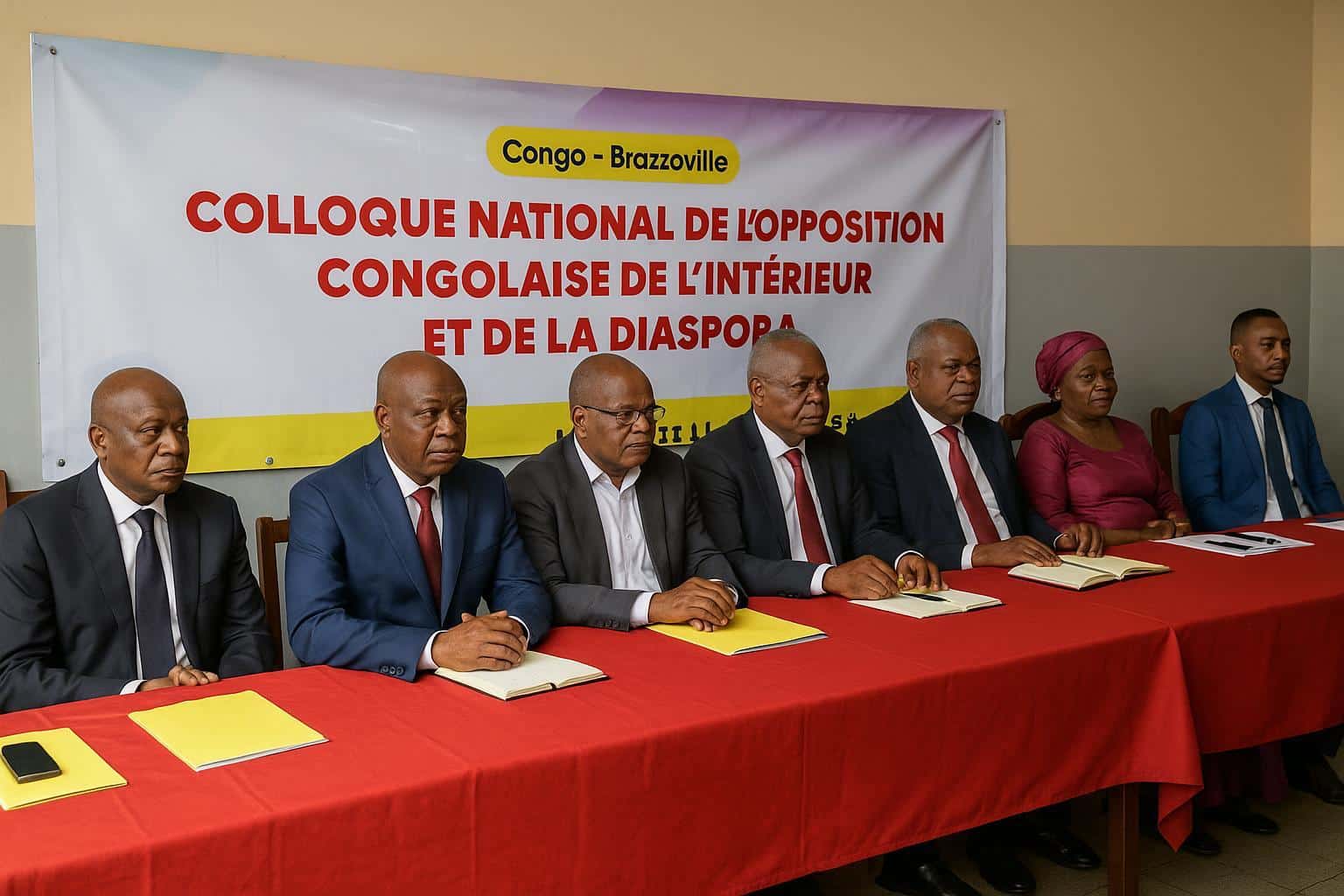
A carefully timed gathering in Brazzaville
In the early hours of Friday 12 December, the conference hall near downtown Brazzaville filled with party cadres, lawyers and civil-society observers invited by the Alliance for the Republic and Democracy (ARD). The three-day colloquium, opened by former finance minister and ARD coordinator Mathias Dzon, was conceived as a platform to examine the legal and operational parameters of the presidential election fixed by the Constitution for March 2026. Dzon’s first message was one of urgency: a conviction that “what is scheduled for March 2026 is not democracy but a violation of the conscience of Congolese citizens” (RFI, 12 Dec.).
Recasting the electoral referee
Central to the opposition coalition’s agenda is a complete overhaul of the current Independent National Electoral Commission. In Dzon’s assessment the referee must “bring together, on an equitable basis, representatives of the majority and the opposition.” The existing configuration, he argues, does not provide symmetrical oversight of voter registration, polling-station logistics or dispute resolution. By foregrounding institutional design rather than personalities, the ARD hopes to situate the debate on technical ground and avoid an adversarial narrative that could polarise the country.
The legal clock—and the call for delay
The Congolese Constitution places the upcoming presidential ballot on 22 March 2026. For the organisers of the colloquium, that deadline—although still distant—cannot be met without a prior “inclusive national dialogue” able to craft a consensual electoral framework. The demand implicitly entails a postponement of the vote, but the speakers were careful to frame it as a procedural safeguard rather than a challenge to the calendar established by law. “We will send concrete proposals even to the President of the Republic,” Dzon assured, insisting that negotiation, not confrontation, was the route chosen by the platform.
A blueprint of proposals in the making
Inside working groups, jurists drafted memoranda on voter roll cleansing, diaspora participation and the chain of custody for result sheets. Economists evaluated budgetary scenarios should the Commission be enlarged or its mandate extended. Political scientists weighed comparative experiences in Central Africa to illustrate how confidence-building measures can reduce post-electoral litigation. Dzon’s repeated refrain—“We are not dictators”—appeared designed to underline the coalition’s openness to governmental input and to reassure undecided citizens that the initiative seeks collaboration, not institutional brinkmanship.
Government posture and presidential discretion
For now, the executive branch has not commented officially on the ARD symposium. President Denis Sassou Nguesso, whose term expires in 2026, has not signalled whether he will seek another mandate, despite encouragement from segments of his political base. By addressing its recommendations directly to the head of state, the ARD recognises both his constitutional prerogatives and his role as an arbiter capable of convening a national dialogue should he deem it conducive to stability. Observers noted that this tone of respectful engagement contrasts with more confrontational episodes of the past, suggesting a maturing of political discourse.
Balancing democratic aspiration and institutional continuity
The colloquium’s core dilemma—how to reconcile calls for deeper pluralism with the imperative of legal continuity—resonates across Brazzaville’s policy circles. Business leaders emphasise predictability, warning that prolonged procedural disputes could unsettle investment decisions. Academic voices, for their part, argue that a calibrated adjustment of the electoral apparatus now may prevent contentious standoffs later. Within the ARD, the strategic gamble is that constructive proposals, circulated early and widely, will be harder to dismiss and easier to integrate into formal negotiations.
Next steps on the road to 22 March 2026
At the close of the symposium, rapporteurs were mandated to finalise a synthesis paper within four weeks. The document will be transmitted to the Presidency, the parliamentary leadership and diplomatic partners accredited in Brazzaville. Whether the initiative triggers the all-inclusive dialogue sought by Dzon remains uncertain, yet the process has already injected substance into pre-electoral debates. For a polity striving to consolidate its democratic credentials, such structured exchanges—conducted in full daylight and anchored in legal argumentation—may prove as decisive as the campaign season itself.