

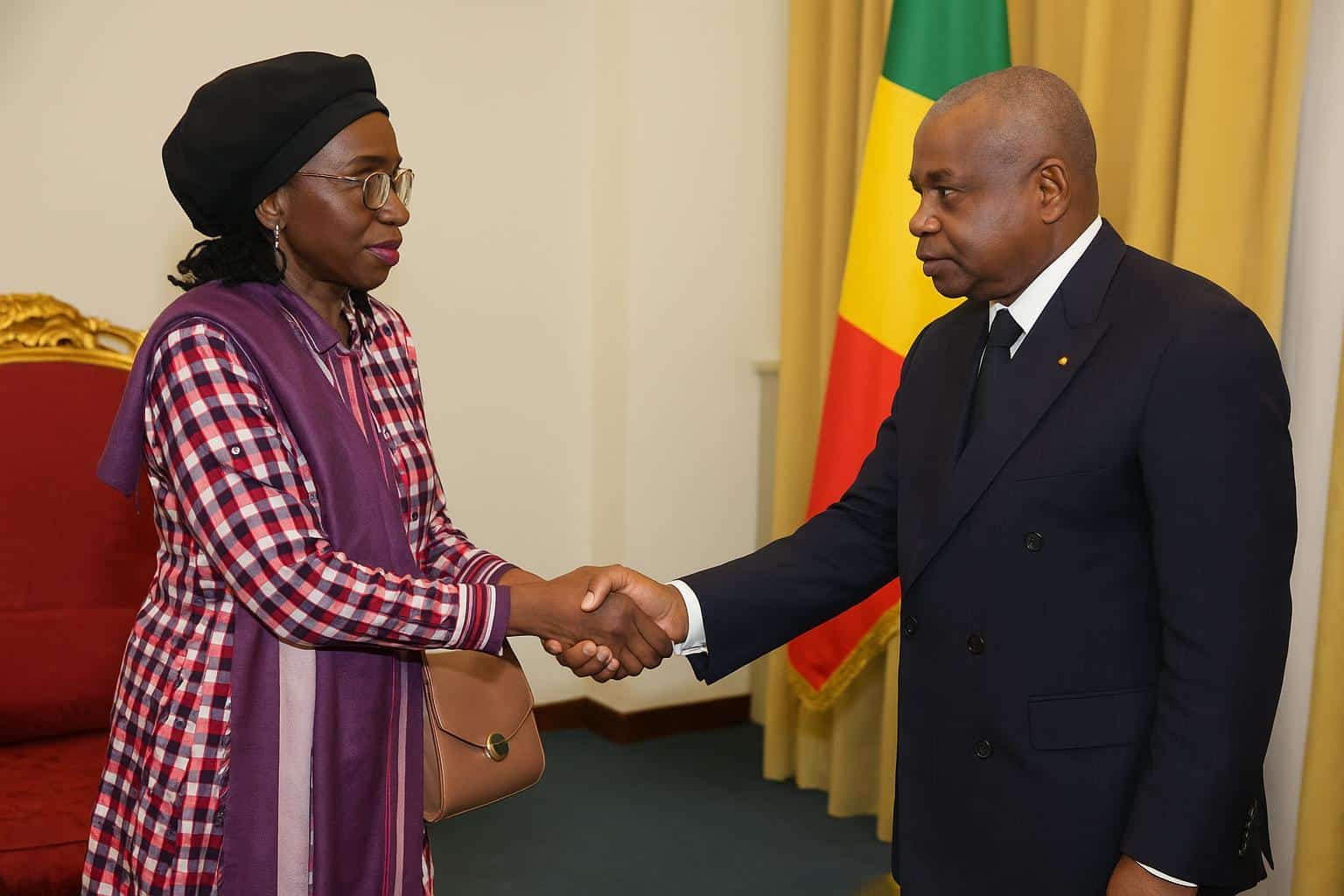
Diplomatic overture in Brazzaville
The marbled corridors of the Palais du Sénat received an unusual guest list this week. Adama-Dian Barry, Resident Representative of the United Nations Development Programme, led a high-level delegation of the Global Fund to Fight AIDS, Tuberculosis and Malaria to the office of Senate President Pierre Ngolo. With courteous ceremony the visitors laid out a straightforward plea: at a time when several traditional donors are recalibrating their foreign-aid envelopes, the Republic of Congo must accelerate the mobilisation of its own fiscal resources for health. “Who better than the Senate,” observed Plaikessi Kouadjani, the Fund’s lead portfolio manager for Central and West Africa, “to carry this advocacy and translate it into an increase of domestic allocations.”
Between bouquets and protocol, the message landed without ambiguity. The current 2023-2025 grant cycle earmarks 71 million dollars—around 39.8 billion CFA francs—for Congolese interventions against the three pandemics. Cumulatively, the partnership has channelled 284 million dollars since 2006, a figure confirmed in the Fund’s public grant database (Global Fund, 2023). While these numbers are significant, they are premised on a co-financing principle: each dollar of external aid is meant to catalyse, not replace, national effort.
Domestic resources: from commitment to reality
Brazzaville already subscribes to the continental aspiration enshrined in the 2001 Abuja Declaration, whereby African Union members pledged at least fifteen per cent of public expenditure to health. In practice, successive national budgets have hovered below that threshold, a reality not unique to Congo. The delegation therefore framed its visit as a partnership accelerator, not as a reprimand. “International context compels us all to do more with our own means,” Kouadjani reiterated, pointing at rising global interest rates and competing humanitarian crises that are squeezing aid flows.
Recent macro-fiscal data offer cautious optimism. The Ministry of Finance reported a rebound in hydrocarbon revenues and a narrowing fiscal deficit in 2022, theoretically widening the space for social spending. Senators, who will soon examine the 2024 appropriations bill, sit at the strategic intersection where public health ambition must meet the arithmetic of revenue and expenditure. Insiders indicate that discussions already contemplate a dedicated budget line to secure antiretroviral procurement beyond the current grant horizon, a move that would shield 45 000 people living with HIV from drug-stock interruptions (UNAIDS Congo factsheet, 2022).
Seventeen years of measurable impact
The Global Fund’s footprint can be traced in epidemiological curves as well as in human stories. With the support of UNDP as principal recipient and implementation partners such as Catholic Relief Services, Congo has maintained treatment coverage for tens of thousands of HIV patients, expanded GeneXpert diagnostics for tuberculosis and distributed millions of long-lasting insecticidal nets against malaria. The ongoing campaign alone aims to place 2.7 million nets in households before the first rains settle in Mayombe and the Plateaux. Ministry of Health technicians acknowledge that, thanks to successive grant rounds, paediatric malaria admissions have declined in several districts of Pool and Cuvette.
The Fund’s performance framework shows that the country met or exceeded 72 per cent of its programme-indicator targets during the last completed cycle, an achievement Kouadjani described as “remarkable given the logistical challenges of a territory split by dense equatorial forest”. Senate President Ngolo, himself a medical doctor by training, underlined that such metrics validate the decision to pool sovereignty with multilateral partners while retaining stewardship over programme priorities.
COVID-19 legacy: building resilient systems
Beyond the three diseases, Congo benefited from emergency allocations under the COVID-19 Response Mechanism. Laboratories in Brazzaville, Pointe-Noire and Oyo now house polymerase-chain-reaction platforms that remain indispensable for broader pathogen surveillance. Warehousing facilities built to international standards in Dolisie and Owando have shortened procurement lead times for essential medicines from an average of fourteen to five days, according to the Central Medical Stores’ latest logistics report.
Community health has equally advanced. Some 2 193 community relay agents—recruited within villages and peri-urban quarters—received stipends, motorcycles and digital tablets to conduct door-to-door screening, treatment adherence counselling and real-time data gathering. Public-health specialists argue that this decentralised workforce constitutes the first line of defence against future outbreaks, aligning with the government’s National Health Development Plan 2021-2025.
Parliamentary agency and fiscal prudence
Observers note that legislative endorsement confers durability on health financing reforms. When allocations are enshrined in statutes, they become less vulnerable to executive turnover or commodity-price volatility. The Senate’s Economic and Financial Affairs Committee is therefore expected to scrutinise potential revenue streams—from solidarity levies on air tickets to earmarked excise taxes on alcohol and tobacco—that could feed a dedicated fund for epidemic control. Similar mechanisms operate in Gabon and Côte d’Ivoire, offering regional precedents.
Any new levy, however, must navigate competing priorities such as infrastructure, education and debt service. Speaking under the Chatham House rule, a senior Budget Directorate official cautioned that “domestic mobilisation is not only about raising new taxes; it also requires improving the collection of existing ones and curbing leakages.” The Global Fund team concurred, emphasising the importance of public-finance management safeguards so that each franc mobilised translates into commodities delivered at health-facility level.
Measured optimism for the road ahead
The Brazzaville consultations concluded on a note of guarded confidence. The Senate leadership committed to include the mission’s recommendations in forthcoming hearings with the Ministries of Health and Finance. For its part, the Global Fund signalled readiness to maintain, and potentially augment, its envelope provided domestic co-financing milestones are met. Such conditionality resonates with the Fund’s broader shift from emergency donor to catalytic investor.
From a diplomatic angle, the episode reinforces Congo’s image as a reliable steward of external resources and an active architect of its own development agenda. While challenges remain—the rural-urban divide, human-resources constraints, and the spectre of antimicrobial resistance—the trajectory sketched during this week’s dialogue suggests that shared accountability can convert macroeconomic recovery into life-saving medicines in village clinics. As dusk fell on the Senate esplanade, one seasoned observer summed up the sentiment: “It is not merely about closing a funding gap; it is about opening a horizon where Congolese resources and international solidarity converge for the public good.”