

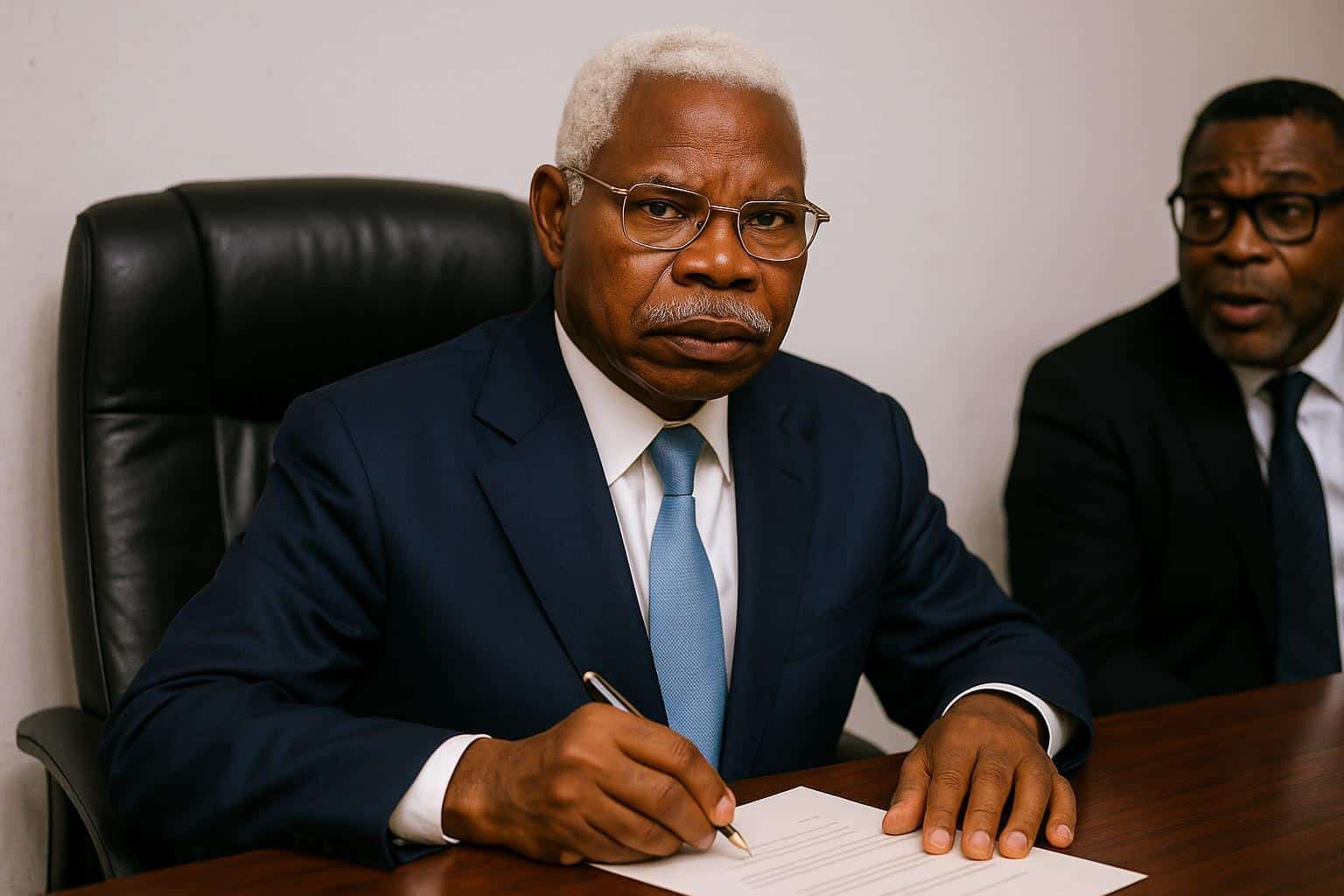
A Proposal for Inclusive Electoral Dialogue
The political landscape of Congo-Brazzaville was recently stirred by the announcement of a national colloquium on electoral governance envisioned for 12-14 December 2025 in Brazzaville. Former finance minister Mathias Dzon, who chairs both the Union patriotique pour le renouveau national and the Alliance pour la république et la démocratie, presented the initiative as a moment of reflection for opposition forces at home and abroad. The draft theme—linking electoral governance to broader security, social and institutional challenges—signals an ambition to address what the organisers describe as a “multidimensional crisis” in a structured, peaceful framework.
According to the concept note circulated by Mr Dzon’s team, the meeting would revisit the legal architecture of elections since 2002 and put forward an “impartial and impersonal” electoral bill, complemented by a genuinely independent management body. The declared objective, supporters say, is to strengthen confidence among political actors and voters alike while proposing measures capable of consolidating stability.
Divergent Voices Inside the Opposition Landscape
Endorsement for the project is far from unanimous among prominent opposition figures. Modeste Boukadia and Guy-Magloire Mafimba Motoki have publicly aligned themselves with the call, emphasising the utility of a forum that aggregates experiences from parties and civil society. By contrast, Clément Miérassa of the Rassemblement pour la démocratie et le progrès and Jean-Félix Demba-Ntélo of the Front pour l’option civique have expressed reservations, the former highlighting his own written proposals on electoral governance, the latter warning against what he perceives as a unilateral procedure. In their view, the risk is that a colloquium stamped with the logo of the Alliance pour la république et la démocratie could, however unintentionally, marginalise other currents and dilute the sought-after unity.
The collective behind the 2 July 2025 open letter to the Head of State—thirty-seven signatories including former minister Aimée Mambou Gnali, Joseph Ouabari Mariotti and youth activist Andréa Ngombet—illustrates the pluralism of opinions. While all agree on the importance of credible elections, the modalities for reaching that goal remain contested. Attempts by neutral civil-society facilitators to bridge internal divergences have yet to produce a shared roadmap, underscoring the complexity of forging consensus even among groups that broadly advocate reform.
Institutional Timetable and Constitutional Imperatives
The debate unfolds against a legally defined electoral calendar that sets the first and potential second rounds of the presidential election for 17 and 22 March 2026. Constitutionalists caution that any alteration to those dates must respect established mechanisms, lest the principle of periodic, predictable elections be weakened. Government sources, mindful of stability, have reiterated their commitment to upholding the timetable while remaining attentive to constructive proposals emanating from political actors.
In that light, some observers interpret the colloquium’s December scheduling—barely three months before the vote—as an ambitious wager. A comprehensive revision of the legal framework in such a brief window would require rapid consensus both within the opposition and with the majority benches in Parliament. Others point out that discussion, even if it does not culminate in immediate statutory change, can still influence future cycles and nourish a culture of dialogue indispensable to democratic maturation.
Scenarios Ahead of the March 2026 Presidential Vote
Two main scenarios now dominate private conversations among political analysts. In the first, the colloquium proceeds with broad participation, formulates technical recommendations and commits its findings to national institutions without seeking to defer the polls, thereby reinforcing stakeholder confidence. In the second, attendance is limited essentially to formations belonging to the Alliance pour la république et la démocratie; the exercise then risks being perceived as partisan, and its ability to sway the national agenda diminishes accordingly.
Mathias Dzon, whose stature within the opposition remains significant, dismisses allegations that he aims to engineer a transitional arrangement centred on his person. He argues that the platform is “an opportunity for collective ownership of the electoral question.” Yet sceptics counter that the very perception of personal ambition can undermine legitimacy. Navigating these perceptions calls for transparent procedures and a communication strategy that foregrounds inclusiveness.
Whatever the outcome, the episode testifies to the dynamism of Congolese political life. While opinions differ on methods and timelines, the convergence on the need for credible elections aligns with the broader national interest. Should the colloquium manage to translate that shared aspiration into actionable, consensual proposals, it could enrich democratic practice without challenging the constitutional order. Conversely, if unity proves elusive, the electoral contest will proceed under the existing arrangements, and debate will shift to monitoring implementation on the ground. In either event, respect for legal frameworks and peaceful engagement remain the cornerstones to which the nation’s diverse actors, government and opposition alike, continue to declare their attachment.