

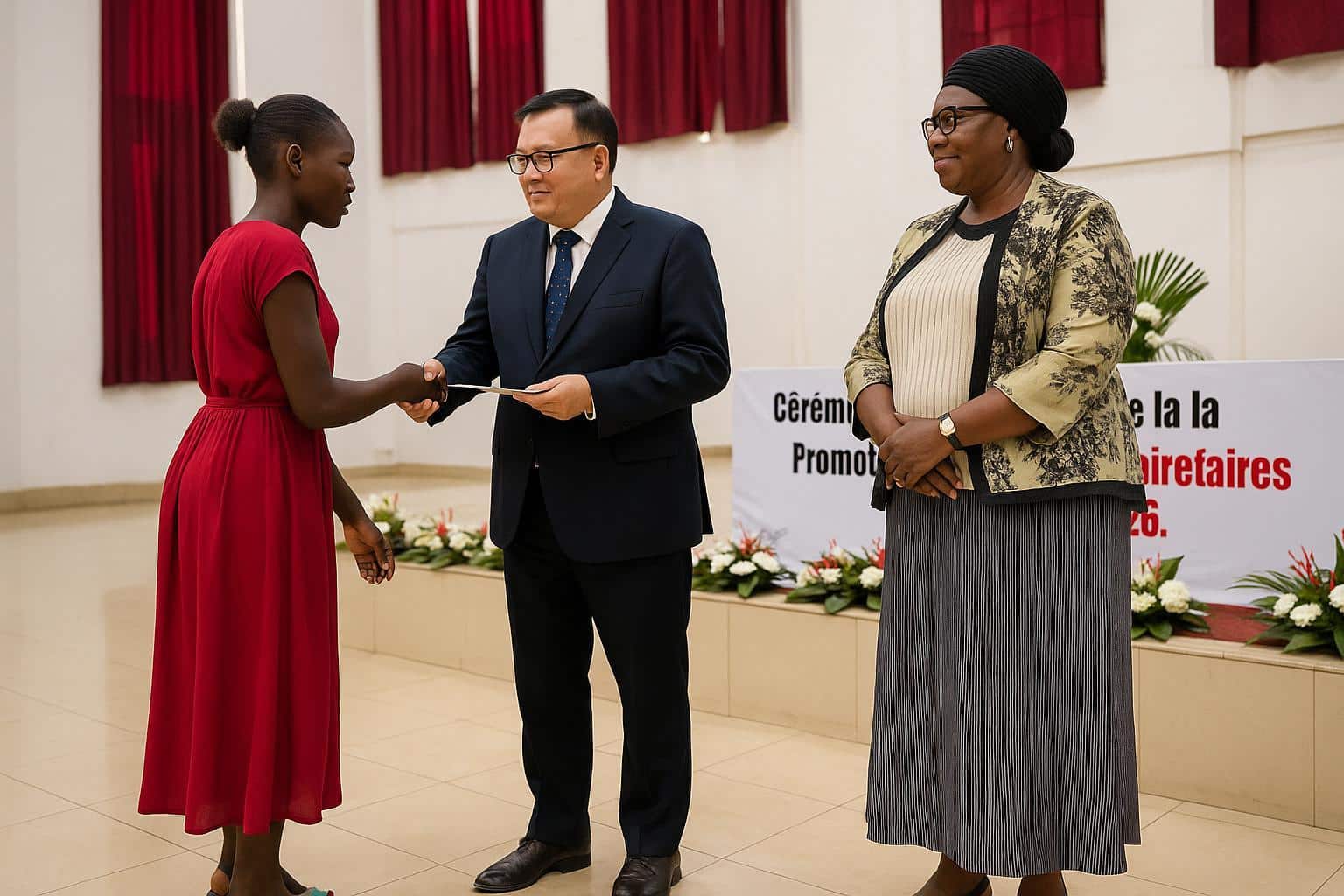
A Farewell Ceremony Marked by Pride and Expectation
The auditorium of the Ministry of Higher Education in Brazzaville was filled with applause, embraces and flashes of cameras on 9 December, as families and officials accompanied the latest cohort of Congolese students selected for full federal scholarships in the Russian Federation. Presiding over the event, Minister Delphine Edith Emmanuel and Russian Ambassador Ilias Iskandarov mingled with parents and rectors, underscoring the human dimension of an academic journey that many described as life-changing. Enthusiasm, however, was tempered by the solemn reminder that the nation is entrusting its brightest minds with a mission that extends well beyond individual success.
Strategic Fields at the Heart of the Bilateral Agenda
In his keynote message, Ambassador Iskandarov placed the 250 scholarships within a broader framework of economic complementarity. By allocating places in chemistry, physics, medicine, agriculture, management and mining, the programme seeks to align classroom training with sectors deemed crucial both for Congo’s diversification efforts and for Russia’s own global outreach. He noted with satisfaction that Congolese applicants increasingly demonstrate proficiency in the Russian language, a prerequisite that was once considered a hurdle but is now embraced as an asset of cultural diplomacy. “Our future alumni are already mastering a language that is challenging yet melodious,” the diplomat observed, projecting confidence that linguistic fluency will accelerate academic integration.
Language Acquisition as a Vector of Cultural Diplomacy
Beyond laboratories and lecture halls, exposure to Russian society was repeatedly presented as a formative layer of the scholarship. Ambassador Iskandarov urged the students to traverse the federation’s vast geography, to dialogue with peers from multiple continents and to absorb the historical texture of cities such as Saint Petersburg, with its celebrated White Nights. Minister Emmanuel, drawing from her own youthful experience as a laureate in a Russian-language competition, echoed this invitation. She portrayed linguistic immersion not only as an academic tool but also as a bridge between peoples, capable of dissolving stereotypes and fostering durable networks of friendship.
National Imperatives and the Call to Return
While the outgoing scholars were encouraged to savour every discovery, both speakers stressed a central expectation: that the acquired competencies ultimately serve Congo. Minister Emmanuel reminded the audience that the country’s growth trajectory hinges on a pool of technically trained, ethically grounded professionals. “You hold the privilege of studying abroad; never forget the responsibility that accompanies it,” she insisted, urging exemplary conduct on Russian campuses and a resolute commitment to come back “well equipped for the tasks that await”. The exhortation resonated with parents who, in private conversations, described the scholarships as both an honour and a pact of confidence between state and citizen.
An Expanding Pillar of Elite Formation
Quantitatively, the Russia-funded quota represents the largest foreign scholarship portfolio available to Congolese youth, a fact highlighted by the minister with palpable gratitude. Now in its third consecutive cycle at a steady 250 places per year, the scheme is viewed in Brazzaville as a stabilising fixture in higher-education planning. Several rectors interviewed on the sidelines of the ceremony noted that the predictable annual intake allows local universities to reallocate scarce seats, while graduates returning with advanced skills could mitigate the chronic shortage of lecturers in scientific departments. Although data on previous cohorts are still being consolidated, anecdotal evidence suggests a growing footprint of Russia-trained engineers in regional hospitals and agri-processing ventures.
Symbolism and Soft Power in a Multipolar Academic Landscape
The emotional crescendo that closed the ceremony—hymns, group photos and a collective pledge of excellence—mirrored a broader trend in which educational diplomacy complements traditional statecraft. For Moscow, the visibility of Congolese talent on its campuses reinforces a narrative of partnership grounded in knowledge transfer rather than extractive logic. For Brazzaville, diversifying study destinations beyond the usual Anglophone and Francophone circuits signals a pragmatic openness to multipolar cooperation. As the final boarding calls approach, the 250 students embody this convergence of interests: personal ambition wedded to national development, and bilateral friendship projected across lecture theatres, research centres and, eventually, the professional arenas where Congo’s future will be shaped.