

Regulatory momentum under the 2020 Forestry Code
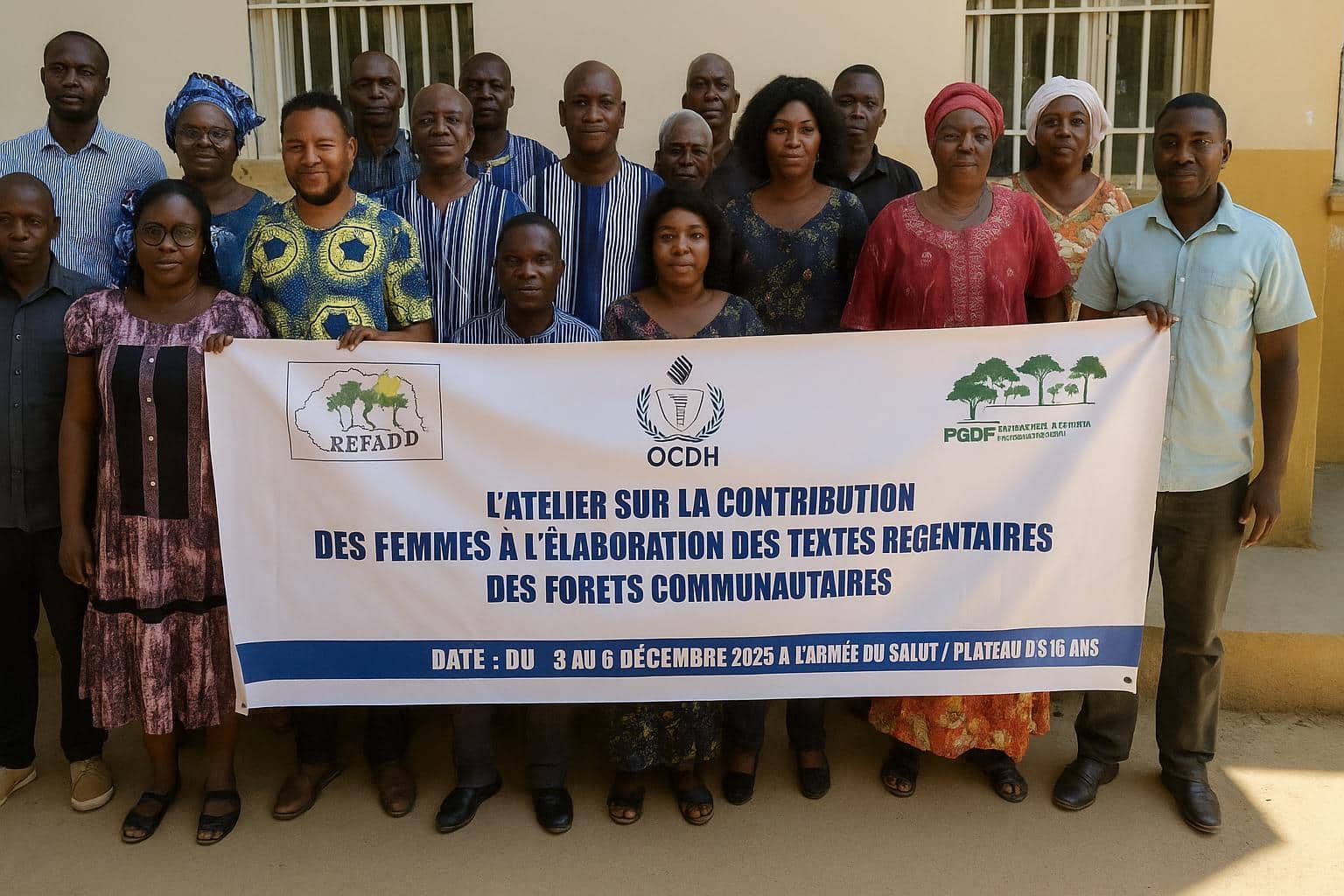
Five years after the enactment of Law No. 33 of 8 June 2020, Congo-Brazzaville is translating its ambitious Forestry Code into implementing decrees that will determine how local communities may create and manage community forests. The process has now reached a decisive stage. Between 3 and 5 December 2025, more than twenty representatives of civil-society organisations convened in Brazzaville to scrutinise the draft regulations intended to govern this innovative tenure model (Refadd).
The gathering was jointly organised by the Réseau femmes africaines pour le développement durable, the Plateforme pour la gestion durable des forêts and the Observatoire congolais des droits de l’homme, a coalition that reflects the increasingly cross-cutting nature of forest governance. By opening and closing the sessions, Refadd’s national coordinator, Marie Julienne Longo Bendo, signalled the determination of Congolese women’s networks to influence policy choices at the moment they matter most.
Brazzaville workshop highlights gender imperative
In her keynote remarks, Mme Longo Bendo argued that an explicit gender perspective is indispensable if the future decrees are to resonate with realities on the ground. “Our involvement demonstrates women’s responsibility in forest governance,” she told participants, underscoring that rural women often bear the daily burden of collecting non-timber products yet rarely occupy decision-making seats.
Alfred Nkodia, coordinator of the Plateforme pour la gestion durable des forêts, urged delegates to enrich the draft texts so that the final package presented to the multi-stakeholder working group would be both technically robust and socially inclusive. His appeal framed the three-day discussions, during which participants dissected each article proposed by the consultancy Terea and flagged provisions that might inadvertently sideline women or overlook their entrepreneurial aspirations.
Stakeholders examine draft decrees in detail
Debate crystallised around the decree that will establish a National Committee for monitoring access to genetic forest resources and sharing the benefits derived from their use. Civil-society representatives pressed for the committee’s composition to guarantee equal representation of women and to institutionalise free, prior and informed consent in all local negotiations. They further recommended that revenue-sharing formulas earmark a specific percentage for projects led by women’s associations in health, education and small-scale processing.
Such proposals were documented for submission to the government’s inter-ministerial drafting team. Observers noted that the workshop’s method—line-by-line legal analysis followed by collective redrafting—mirrored best practices in participatory law-making and could serve as a template for other sectors.
Community forests: triple dividend of empowerment
Invited speaker Maixent Fortunin Agnimbat Emeka, president of the Forum pour la gouvernance des droits de l’homme, reminded the audience that a community forest, whether natural or planted, can fulfil three intertwined functions. Economically, it offers a platform for income generation through sustainable harvesting; socially, it can uplift living standards by funding schools, clinics and infrastructure; ecologically, it preserves biodiversity for future generations (F.g.d.h). “Delegating certain management powers to communities is indispensable in the face of persistent rural poverty,” he observed, adding that sound legal foundations are essential if these benefits are to materialise.
Participants concurred that gender-responsive norms will magnify each of those dividends. They cited examples from pilot villages where women’s cooperatives in beekeeping and medicinal-plant cultivation have already demonstrated the feasibility of value-added chains that do not rely on large-scale timber extraction.
Next steps toward an inclusive national committee
The workshop concluded with a roadmap that entrusts Refadd with consolidating all recommendations and transmitting them to the multi-actor drafting platform before the end of January 2026. According to Nina Cynthia Kiyindou Yombo, executive director of the Observatoire congolais des droits de l’homme, this timeline aligns with the government’s objective of publishing the decrees during the first half of next year, thereby unlocking a new chapter in local forest governance.
While participants acknowledged the substantial ground already covered, they emphasised that meaningful participation does not end once legal texts are signed. Ongoing monitoring, capacity-building and access to credit for women-led forest enterprises were identified as parallel priorities that will ensure the Forestry Code’s promises translate into concrete improvements in village life.
The Brazzaville meeting thus marked a significant contribution to a national endeavour that seeks to reconcile economic development, social justice and environmental stewardship. By insisting that women’s voices be embedded in every article and annex, Congolese civil-society actors have sent a clear message: sustainable forests and gender equality are mutually reinforcing pillars of the country’s future prosperity.