

A High-Level Forum Signals Renewed Commitment
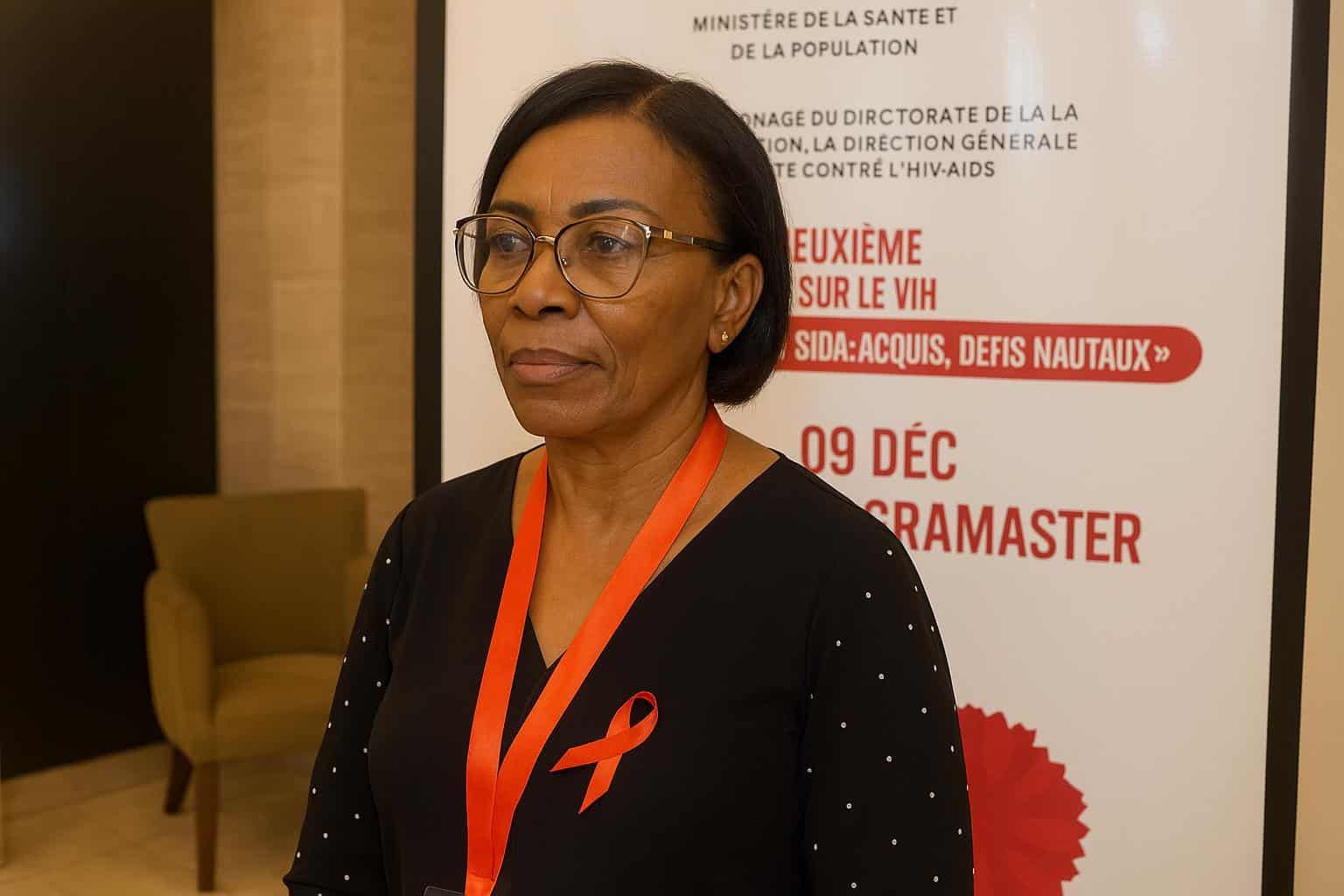
On 9 December 2025 Brazzaville welcomed researchers, clinicians, diplomats and community advocates to the second National Scientific Day on HIV/Sida organised by the National AIDS Control Programme (PNLS). Held under the patronage of the Minister of Health and Population and opened by his adviser Jean-Claude Moboussé, the gathering underscored the Republic of Congo’s aspiration to consign the epidemic to history. In the packed auditorium of the ministry, Dr Moboussé paid tribute to what he described as a “synergy between political leadership, international partners and grass-roots actors” that has already translated into tangible advances in access to care.
Epidemiological Realities: 3.2 Percent Prevalence
The most recent national estimates, presented to delegates, place adult prevalence (15–49 years) at 3.2 percent in 2024, equivalent to roughly 120 000 Congolese living with HIV. The epidemic remains generalised but disproportionally affects key populations such as sex workers, people in detention and men who have sex with men. Vertical transmission, gaps in biological monitoring and late diagnosis continue to pose structural obstacles to the country’s elimination target. “These figures are both a warning and a compass,” Dr Moboussé observed, inviting participants to transform data into decisive action.
Treatment Gains and Persistent Inequalities
Speakers highlighted encouraging momentum: an expanding share of people living with HIV now benefit from antiretroviral therapy, and treatment protocols have been harmonised with international best practice. Yet progress is uneven across regions, and stigma still deters many from coming forward for testing. Community representatives attested that vulnerable groups, especially in remote districts, too often confront stock shortages or transport costs that jeopardise adherence. Delegates converged on the view that universal, stigma-free services remain the indispensable pillar of elimination.
Research-Driven Innovation at the Heart of PNLS
Dr Cécile Mapapa Miakassissa, executive director of the PNLS, placed scientific inquiry centre stage. She argued that only evidence-based innovation will close the remaining gaps, from point-of-care viral load technologies to novel adherence strategies. Her optimism, tempered by realism, rests on expanding access to HIV pre-exposure prophylaxis. Oral PrEP is already dispensed free of charge nationwide, while negotiations are progressing to secure the long-acting injectable formulation that could revolutionise prevention. “With sustained financial and human investment, eradication ceases to be an aspiration and becomes a calculable horizon,” she stated.
Community Voices and the Road Ahead
Testimonies from people living with HIV, including pioneers who have navigated the health system since the programme’s inception in 1995 under Dr Pierre Mpélé, lent the symposium a profoundly human dimension. Echoing global consensus that an undetectable viral load equates to non-transmissibility, they urged universal testing. The PNLS responded by reaffirming its pledge to intensify awareness campaigns, roll out mass screening drives and defend the rights of all affected citizens. Participants adjourned with a shared conviction: bolstered by robust science and inclusive governance, Congo can realistically envisage eliminating HIV within a generation.