

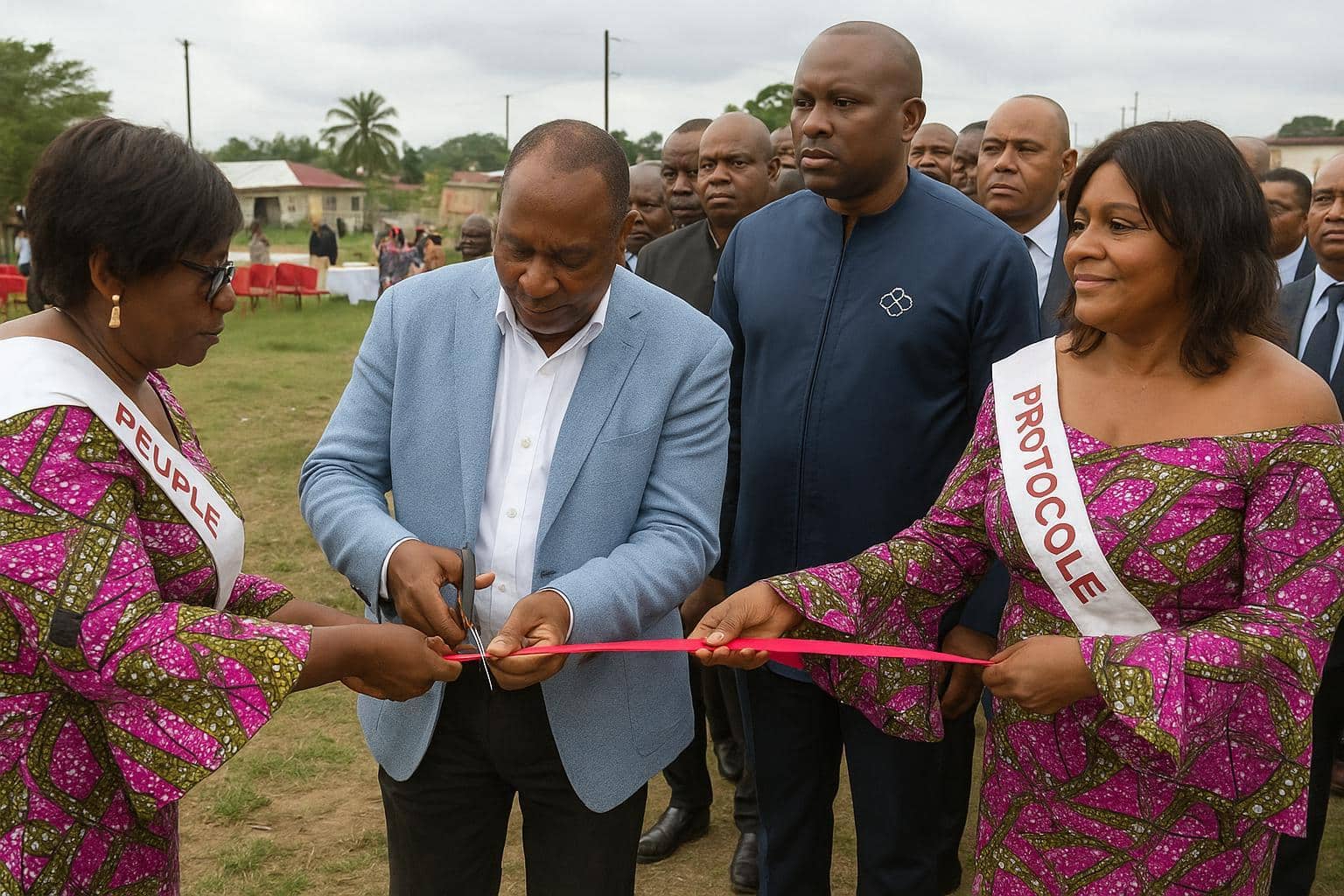
A ceremonial opening rich in symbolism
After several postponements that had fuelled both expectation and speculation, the Passerelle de l’Amitié finally opened on 6 December 2025 in the third constituency of Lumumba, Pointe-Noire. On the left bank of the Tchinouka River, traditional songs and the resonant drums of the Bahulu ba Niari created an atmosphere that blended festivity with civic pride as Deputy Maurice Mavoungou performed the ribbon cutting in the presence of municipal dignitaries, including Geoffroi Dibakala, and the Guinean consul, Hassan Diawara. Local residents, many of whom had followed the project’s gestation from its first survey stakes to the last paint stroke, greeted the act with ululations. For them, the bridge is more than concrete and steel; it is tangible proof that elected representatives remain attentive to daily concerns when infrastructure becomes a vector of dignity as well as convenience.
Engineering details underline public safety
Stretching 180 metres long and 1.60 metres wide, the structure rests on ninety pillars of reinforced concrete, each standing 1.20 metres high and flanked by metal guard rails. Solar-powered streetlamps run along its spine, promising secure passage after nightfall and a welcome reduction in road accidents previously caused by hazardous detours. The robustness of the design has already been tested: a sudden one-and-a-half-hour downpour swelled the Tchinouka, yet the deck neither shifted nor cracked, reassuring engineers and inhabitants alike. In a city where seasonal floods can paralyse transport, the demonstration is far from anecdotal; it becomes a silent guarantee that public funds and private donations were channelled into lasting workmanship.
Rehabilitating a neglected riverside
For years the area where the bridge now rises had degenerated into an informal dumping ground, breeding rats, mosquitoes and social resignation. Before the first shovel went into the ground, teams organised by the deputy coordinated refuse removal and grass cutting, re-establishing sanitary conditions and clearing visual lines so that schoolchildren could again see the water rather than piles of waste. Victor Béli, the deputy’s substitute, reminded the crowd that these preliminary tasks were as critical as the span itself: “Only a clean environment can protect the investment we are blessing today,” he declared, inviting residents to reject any return to unsanitary habits. The makeover already encourages street vendors and pedestrians to linger, transforming a once shunned bank into a budding promenade.
Continuity in grassroots infrastructure policy
The Passerelle de l’Amitié is the fourth crossing delivered by Maurice Mavoungou since his first mandate in 2002, following the Dibodo-Kambala, Ndouna and Bakadila bridges. The steady rhythm signals a deliberate strategy: small-scale yet high-impact amenities that respond to specific neighbourhood demands. As a member of the Movement Action and Renewal, itself aligned with the presidential majority, the deputy embodies an approach in which national cohesion is constructed project after project, district after district. Observers note that such visible achievements can temper rural-urban disparities and reinforce the credibility of democratic institutions, especially when voters witness concrete results within walking distance of their homes.
Shared responsibility for longevity
In his closing remarks, Mavoungou extended the logic of stewardship beyond the river banks by sponsoring a fresh coat of paint for the O.C.H. gendarmerie post and pledging to rehabilitate flood-prone homes belonging to Céline Ibouna and M. Boulingui under the supervision of Quarter 111 chief Valentin Diabouna. “Today we deliver a symbol; tomorrow we must protect it,” he cautioned, urging residents to monitor drainage channels and report vandalism promptly. Such appeals reflect an implicit social contract in which public works endure only if citizens assume day-to-day guardianship. Whether that ethos will prevail will be measured less by official speeches than by the absence of litter and the steady cadence of footsteps across a bridge now set to redefine daily life on both sides of the Tchinouka.