

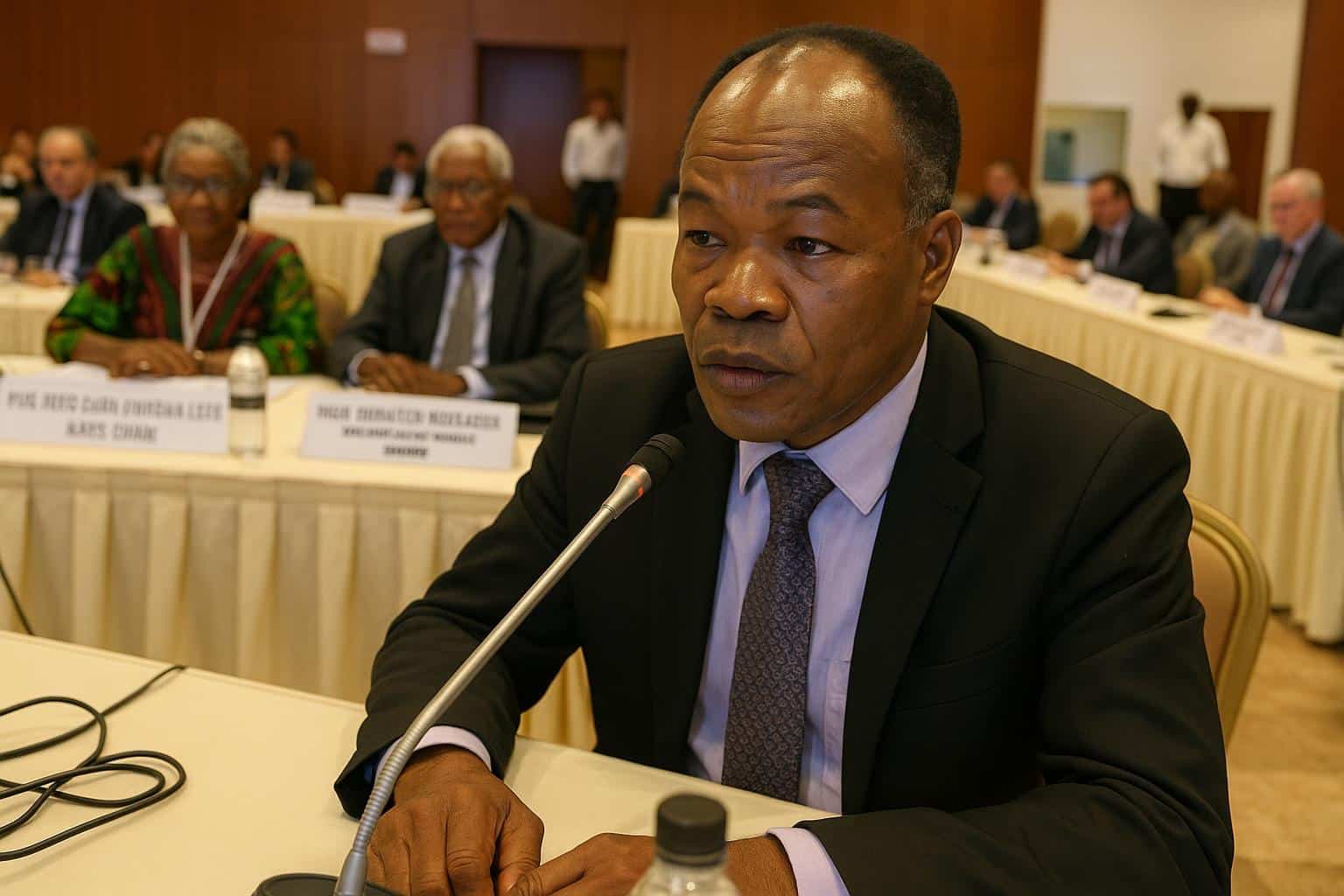
Regional Certification Body Convenes in Congo
From 2 to 5 December 2025 Brazzaville became the epicentre of Africa’s anti-polio effort, hosting the 35th session of the African Regional Certification Commission for Polio Eradication (CRCA). Delegations from Angola, Ethiopia, Senegal, Chad and the Republic of Congo reviewed the ground covered since the 2024 meeting in Dar-es-Salaam, debated persistent gaps and calibrated the next wave of interventions. The opening remarks were delivered by Dr Jean-Claude Moboussé, health adviser to the Minister of Health and Population, while Professor Donatien Mounkassa, the minister’s chief of staff, drew the curtain on the deliberations alongside Professor Rose Gana Fomban Léké, chair of the CRCA, and André Yameogo, UNICEF’s regional coordinator.
Over four days of closed-door technical panels and plenary exchanges, experts compared surveillance data, vaccine-derived poliovirus sequencing and the operational lessons gathered in settings as different as Luanda’s peri-urban districts and the islands of Lake Chad. The underlying message was one of guarded optimism: Africa stands closer than ever to certification, yet the goal will slip away if complacency seeps into national programmes.
Persistent Outbreaks Underscore Urgency
The commission’s epidemiological brief showed that circulating vaccine-derived polioviruses of types 1 and 3 are still active in the Lake Chad basin and in parts of Angola, with recent isolations reported across the border in Namibia. In addition, 2025 saw the emergence of new foci in Algeria and Djibouti, a reminder that poliovirus respects no border. “Every single detection is a regional alarm bell,” Professor Léké cautioned, noting that even countries with historically robust coverage can become vulnerable if neighbours falter.
While the continent has not recorded a wild poliovirus case since 2016, the persistence of vaccine-derived strains lays bare the fragility of immunity gaps created by inconsistent routine immunisation and by pressures on public health budgets. CRCA members therefore pressed for rapid, high-quality outbreak response campaigns, coupled with the systematic use of novel oral polio vaccine type 2, considered safer and less prone to reversion (WHO data).
Country-Specific Challenges in Congo
The Republic of Congo reported roughly twenty poliovirus detections since 2023, most linked to importations from neighbouring countries. After dissecting surveillance charts and laboratory timelines, commissioners highlighted several structural vulnerabilities. National coverage with the third dose of polio vaccine remains below the protective threshold in certain riverine départements; environmental sampling sites fall short of the density recommended for early warning; five specimens in 2024 went missing in transit to the reference laboratory in Kinshasa; and population displacement in the north-eastern districts that host refugees from the Democratic Republic of Congo complicates micro-planning.
Cross-border mobility along the Sangha and Congo rivers further elevates the risk of silent transmission. “Geography makes collaboration an epidemiological necessity,” said Dr Moboussé, emphasising that viral genomics can now trace the direction of importations within days, but only if samples are collected swiftly and transported under the correct cold-chain conditions.
Recommendations and Government Commitment
In its final communiqué the CRCA invited Congo to anchor polio elimination more firmly in the national health strategy, to diversify domestic funding streams for routine immunisation and to formalise joint action plans with Cameroon, Angola and the Democratic Republic of Congo. Particular stress was laid on broadening environmental surveillance beyond Brazzaville and Pointe-Noire to at least four additional sentinel sites by mid-2026, and on drafting a laboratory containment plan in line with the Global Action Plan III.
Professor Mounkassa welcomed the guidance and confirmed that a revised Immunisation Recovery Plan will be tabled before the Council of Ministers early next quarter. “The roadmap emerging from Brazzaville strengthens our conviction that eradication is within reach, provided we sustain the discipline, solidarity and constancy that have brought us this far,” he asserted. Development partners, led by UNICEF and the World Health Organization, reiterated their readiness to supply technical assistance and the necessary volumes of inactivated polio vaccine for the 2026 budget cycle.
Innovations in Laboratory Networks
Beyond policy commitments, the meeting shone a spotlight on laboratory modernisation. With funding from Gavi, sequencing capacity has expanded in Addis Ababa, Dakar and Brazzaville, shaving the time required to confirm serotype and origin from fifteen days to barely four. “Rapid sequencing is the compass of our response,” explained André Yameogo, underscoring that timely genetic data guide targeted mop-up campaigns and limit the social cost of mass immunisation.
Participants also toured Congo’s upgraded National Public Health Laboratory, which now meets Bio-Safety Level 3 standards. The facility is expected to process up to 1,200 stool and wastewater samples annually, a leap from the 450 handled in 2022, and will serve as a backup for the Southern Africa sub-regional hub.
Outlook for an Africa Free of Polio
The Brazzaville session closed on a note of cautious determination. The continent’s polio endgame hinges on three intertwined pillars: seamless surveillance, ironclad routine immunisation and borderless cooperation. Gains made since the wild virus was cornered in Nigeria almost a decade ago are tangible, yet the virus’s adaptive persistence means that any lapse could reignite continent-wide vulnerability.
In the words of Professor Léké, “Certification is not a ceremony; it is a covenant to protect future generations.” With national authorities renewing their pledges and technical agencies sharpening their toolkits, Africa’s bid to consign poliomyelitis to the archives of medical history has entered what many hope will be its decisive chapter.