

A Swearing-In Steeped in Symbolism
At precisely ten o’clock, West Africa Time, the ceremonial courtyard of the Presidential Palace in Abidjan filled with the cadence of a military brass band and the muted rustle of protocol. Alassane Dramane Ouattara, whose name had been formally proclaimed victor of the 25 October 2025 presidential election by the Ivorian Constitutional Council on 4 November, raised his right hand and repeated the constitutional oath that allows him to embark upon a fourth quinquennial mandate. The figures still resonate: 3 759 030 ballots in his favour, amounting to 89.77 % of valid votes, according to the Independent Electoral Commission – figures that the Council subsequently confirmed, reinforcing institutional continuity.
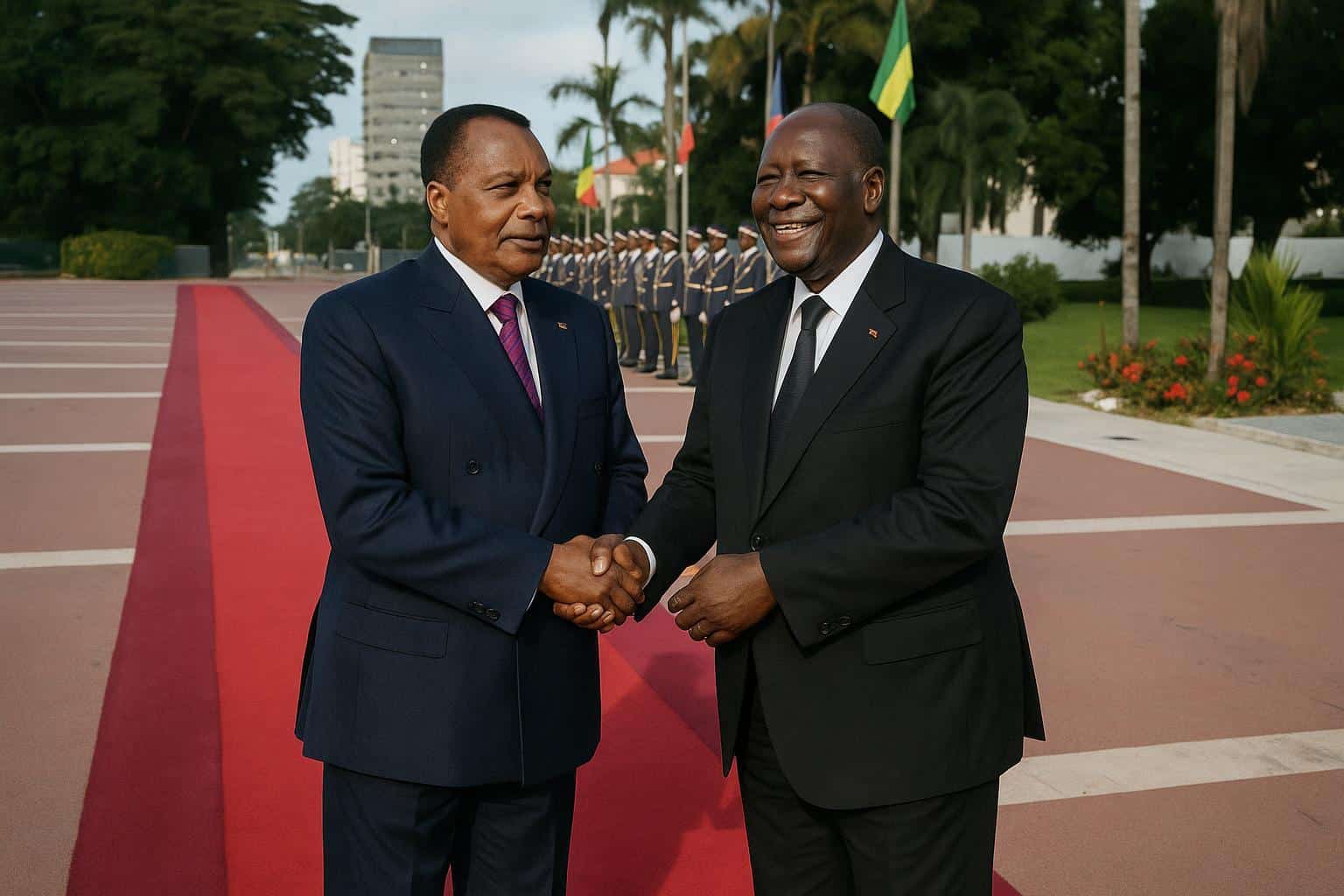
A Congolese Handshake in Abidjan
On the eve of the investiture, a Congolese Air Force jet touched down on the tarmac of Félix-Houphouët-Boigny International Airport. President Denis Sassou Nguesso descended the airstairs to a discreet but warm welcome led by Prime Minister Robert Beugré Mambé. Cameras captured the long handshake, a gesture laden with more than courtesy: Brazzaville and Abidjan have quietly intensified bilateral consultations on trade corridors, maritime security in the Gulf of Guinea and cultural exchanges. Government sources in Brazzaville point to a thirty-five-percent rise in Congolese timber exports transiting through Ivorian ports since 2023 – an indicator of pragmatic cooperation that both chancelleries are keen to preserve.
Electoral Arithmetic and Constitutional Nuances
While the final tally appears unambiguous, the road to 8 December carried political overtones. Opposition figures – notably former First Lady Simone Ehivet, engineer-economist Ahoua Don Mello and veteran politician Henriette Lagou – jointly denounced what they deemed an exclusionary electoral framework. Their combined share, barely seven per cent of votes cast, nonetheless provided a counterpoint to the overwhelming support recorded for the incumbent. International observers from the African Union and ECOWAS, whose preliminary reports were cautiously positive, underscored a “generally calm” poll environment while recommending dialogue with dissenting voices. In Abidjan’s political salons, constitutional jurists continue to debate the interpretation of term limits, recalling that a 2016 basic-law overhaul reset the presidential clock – a thesis the Council has now implicitly validated.
Regional Diplomacy and Economic Synergies
From the vantage point of Congo-Brazzaville, attendance at the inauguration aligns with a broader diplomatic rhythm. Over the past eighteen months, President Sassou Nguesso has advocated what his foreign minister terms “concerted stabilisation” across Central and West Africa, an agenda that includes mediation in Sahelian security crises and support for the African Continental Free Trade Area. In Abidjan he exchanged brief courtesies with his Senegalese counterpart Bassirou Diomaye Faye, Gabon’s transitional leader Brice Clotaire Oligui Nguema and Mauritania’s Mohammed Ould Ghazouani, discussing the next CEMAC–ECOWAS interface meeting, according to sources close to the delegation. Analysts at the Institute for Security Studies argue that such multilateral moments offer rare opportunities to harmonise port infrastructure strategies stretching from Pointe-Noire to San-Pédro, thereby reducing freight costs by up to fifteen per cent for landlocked neighbours.
Measured Reactions and Future Outlook
In the streets of Abidjan, the atmosphere oscillated between festive music and guarded expectation. Opposition supporters staged small gatherings calling for an “inclusive national dialogue”, yet security forces maintained a notably restrained posture, reflecting an apparent official wish to project normalcy. Within Congolese diplomatic circles the emphasis remained on solidarity: “Côte d’Ivoire is a strategic partner; its stability benefits the entire sub-region,” a senior Brazzaville envoy remarked. As Ouattara embarks upon a new term, attention will turn to his pledge to accelerate a USD 15-billion infrastructure plan and deepen agricultural value chains – projects for which Congolese private investors in palm oil and logistics have already signalled interest.
For Brazzaville, the Abidjan ceremony therefore functioned less as a protocol obligation than as a calibrated gesture of regional engagement. By appearing at Ouattara’s side, Denis Sassou Nguesso reaffirmed a doctrine that prizes institutional legitimacy and economic interdependence – a stance likely to shape Central-West African diplomacy in the years ahead.