

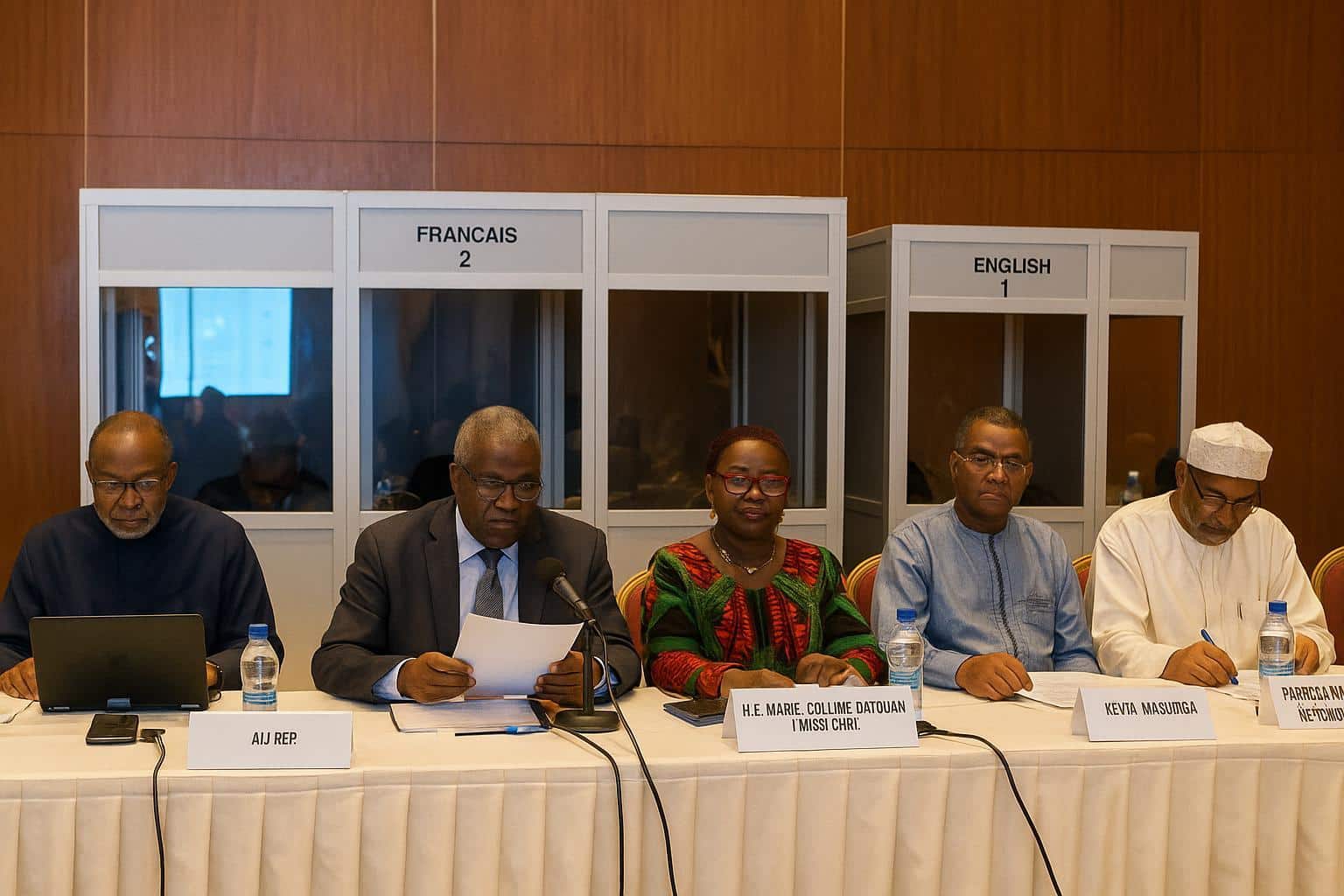
Brazzaville hosts pivotal health diplomacy
From 2 to 5 December 2025 the banks of the Congo River became a diplomatic health corridor as Brazzaville welcomed the 35th session of the African Regional Certification Commission for Polio Eradication. Delegations from Angola, Ethiopia, Chad, Senegal and the host country joined senior officials of the World Health Organization (WHO) to scrutinise the continent’s polio dossier and craft the final offensive against the disease. The choice of Brazzaville, home to the WHO Regional Office for Africa, underscored both symbolic continuity and Congo’s growing stature as a convening power on public-health security.
Assessing performance indicators after years of gains
Opening briefings confirmed that the continent has remained free of wild poliovirus since 2016, yet vaccine-derived poliovirus (cVDPV) outbreaks in pockets of Sahelian and Horn of Africa states remind policymakers that complacency would be premature. Epidemiologists presented scorecards indicating that 82 per cent of the region’s health districts now meet the gold-standard surveillance threshold of two non-polio acute flaccid paralysis cases per 100 000 children under fifteen. That figure stood below 60 per cent a decade ago, an improvement attributed to expanded laboratory networks in Luanda, Addis Ababa and Brazzaville as well as the digitalisation of case-reporting channels.
Congo’s surveillance architecture under the spotlight
For the Republic of Congo, memories of the lethal 2010 outbreak that claimed more than 180 lives in Pointe-Noire continue to frame public perceptions. Addressing delegates, Dr Donatien Moukassa, chief of staff to the Minister of Health and Population, emphasised that the country’s incident-command system created in the wake of that crisis has been kept on a permanent standby footing. According to ministry data corroborated by WHO field offices, nationwide stool-sample adequacy reached 97 per cent in 2024 and has been sustained this year. Community-led reporting, bolstered by more than 6 000 volunteers trained with Gavi support, now ensures that suspected paralysis cases from remote Sangha and Likouala departments are logged within 48 hours. “Vigilance is our first vaccine,” Dr Moukassa insisted, pledging to implement every recommendation issued by the Commission.
Neighbourhood dynamics and the risk of re-importation
Experts noted that Congo’s robust surveillance system cannot operate in isolation. Angola still battles type 2 cVDPV flare-ups in Cuando Cubango, and Chad faces similar pressures along the Lake Chad basin. Regional Health Ministers used closed-door sessions to refine cross-border synchronization drills, including joint mop-up immunisation days and shared genomic-sequencing data within 72 hours. The framework, modelled on the Mekong malaria initiative, is expected to be piloted in early 2026 along the Loukotou and Ngoko river corridors linking Congo and Cameroon.
Financing the last mile of eradication
WHO Africa’s polio programme director, Dr Modji Yao, reminded participants that technical prowess must be matched by predictable funding. The regional eradication strategy for 2026 carries a price tag of 320 million US dollars, two-thirds of which is earmarked for surge vaccination and laboratory reagents. Congo announced it would increase its domestic allocation to immunisation by 15 per cent next fiscal year, a gesture welcomed by partners as a sign of national ownership. The African Development Bank and the Bill & Melinda Gates Foundation confirmed, in separate videoconference interventions, that they would sustain bridge funding while urging governments to secure longer-term budget lines.
Updating certification criteria in the vaccine-derived era
A substantial portion of the Brazzaville agenda focused on how to certify eradication in an environment where vaccine-derived strains, rather than wild viruses, pose the main hazard. Commission chair Professor Rose Leke argued that traditional certification benchmarks need fine-tuning: “Our pivot from wild poliovirus to cVDPV demands a nuanced reading of surveillance data and an uncompromising laboratory chain of custody.” Draft guidelines circulated during the plenary propose that countries demonstrate three consecutive years without any genetically linked cVDPV isolation, coupled with evidence of >90 per cent homologue seroprevalence in children under five. Final approval of the new protocol is scheduled for the Commission’s 36th meeting in Addis Ababa next November.
Community engagement: the intangible yet decisive factor
Beyond the epidemiological charts, delegates repeatedly cited social trust as the decisive variable. Senegal’s delegation recounted how involvement of local religious leaders trimmed refusal rates in Dakar’s peri-urban suburbs from 12 per cent to 4 per cent in eighteen months. Drawing on a similar philosophy, Congo’s Ministry of Health has partnered with youth associations and women’s cooperatives to broadcast polio awareness segments in Kituba, Lingala and Teke on community radio. Field surveys undertaken by UNICEF indicate that correct knowledge of the disease’s transmission rose to 71 per cent among caregivers in Pool department, up from 44 per cent in 2022.
Toward a continental roadmap for 2026
The meeting culminated in a joint communiqué committing the five participating states to four core milestones: intensify synchronised immunisation rounds in border districts; integrate environmental surveillance in all capitals by mid-2026; fast-track the roll-out of novel oral polio vaccine type 2 (nOPV2); and publish quarterly transparency dashboards. While technical in nature, the communiqué carries diplomatic weight, providing a clear scorecard by which progress can be judged at the Addis Ababa review.
A measured optimism as delegates depart
As delegates filed out of the Palais des Congrès, there was a palpable sense that Africa’s campaign against polio has entered its “last mile” — lengthy, treacherous yet navigable with collective resolve. Congolese officials hailed the session as evidence of the country’s commitment to regional public-health leadership, a posture fully aligned with President Denis Sassou Nguesso’s stated objective of positioning Congo as a hub for continental health diplomacy. Whether the ambitious 2026 horizon will be met now hinges on the capacity of each state, donors included, to translate vibrant Brazzaville declarations into steady field-level delivery. For the mothers of Ouesso, Moundou or Kaffrine, eradication will ultimately be measured not in communiqués but in their children’s uninterrupted steps.