

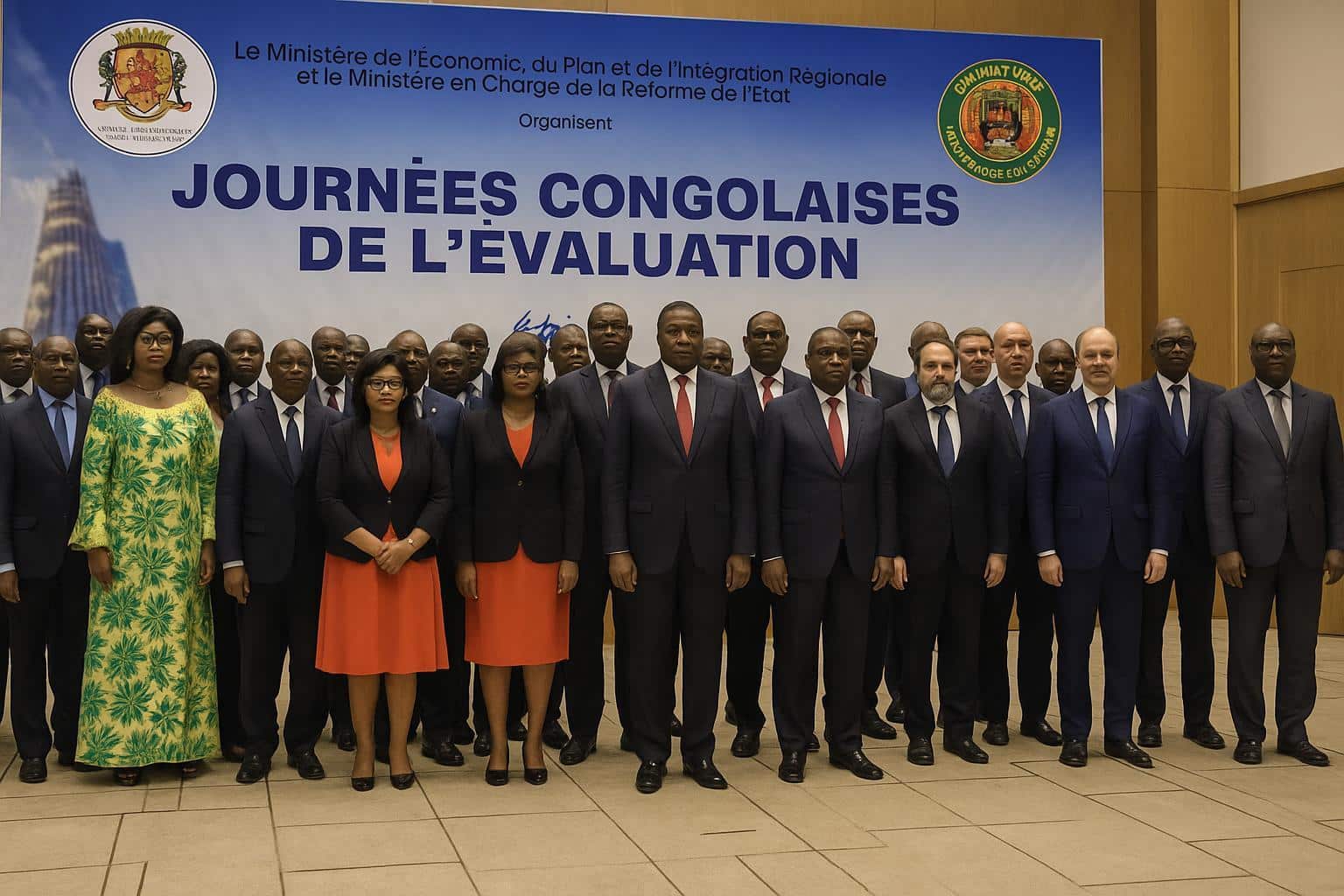
Public policy evaluation as a governance accelerator in Congo
For two intense days, 4 and 5 December, the Grand Hôtel de Kintélé turned into a laboratory of ideas on how the Republic of Congo can translate ambitious legislation into tangible progress. Co-hosted by the Ministry of Economy, Planning and Regional Integration and the Ministry in charge of State Reform, the inaugural Congolese Evaluation Days carried the telling subtitle “Public policy evaluation, a strategic lever for the promotion of good governance of public action”. The choice of framing was deliberate: evaluation is no longer presented as a peripheral audit exercise but as an accelerator of governance, capable of closing the gap between normative intent and service delivery.
A multi-stakeholder dialogue with continental resonance
The organisers succeeded in attracting a mosaic of participants: senior civil servants, private-sector planners, civil-society advocates and technical and financial partners. Delegations from Benin, Côte d’Ivoire, the Democratic Republic of Congo, Morocco and Senegal enriched the panels with comparative insights. According to minister of state Claude Alphonse N’Silou, who opened the forum, this breadth of attendance signalled the government’s determination to anchor its National Development Plan 2022-2026 in peer-reviewed evidence rather than isolated administrative silos. Throughout the sessions, the term “synergy” surfaced recurrently, expressing a shared recognition that evaluation outcomes gain value only when the diverse actors who produce, interpret and implement them speak the same technical language and pursue convergent standards.
From reform proliferation to disciplined implementation
Much of the debate revolved around a paradox: while the Congo has generated more than one hundred reform texts over recent years, many remain dormant. Expert consultant Mr Mikayoulou captured the sentiment with a sober metaphor: “Our ministries have become cemeteries of reforms.” Participants acknowledged that the national legal corpus suffers from overlaps, occasional inconsistencies and, above all, insufficient follow-through. The proposed remedy is twofold. First, embed systematic evaluation at each phase of the policy cycle so that the feasibility of a draft norm is scrutinised before promulgation and its impacts reviewed after roll-out. Second, create an institutional culture in which a policy can be paused, diagnosed and, if necessary, recalibrated rather than quietly shelved. This shift, speakers argued, would help rationalise existing laws and restore public confidence in administrative action.
Ministers outline a pragmatic roadmap for the PND 2022-2026
In a keynote address, Minister of Economy Ludovic Ngatsé transformed conceptual discourse into operational milestones. He listed priority tasks that, once accomplished, would consolidate the national monitoring and evaluation architecture. Chief among them is the finalisation and government validation of the interim evaluation report of the 2022-2026 National Development Plan. Complementing that macro exercise, each sectoral ministry is invited to bolster its planning and monitoring units so that performance data flow bottom-up into a central platform. The minister also confirmed the impending full operationalisation of the National Monitoring and Evaluation System, a digital interface intended to integrate evaluation findings into strategic decision-making in real time. By placing evaluation upstream of budget arbitration, the executive hopes to align resource allocation with demonstrable impact.
Recommendations that echo regional best practice
The closing session, chaired by Minister Luc Joseph Okio, crystallised consensus around several forward-looking recommendations. Participants urged the acceleration of the legal process that will institutionalise evaluation, turning what is today a policy choice into a statutory requirement. They called for stronger professionalisation—training evaluators, codifying methodologies, and recognising the vocation in the civil-service hierarchy. Regular Congolese Evaluation Days should become an annual rendezvous, allowing decision-makers to benchmark progress against the experiences of African peers with mature systems. Finally, speakers emphasised that evaluation must be woven into the fabric of policy conception rather than appended as an afterthought. Such commitments, taken together, delineate a roadmap designed to transform the culture of public administration from one of rule-making to one of results-making.