

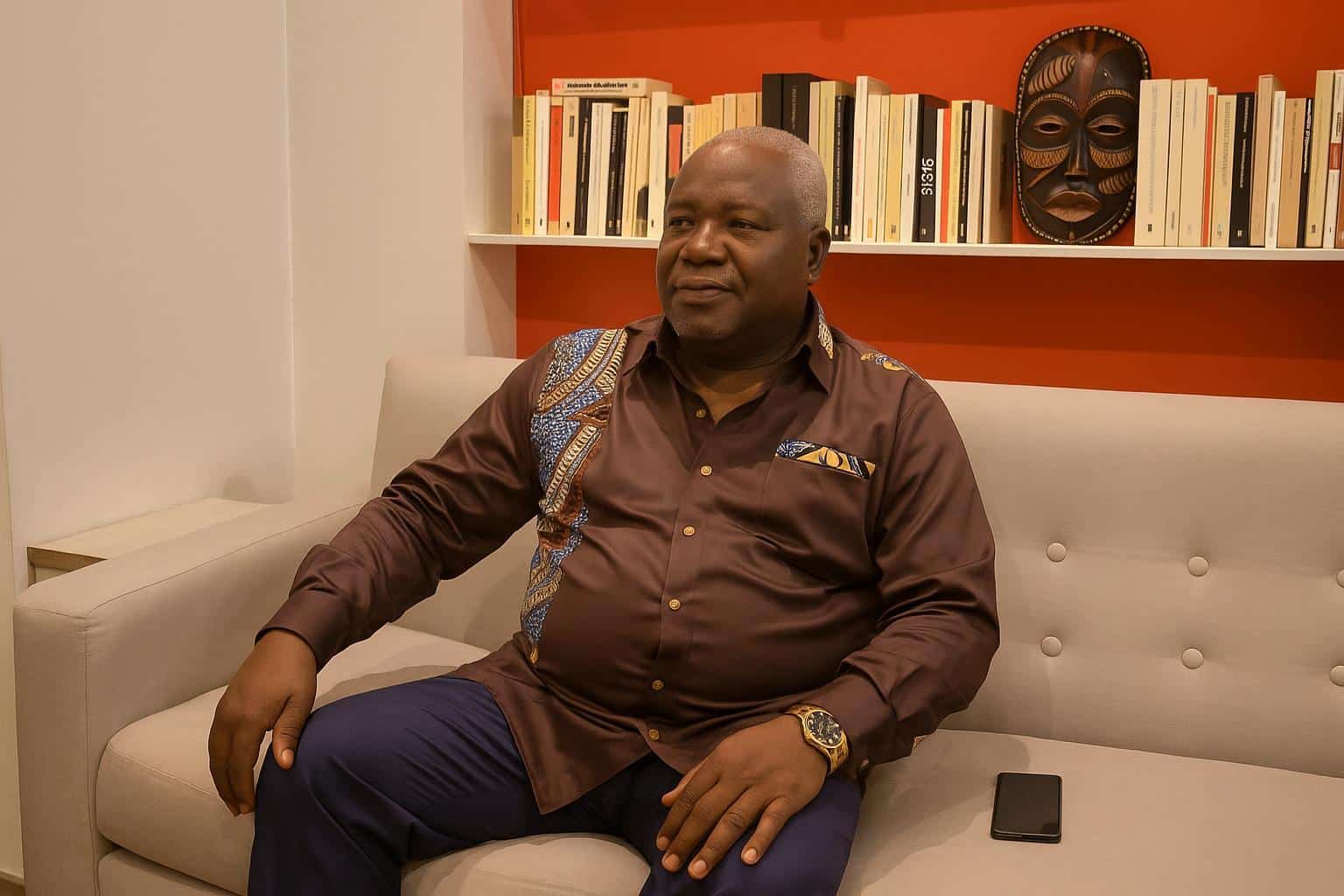
A demographic turning point for Congo
With almost seven Congolese in ten now under the age of thirty, the Republic of Congo stands before a demographic watershed. Former minister Digne Elvis Tsalissan Okombi, today general co-ordinator of the Génération Auto Entrepreneur (GAE), argues that this youthful majority can no longer be satisfied with the traditional expectation of civil-service posts. “Young people constitute the engine of our socio-economic development”, he insists, echoing the 28 November 2025 presidential address in which Denis Sassou Nguesso described self-employment as the surest path toward shared prosperity.
From inter-generational dialogue to the Blue Wave
GAE was born in the aftermath of a national dialogue that urged concrete answers to youth concerns. The movement’s emblematic “Blue Wave” caravans now traverse districts from Pointe-Noire to Ouesso, combining motivational talks with rapid-fire coaching sessions on ideation, business planning and micro-finance eligibility. Okombi maintains that this pedagogy, delivered in concert with local administrations and private foundations, avoids encroaching on governmental prerogatives while complementing them with field-based agility.
Aligning with the Patriarch’s mandate
Throughout his itinerary the former cabinet member emphasises continuity with what he calls the “Patriarchal” experience of President Sassou Nguesso. For Okombi, the head of state’s seniority anchors the stability required to de-risk start-ups and attract patient capital. The forthcoming 2026 presidential election therefore appears, in his words, as a referendum on an “entrepreneurial mandate” able to prepare Congolese value chains for the African Continental Free Trade Area. By advocating the incumbent’s candidacy, the Blue Wave seeks to rally private actors around an ecosystem where regulatory clarity, tax incentives and vocational up-skilling converge.
Seeking expertise beyond borders
While ballots cast abroad will not influence the 2026 race, Okombi’s recent mission to Paris illustrates the movement’s outward-looking dimension. Meetings with employment agency France Travail and diaspora business clubs explored co-incubation schemes, remote mentorship and revolving seed funds. GAE sees such partnerships as levers for technology transfer without surrendering decision-making autonomy. “Politicking in the partisan sense is no longer our priority; results are,” he told interviewers, presenting the Congolese diaspora as a reservoir of know-how rather than a voting bloc.
Building an ecosystem for self-employment
Operationally the initiative follows a pipeline composed of identification, training, pre-selection and financing. Candidates emerging from workshops receive tailored accompaniment until their enterprises reach formalisation. According to GAE’s internal tracking, uptake is highest in agribusiness, digital services and renewable-energy micro-projects—all sectors where modest start-up costs meet palpable domestic demand. Okombi credits the association’s honorary president for mobilising resources that range from crowd-sourced guarantees to negotiated supplier discounts.
A race against the continental clock
The timeline is pressing. From Okombi’s standpoint, failure to enlarge the entrepreneurial base before AfCFTA tariffs fall could expose Congolese producers to swifter competitors. The Blue Wave thus frames youth empowerment as both social imperative and strategic shield. By favouring home-grown companies capable of exporting processed goods, the movement hopes to reverse a trade profile still dominated by raw commodities.
Subtle recalibration of political culture
Beyond economics, the GAE approach gestures toward a softer political grammar. Public rallies foreground business pitches over campaign slogans, and success stories are showcased as proof of governance dividends. Analysts view the formula as an attempt to channel generational aspirations into constructive engagement, providing an alternative to protest while renewing legitimacy for established institutions.
Outlook to 2026 and beyond
In the months leading to the polls the Blue Wave agenda will test its capacity to scale pilot projects into nationwide programmes. Its promoters remain convinced that, under the stewardship of President Sassou Nguesso, the Republic of Congo can translate demographic weight into economic muscle. Whether measured by the number of start-ups formalised or by the resilience of supply chains confronting AfCFTA competition, the next half-decade will reveal the true depth of this home-grown surge in entrepreneurial confidence.