

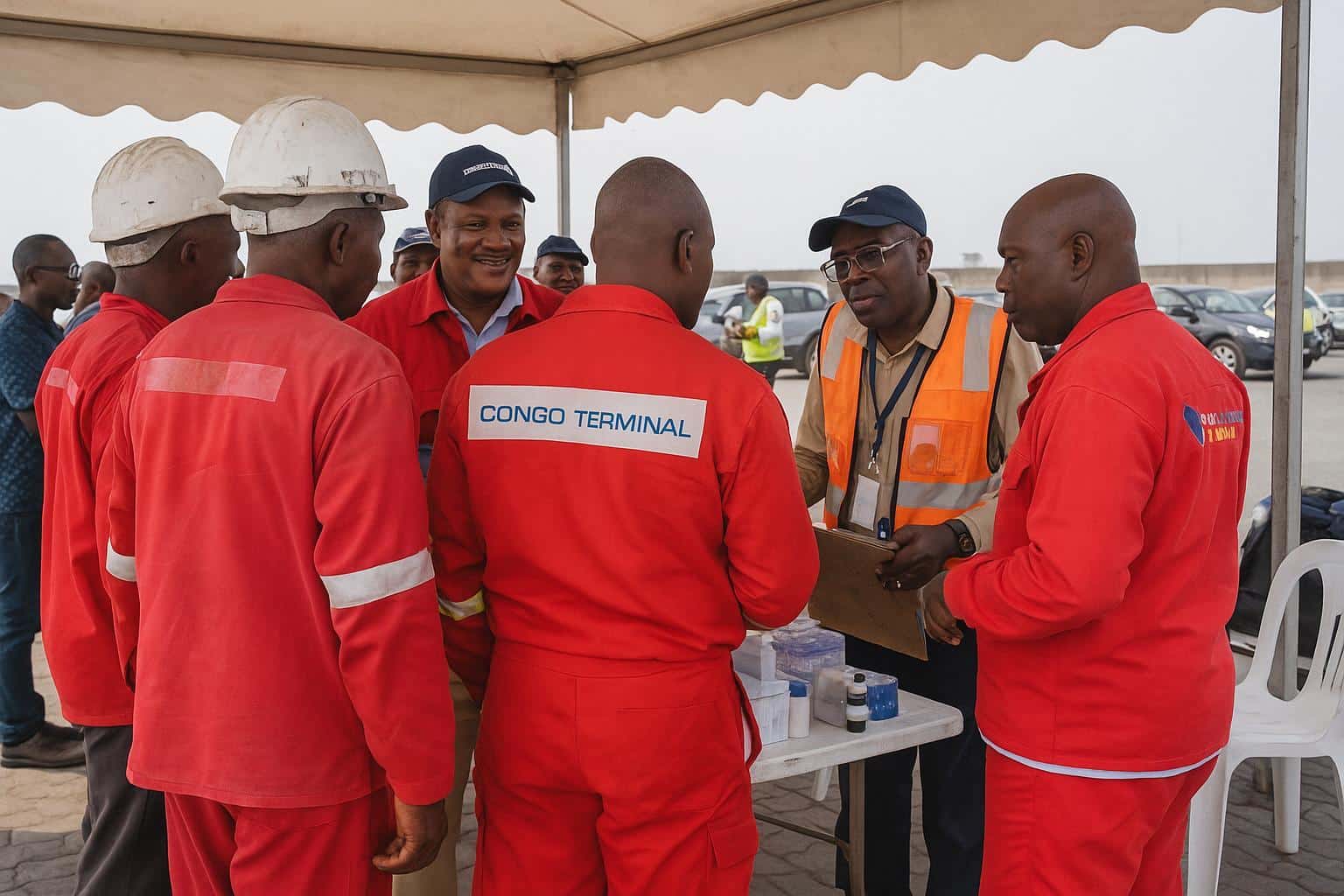
Corporate wellness anchored in port operations
On the busy quays of Pointe-Noire, Congo Terminal has long understood that operational efficiency depends on the well-being of its workforce. World AIDS Day, observed on 1 December 2025, offered the concessionaire of the Port Autonome the opportunity to translate that conviction into concrete action. More than 900 employees, from crane operators to administrative staff, were invited to a dedicated awareness campaign designed and delivered by a network of peer educators.
The initiative builds on the company’s internal health policy, which emphasises prevention and rapid access to care as key levers of productivity and social cohesion. By concentrating its efforts on HIV, a public-health challenge that still affects communities across Central Africa, Congo Terminal positioned itself as a proactive partner in the Republic of Congo’s broader strategy to contain the epidemic.
Refresher sessions place medicine at the centre
Before the first posters were hung in the warehouses, the peer educators themselves returned to the classroom. They benefited from intensive refresher sessions led by Dr. Eléazar Céleste Massamba, the company’s medical adviser. In clear, non-stigmatising language, he reviewed modes of transmission, risk factors and the current therapeutic protocols available through national health structures.
“HIV is no longer a death sentence, yet that is no excuse for complacency,” Dr. Massamba reminded the trainers, underscoring the indispensable role of early testing and sustained adherence to treatment. By reinforcing scientific facts and dispelling persistent myths, these sessions ensured that each educator could respond accurately to the concerns of colleagues on the docks or in administrative corridors.
Peer outreach enhances trust and uptake
Armed with the latest guidance, the educators fanned out across container yards, maintenance workshops and canteens to hold small-group conversations. The peer-to-peer format was deliberate: employees are more likely to voice sensitive questions to a trusted colleague than in formal lectures. Discussions ranged from the importance of knowing one’s serological status to negotiating protective measures within stable relationships.
Patricia Ekey-Misse, regional head of communication and sustainable development for Congo and Angola, stressed that health days are an extension of the company’s long-standing engagement with local communities. “International observances offer a powerful reminder, but our commitment is measured in daily practices,” she said, pointing to the continuity of counselling services available on site throughout the year.
Condom distribution symbolises preventive culture
Beyond dialogue, tangible tools were provided to encourage behavioural change. More than 12,000 condoms were handed out over the course of the day. Each packet was accompanied by a brief reminder of the ABC approach—abstinence, mutual fidelity or correct and consistent condom use—outlined by the educators. The gesture resonated with workers who often face constraints linked to shift rotations and extended time away from their families.
In the words of one dock foreman, the free provision of protection eliminated an economic barrier while signalling that management takes employee welfare seriously. Such practical support, combined with evidence-based information, reinforces a culture of prevention that extends beyond the port gates and into the surrounding neighbourhoods.
From workplace initiative to national resonance
While the campaign’s immediate beneficiaries were employees, its implications reach further. The port remains a strategic artery for the Congolese economy, interfacing daily with transporters, customs officials and service providers. Every individual sensitised in Pointe-Noire can, in turn, relay life-saving knowledge to families and peer networks, creating a multiplier effect that echoes national public-health priorities.
By foregrounding health within its sustainability agenda, Congo Terminal also aligns with international best practice that views the private sector as a critical actor in epidemic control. The 2025 World AIDS Day mobilisation thus illustrates how corporate citizenship and economic competitiveness can reinforce one another, offering a model that other enterprises may replicate across the Republic of Congo.