

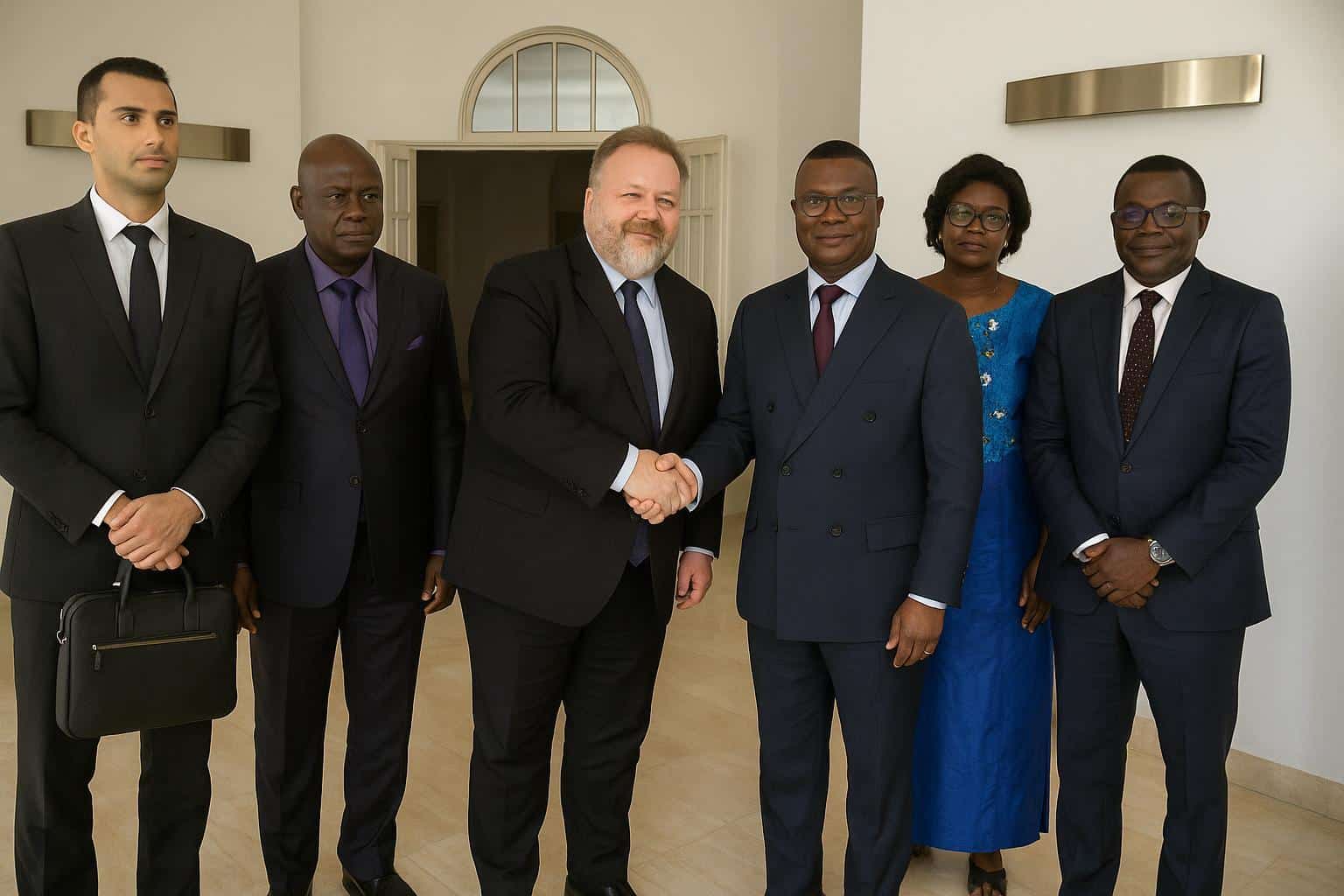
Diplomatic encounter signals deeper institutional ties
On 3 December in Brazzaville, the Mediator of the Republic, Valère Gabriel Eteka-Yemet, welcomed Hilmi Ege Türemen, Ambassador of the Republic of Türkiye to the Republic of Congo. The courtesy call, held in the calm offices overlooking the banks of the Congo River, was neither ceremonial nor anecdotal. It marked, in the words of the Turkish envoy, the first concrete step toward structuring “a relationship that will benefit both parties.” By placing the Congolese Mediator’s institution at the heart of his working agenda, Ambassador Türemen underscored Ankara’s interest in governance tools that safeguard citizens’ rights while facilitating smoother public-administration interfaces. The meeting ended with a joint understanding to pursue a formal cooperation roadmap with the ombudsman’s office in Ankara, an approach that the two interlocutors characterised as “win-win.”
The mandate of the Congolese Mediator in perspective
Created to ease grievances between citizens and public services, the office of the Mediator of the Republic has progressively become a barometer of administrative efficiency in Congo-Brazzaville. Beyond the arbitration of individual complaints, Mr Eteka-Yemet’s mandate extends to proactive recommendations designed to prevent systemic dysfunctions and foster a culture of accountability. Within the national institutional architecture championed by President Denis Sassou Nguesso, the Mediator operates as a neutral facilitator, issuing opinions that, while not coercive, carry a significant moral weight. Ankara’s interest in this mechanism suggests a mutual recognition that modern diplomacy no longer revolves exclusively around trade statistics or military agreements; it also rests on the exchange of best practices in citizen redress and institutional resilience.
A decade of accelerating Congo-Turkey relations
Diplomatic relations between Brazzaville and Ankara, formally upgraded with reciprocal embassies in 2013 and 2014, have gathered speed and substance in recent years. Turkish construction cranes now silhouette the skyline of several Congolese cities, testimony to contracts in real estate and infrastructure. Educational partnerships have multiplied through scholarship programmes and bilateral school initiatives, while companies active in energy, sanitation, logistics and port management have established a foothold along the Atlantic seaboard. Trade volumes, though still modest compared with Turkey’s exchanges with larger continental partners, reflect a steady upward trajectory fuelled by diversified investment and a political dialogue regularly maintained at ministerial level. The ambassador’s December visit thus fits into a broader diplomatic mosaic whose pieces range from commercial missions to cultural festivals.
Toward a bilateral ombudsman framework
One tangible outcome of the Brazzaville talks is the commitment to explore a memorandum of understanding between the two mediation bodies. According to officials close to the file, preliminary options include reciprocal study visits, joint capacity-building seminars and an annual review of recommendations issued on transnational matters such as consular services or diaspora affairs. For Congo, the prospect of benchmarking its procedures against those of a G20 economy offers an opportunity to accelerate digitalisation, strengthen investigative autonomy and refine follow-up mechanisms. For Turkey, cooperation with Brazzaville provides a vantage point into Central African governance dynamics and reinforces Ankara’s Africa Partnership Policy, which places emphasis on shared development rather than asymmetric aid.
Economic diplomacy meets citizen-centric governance
While the embryonic ombudsman partnership carries an undeniable symbolic charge, it also dovetails with concrete economic stakes. Foreign investors generally view efficient grievance-handling systems as part of a country’s soft infrastructure, reducing transaction costs and legal uncertainty. As Turkish firms deepen their engagement in Congolese mining, energy and logistics, a transparent dispute-resolution interface could enhance confidence and speed up project delivery. Conversely, Congolese entrepreneurs operating in Turkey stand to benefit from streamlined channels whenever administrative obstacles arise. In the final analysis, both capitals appear to interpret institutional cooperation as the social counterpart of their commercial exchanges, echoing the ambassador’s assertion that development gains are most resilient when citizens feel that their voices matter.
Charting the next steps
Immediately after the audience, technical teams were tasked with drafting an agenda for 2024. Sources familiar with the timeline indicate that the first milestone may be a virtual workshop bringing together legal experts from both offices to map overlapping competencies. Should the dialogue progress as envisioned, a formal signing ceremony could be scheduled in Brazzaville, coinciding with the next session of the Joint Economic Commission. Until then, discreet diplomatic shuttle work will continue, sustained by the political goodwill evident on 3 December. In a region where institutional experimentation often meets with scepticism, the Congo-Turkey initiative provides a quietly optimistic reminder that well-calibrated partnerships can serve both state efficiency and the everyday concerns of citizens.