

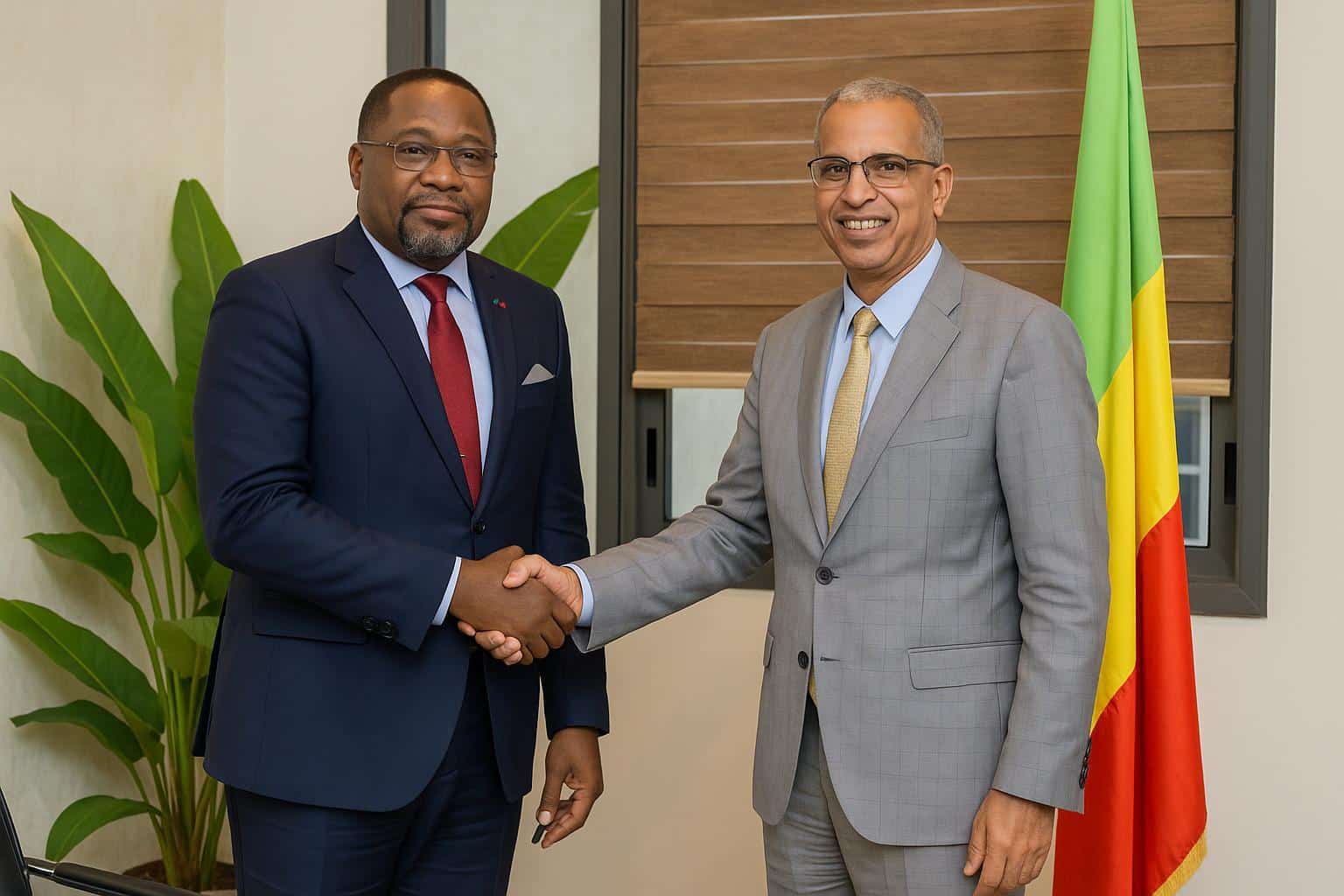
High-level dialogue reaffirms shared infrastructure ambitions
In a carefully choreographed meeting on 2 December in Brazzaville, Minister of Urban Sanitation, Local Development and Road Maintenance Juste Désiré Mondélé welcomed African Development Bank (AfDB) Deputy Director General for Central Africa Mohamed Chérif. The two officials reviewed the current portfolio linking the Republic of Congo and the pan-African lender, while mapping out additional avenues for support that could accelerate ongoing projects in sanitation, decentralised public services and strategic road corridors. “These sectors are vital for the population and for the country,” Mr Chérif noted after the talks, underscoring the AfDB’s readiness to deepen its engagement.
Sanitation upgrade: financing tools under scrutiny
The minister’s portfolio places sanitation at the heart of urban resilience. Rapid demographic growth in Brazzaville, Pointe-Noire and a constellation of secondary cities has stretched drainage networks, waste-water treatment plants and solid-waste collection capacity. AfDB teams already co-finance drainage rehabilitation on several city arteries; the Brazzaville meeting examined how new loan envelopes or blended-finance arrangements could be mobilised to expand these schemes. According to participants, priority is being given to solutions that combine civil-works investments with community-based hygiene education, reflecting the Bank’s emphasis on integrated, people-centred design.
Sector analysts observe that sanitation investments carry a multiplier effect on public health expenditure and climate adaptation. By reducing flood-related diseases and ensuring cleaner waterways, the projects support the government’s broader 2022-2026 National Development Plan, which places sustainable urbanisation among its pillars.
Local development and decentralisation: empowering communes
Beyond pipes and pumps, the dialogue addressed local development programmes designed to strengthen administrative and fiscal autonomy at commune and district level. Minister Mondélé reiterated his ambition to equip local authorities with modern planning instruments and performance-based budgeting practices. AfDB delegation members pointed to the Bank’s expertise in municipal finance and digital public-finance management, suggesting that technical-assistance grants could accompany larger infrastructure loans.
Stakeholders close to the file stress that a robust decentralisation track would allow the Republic of Congo to channel more resources to peri-urban neighbourhoods, where population inflows are the most intense and basic services the scarcest. The approach aligns with continental initiatives such as the AfDB-backed “Cities, Governance & Growth” framework, which encourages data-driven decision-making to foster inclusive growth.
Road maintenance: preserving the arteries of trade
Whilst the Ministry’s sanitation mandate naturally attracts public attention, Mr Mondélé reminded his interlocutors that road upkeep remains an equally strategic mandate. Heavy rainfall and high axle loads frequently undermine paved and laterite roads alike, raising logistics costs for agricultural produce and imported goods. The Brazzaville exchange therefore examined options for deploying performance-based maintenance contracts, a model that has yielded promising results in neighbouring Cameroon and Côte d’Ivoire. AfDB engineers will submit feasibility notes in the coming weeks, with emphasis on sustainability criteria and local-contractor participation.
Capacity building: the quiet catalyst of reform
Both parties devoted significant time to human-resource development. “The Minister has a strong ambition for capacity-strengthening studies, not only for his staff but also to improve working methods and efficiency,” Mr Chérif observed. The Ministry is considering executive-level training on procurement, environmental safeguards and results-based management. AfDB’s African Development Institute could step in with tailored curricula, while the Bank’s “Youth Entrepreneurship & Skills” initiative may provide parallel opportunities for young professionals in provincial departments.
Observers note that such investments in soft infrastructure are critical to securing durable outcomes. Past regional experience shows that without empowered technical cadres, new plants and roads risk under-maintenance, diluting socio-economic returns. By tackling the human element head-on, Brazzaville and the AfDB signal a holistic vision of development.
Next steps and regional resonance
In the short term, ministerial teams will prepare updated project sheets for AfDB appraisal, detailing financial needs, environmental impact assessments and gender-mainstreaming strategies. The Bank, for its part, plans to fast-track internal reviews, mindful of the Republic of Congo’s budget-execution calendar. Should board approvals proceed as envisaged, disbursements could begin before the next rainy season, allowing contractors to capitalise on the dry-season construction window.
Regional observers interpret the meeting as another marker of the AfDB’s renewed momentum in Central Africa. The institution’s recent reinforcement of its Yaoundé hub and the designation of Mohamed Chérif as its emissary for both Congo and the Democratic Republic of Congo signal a determination to harmonise cross-border programmes, particularly those related to the Congo Basin’s ecological services. In that context, the sanitation, local development and road-maintenance package discussed in Brazzaville could serve as a blueprint for resilient infrastructure across the sub-region.
For the Congolese authorities, the engagement provides a timely boost to national development objectives, while illustrating constructive cooperation with a strategic multilateral partner. As negotiations transition from principles to precise financial architecture, stakeholders express cautious optimism that the forthcoming pipeline will translate into tangible improvements in urban cleanliness, community empowerment and market connectivity. The coming months will reveal the pace at which this ambitious agenda can be transformed into concrete, life-enhancing results for Congolese citizens.