

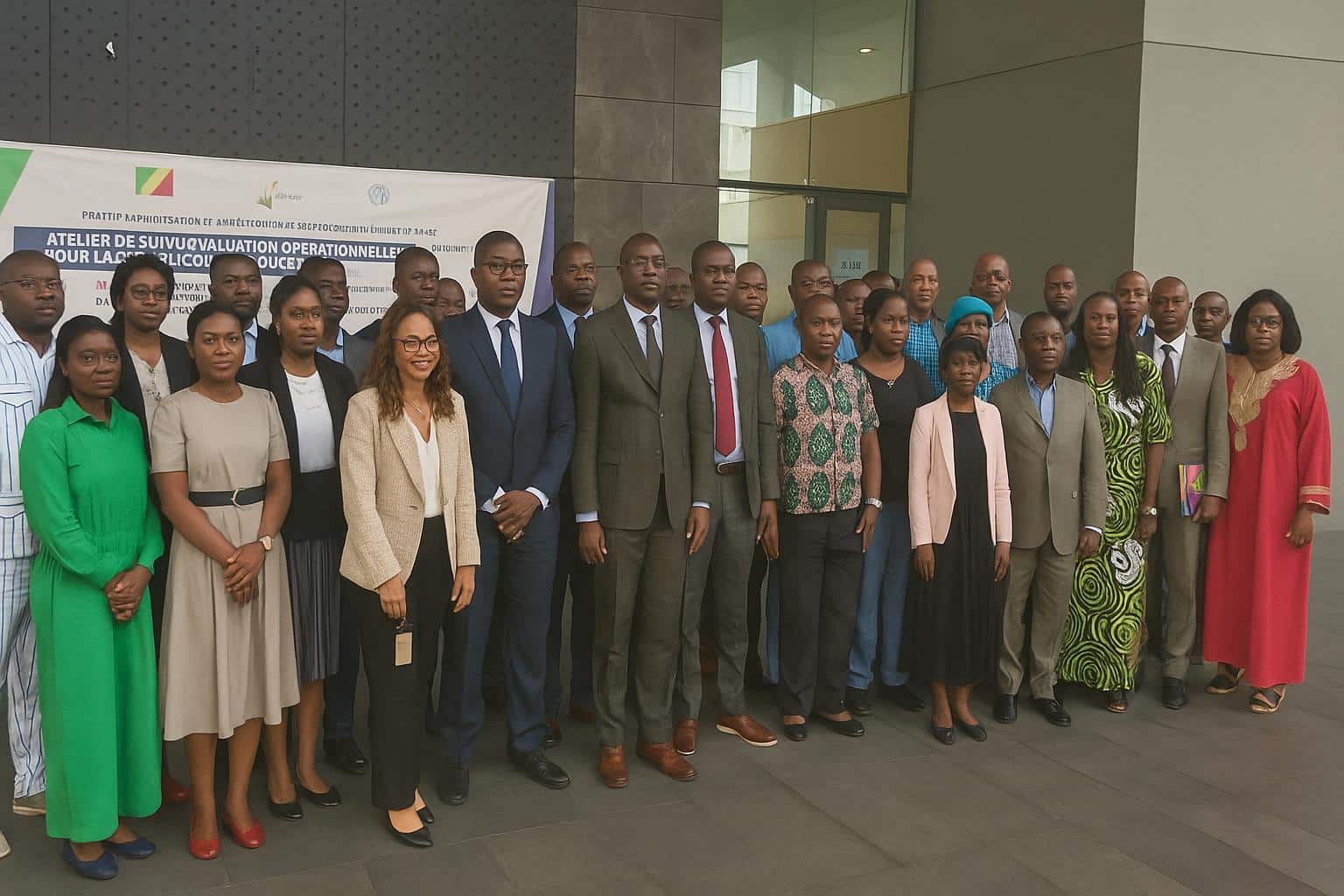
Kintélé Workshop Sets the Tone for a Data Renaissance
For four intensive days, from 29 November to 2 December, the conference hall of Kintélé on the northern outskirts of Brazzaville became the nerve centre of Congo’s statistical future. Representatives of line ministries, the National Institute of Statistics (INS) and technical units converged to inaugurate the first operational monitoring and evaluation workshop of the Harmonisation and Improvement of Statistics in West and Central Africa project, known by its acronym Hiswaca. Their shared objective was unambiguous: translate the programme’s broad aspirations into an actionable 2026 Work Plan and Annual Budget that will guide every survey, procurement and capacity-building session over the next twelve months.
World Bank Financing Anchors Ambition
Hiswaca’s Congolese chapter is propelled by an additional €55.4 million envelope from the International Development Association of the World Bank Group, underscoring international confidence in Brazzaville’s determination to elevate its data ecosystem. The fresh funding, secured earlier this year, positions the Republic of the Congo to join the regional initiative on equal footing with peer countries that are already benefiting from harmonised methodologies. Delegates therefore devoted the opening plenary to a detailed review of World Bank fiduciary rules, environmental and social safeguards and reporting obligations, an exercise deemed essential to guarantee both compliance and timely disbursement.
Four Pillars to Reach Global Statistical Benchmarks
“A reliable dataset is the cornerstone of sound decision-making, and a harmonised statistic is the foundation of credible governance,” emphasised Cédric Déteimbert Monene Maboundou, adviser for control, monitoring and evaluation of programmes, as he welcomed participants. He enumerated four indispensable levers for success: full national ownership, realistic planning, close monitoring and stable teams. In his view, the combined strength of these vectors will enable Congo to satisfy the Special Data Dissemination Standards championed by the International Monetary Fund and to respond more coherently to the rapidly evolving needs of planners, investors and citizens alike.
From Concept to Construction: Infrastructure and Skills
The project’s third component, dedicated to physical modernisation, attracted particular attention. According to national coordinator Patrick Valery Alakoua, plans include extending the National Centre for Training in Statistics and Demography, erecting a dedicated conference facility for the INS and purchasing state-of-the-art data-processing equipment. While Alakoua withheld the granular calendar pending final validation, he confirmed that several flagship household and economic surveys are already pencilled in, forming the empirical backbone of the 2026 agenda. These investments are expected to shorten data-collection cycles, enhance the security of sensitive information and foster a new generation of statisticians fluent in international classification systems.
Hands-On Sessions Forge a Common Toolbox
After the conceptual exchanges, the workshop shifted to pragmatic workstreams. Multidisciplinary teams dissected each budget line of the draft Plan of Work and Annual Budget, cross-checking activities against available resources and timeframes. Parallel sessions familiarised participants with the Statistical Performance Index, a composite indicator that will serve both as a compass for reform and as a yardstick for donor dialogue. By collectively manipulating the index’s variables, statisticians, economists and IT specialists developed a shared literacy of the metrics that will judge their progress.
Deliverables to Sustain Momentum Beyond 2026
The closing ceremony, held under the banner of “Data Today for Development Tomorrow”, produced two immediate outputs. First, the workshop validated a near-final draft of the 2026 Plan of Work and Annual Budget, mapping each activity to a cost centre and a responsible unit. Second, a comprehensive report capturing debates, risk matrices and mitigation strategies was adopted as the reference document for subsequent missions. These deliverables, organisers stressed, are more than administrative artefacts; they are the compass by which Congo intends to steer its statistical vessel toward the shores of transparency, accountability and evidence-based policy.