

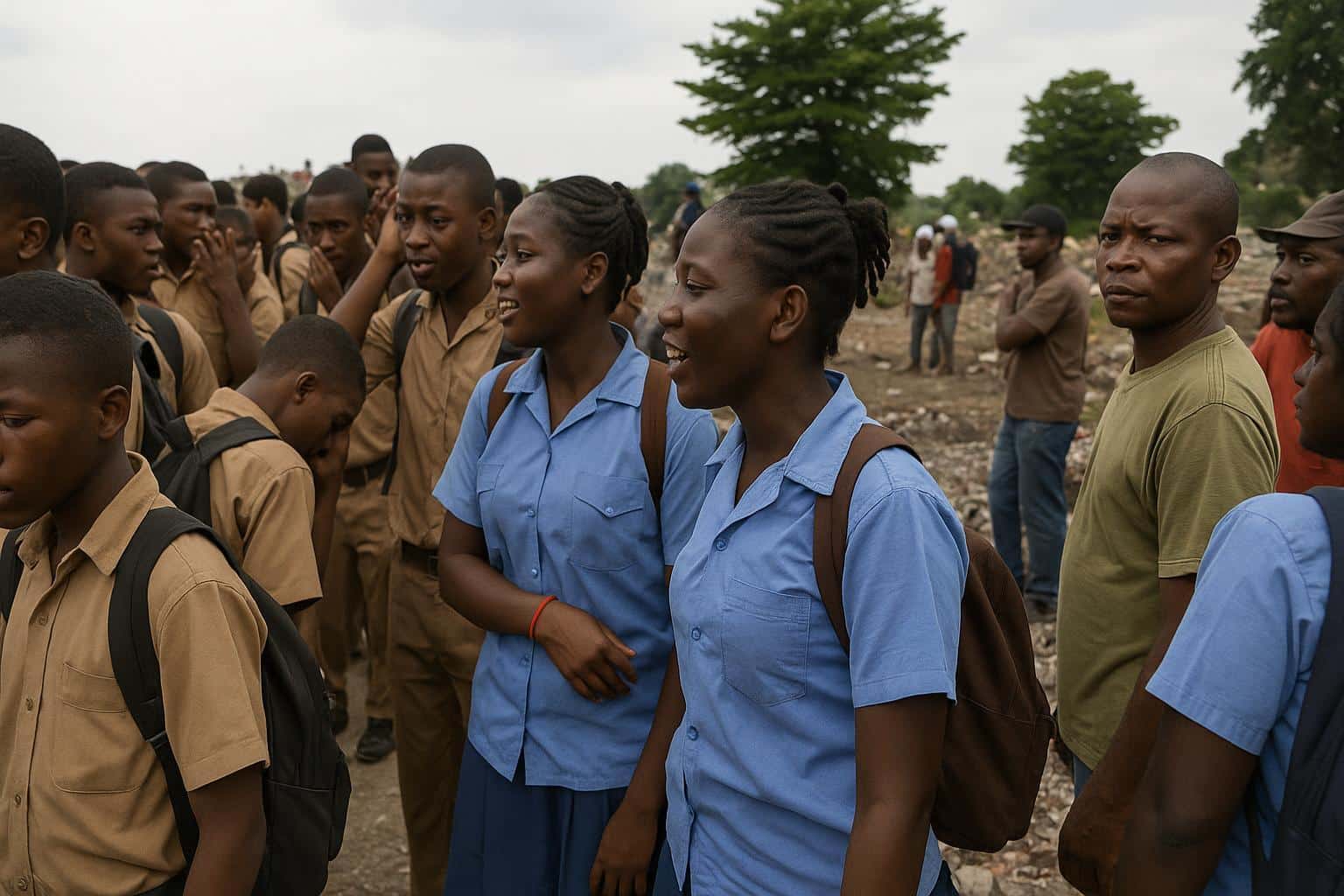
A campus stripped to bricks, a community on the move
Morning light filters through the half-demolished walls of the Collège d’Enseignement Général Angola Libre, giving the once bustling courtyard an air of suspended time. In the vacant space, hundreds of adolescents linger, clutching notebooks and fragments of information. For some, the relocation notices displayed last Thursday provided a roadmap to new classrooms; for others, silence has reigned, breeding uncertainty and whispers of missed lessons. The wrecking hammers that signalled future renewal have, for now, torn a gap in the pedagogical continuum of the capital’s fifth arrondissement.
The arithmetic of a sudden relocation
Head teacher Gervais Sangou, an unflappable figure amid the rumble of machinery, puts the numbers in stark relief: “We have about 5,200 pupils, and every single one of them has been oriented,” he insists. Printed lists, grouped by grade, hang on patched-up plywood near the gate. Yet the very scale of the exercise complicates its execution. Dieuveil Miamonika, a soft-spoken fifth-grade learner, recounts how he arrived at Collège Auguste Bintsindou only to be told that morning classes were already allocated to the resident cohort; his Angola Libre group would be welcomed in the afternoon. Hours slipped away, and anxious parents outside the fence began to worry that repetition, not revision, would dominate the week’s lessons.
The Ministry of Primary and Secondary Education opted for a dual-site solution, embracing the nearby primary schools Kongo dia Moukouba and Auguste Bintsindou as reception centres. Each institution must now run a double shift, stretching teachers and timetables alike. The logistical ballet involves real-time adjustments, from mapping overlapping syllabi to staggering recreation intervals so that playgrounds are never overcrowded.
SNPC’s emergency classrooms and corporate citizenship
Bridging the gap between demolition and delivery, the National Oil Company, SNPC, erected makeshift buildings on both host campuses—a gesture praised by the school administration and parents’ committees. Two wooden halls assembled at Kongo dia Moukouba, complemented by smaller annexes across partnering schools, have multiplied available desks within days. “The idea is to avert even the briefest educational breakdown,” Sangou notes with measured gratitude. In a country where the oil sector occupies a central place in public revenue, this intervention embodies a form of civic dividend: bricks, beams and benches offered in lieu of budgetary paperwork.
Learners navigating a maze of timetables
Reality on the ground remains uneven. Venacia Koléla, peering into the lens of a borrowed mobile phone, confides that she has not found her name on any published roster. Along with friends, she headed to Kongo dia Moukouba “to hear directly from the headmaster,” hoping clarity would replace rumour. By mid-morning, corridors sounded with overlapping announcements, some directing unwp-signup.phped pupils to interim rolls, others reminding relocated classes of afternoon start times.
Such confusion, though temporary, risks engendering absenteeism. Sangou’s call for vigilance therefore doubles as a plea for self-advocacy: read the walls, verify the room numbers, speak to senior teachers. In the delicate chain of continuity, each pupil’s initiative becomes as crucial as institutional design.
Toward a modern learning environment
Beyond the current stopgap measures looms the promise of a new complex meant to replace Angola Libre’s ageing premises. The project, described by education official Luce Sita as a healthier and more conducive environment, aligns with the Head of State’s vision of equipping Congo’s youth with twenty-first-century learning spaces. Until the first foundation stone is laid, however, the present experiment in mobility will test the elasticity of public administration, parental patience and adolescent resilience.
In the soft afternoon glare, pupils disperse to temporary buses, some still unsure which bell will summon them tomorrow. Yet many voice confidence that the upheaval, however unsettling, is the price of progress. “We know the work is for us,” Miamonika reflects, closing his notebook. “When we return, our school will be new.” His words capture the measured optimism that threads through Brazzaville’s educational corridors: a belief that, with coordination and collective will, reconstruction can be more than an architectural undertaking—it can be a lesson in shared responsibility.