

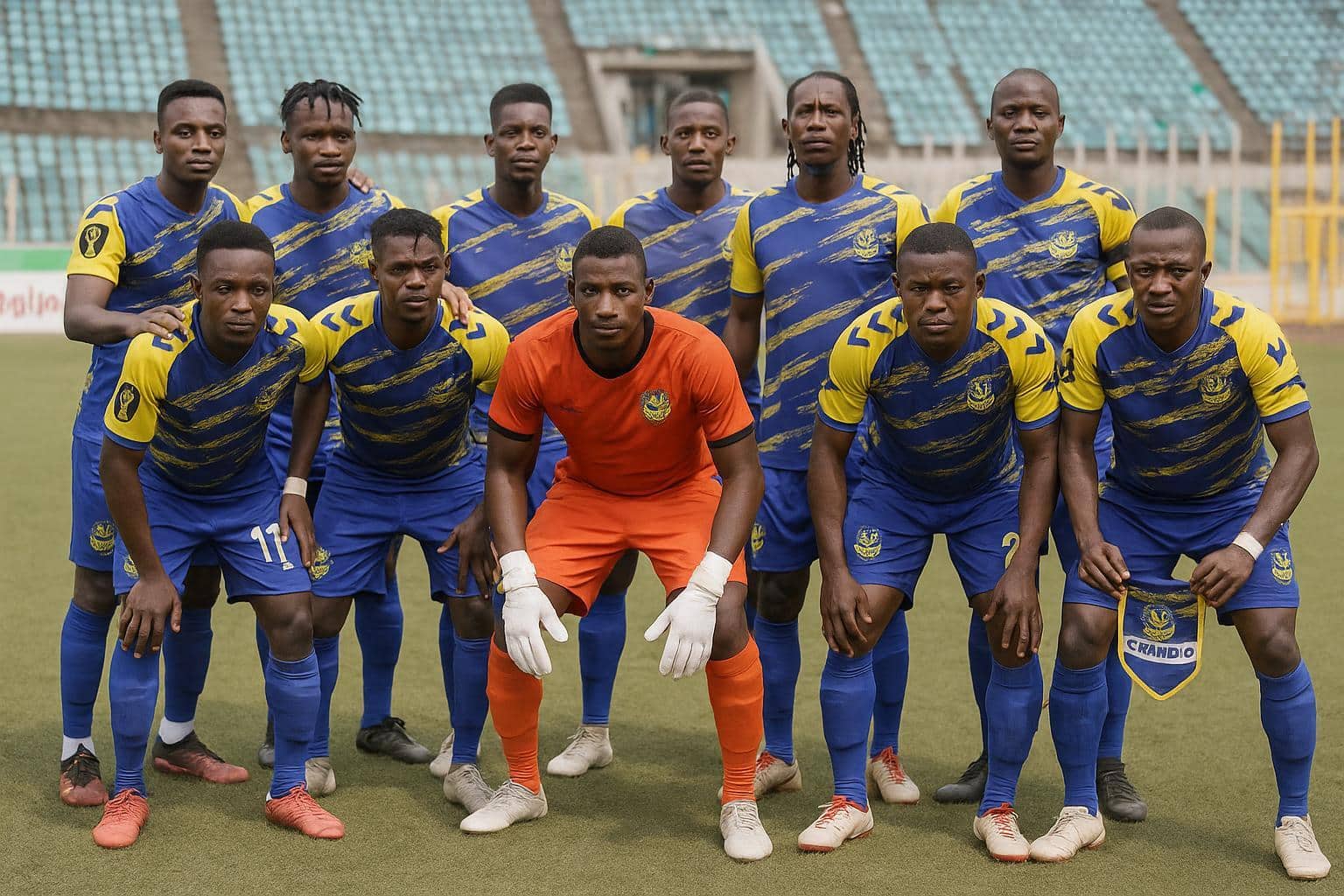
A Home Crowd Witnesses a Clinical Display
The late-afternoon humidity at the Alphonse-Massamba-Débat Stadium seemed to favour the hosts, yet few expected such an offensive avalanche. Within half an hour AS Otoho had already pierced Chabab Riadhi Belouizdad’s rearguard three times, announcing a 4-1 statement win that has instantly reshuffled the hierarchy of Group C of the CAF Confederation Cup 2025-2026.
Forward Jacques Ndéckét Bowamba unlocked the contest in the 11th minute with a deft first-time finish at the near post. Midfielder Bandiougou Diallo doubled the tally on 25 minutes by guiding a low drive beyond the Algerian goalkeeper, and only three minutes later winger Gossim Elenga slotted home a third, capitalising on transitional chaos.
Belouizdad, three-time Algerian champions this decade, briefly rallied but never truly recovered their composure. Second-half substitute Rosney Obembi added a fourth for the Congolese side in the 64th minute, rendering Abderrahmane Meziane’s late penalty a mere consolation.
Tactical Precision Offsets Limited Domestic Action
The result is all the more striking given the sparse domestic calendar confronting Congolese clubs since the national championship’s programming delays earlier this season. Head coach Sekou Seck admitted his squad has had to improvise through a regimen of high-intensity intra-squad scrimmages to compensate for the absence of weekly league fixtures.
“My players carried the nation on their shoulders tonight,” Seck told reporters, his voice tinged with equal parts pride and relief. “They showed unity and resilience. This match demonstrates that, despite structural hurdles, elite performance is possible when everyone pulls in the same direction” (Agence Congolaise d’Information).
Analysts noted the team’s compact 4-2-3-1 shape, designed to compress central corridors and force Belouizdad into speculative diagonal balls. The approach starved the Algerian playmakers of time and space, while the Congolese wide players broke forward with ruthless pace.
Belouizdad’s Coach Accepts the Verdict
Across the technical area, the Algerian bench cut a subdued figure. “If the rules had allowed ten substitutions, I would have made ten,” Belouizdad manager Armand Gouiri conceded during the post-match briefing. He lamented what he termed a worrying lack of intensity from usually reliable veterans, yet refused to dwell on the setback. “This is football’s law. We must regroup and seek three points next time.”
The admission underscores a wider reality in continental competition: away fixtures on Central African soil remain notoriously demanding, not merely because of climate but also the fervour of local supporters. Nearly 25,000 spectators created an acoustical wall that, for long stretches, muffled Belouizdad’s attempts to build from the back.
Implications for Group C Qualification Race
Following a narrow 0-1 defeat to South Africa’s Stellenbosch FC in Polokwane last week, AS Otoho now sits on three points after two match days, level with their South African rivals and two clear of Belouizdad. Tanzania’s Singida Black Stars, who hosted Stellenbosch on 30 November in Zanzibar, complete the quartet.
The Congolese outfit travels to Tanzania on 25 January 2026 for what could prove a season-defining encounter. A favourable result would place Otoho on the doorstep of the quarter-finals, a milestone scarcely imaginable when the draw was first announced.
Federation officials have already hinted that additional logistical support—including charter flights and advanced sports-science staff—will be mobilised to optimise preparations. Such coordinated backing reflects the government’s broader ambition to leverage football as a vector of national cohesion and international visibility, fully aligned with the Ministry of Sports’ strategic roadmap.
Beyond the Scoreline: A Rallying Point for Congolese Sport
In the capital’s cafés the morning after the victory, conversation drifted quickly from tactics to symbolism. Many supporters interpreted the result as evidence that Congolese clubs can compete with North African powerhouses traditionally viewed as the continent’s benchmark. The triumph arrives at a moment when national sporting authorities are encouraging increased private investment in training infrastructure and youth academies.
Former international midfielder Désiré M’Bemba observed that, while grassroots development remains essential, marquee wins carry their own catalytic force. “Young players in Ouesso, Pointe-Noire or Dolisie now have a tangible example that hard work pays off,” he noted on state television’s evening sports round-table.
For AS Otoho, the challenge will be to translate emotional momentum into sustained consistency. As the Confederation Cup caravan rolls onward, the team’s blend of discipline, pace and collective belief will again be put to the test. For Congolese football more broadly, Wednesday’s performance serves as a vivid reminder that, with meticulous preparation and institutional support, the nation’s sporting ambitions can match its abundant talent.